⚔ WoW Classic Rogue Talent Calculator
Plan Assassination, Combat, and Subtlety points with weapon fit, hit breakpoints, combo point tempo, and opener control scoring.
| Tree | Early value | 21-point check | 31-point capstone |
|---|---|---|---|
| Assassination | Malice, Ruthlessness, Lethality | Cold Blood burst access | Vigor energy pool |
| Combat | Precision, Deflection, Riposte path | Blade Flurry cleave | Adrenaline Rush window |
| Subtlety | Master of Deception, Camouflage | Preparation path tools | Preparation reset package |
| Breakpoint | Practical target | Calculator input | Why it matters |
|---|---|---|---|
| Special attack hit | 9% vs raid boss | Gear hit + Precision | Reduces missed Sinister Strike, Backstab, and finishers |
| Precision talent | 5/5 for raids | Precision points | Counts as direct melee hit in this planner |
| Weapon skill | 305 strong, 308 better | Bonus above 300 | Improves boss-level attack table and glancing pressure |
| Dual wield white hit | Far above 9% | Gear hit field | White swings still miss more often than yellow specials |
| Weapon type | Common builder | Talent fit | Best use |
|---|---|---|---|
| Swords | Sinister Strike | Sword Specialization, Combat | Raid, leveling, dungeon cleave |
| Daggers | Backstab or Ambush | Dagger Spec, Seal Fate, Opportunity | Burst, raid daggers, stealth opener |
| Maces | Sinister Strike | Mace Specialization | Control-heavy PvP and leveling swaps |
| Fists | Sinister Strike | Fist Weapon Specialization | Crit scaling when good fists are available |
| Mixed | Sinister Strike | Flexible Combat points | Questing while replacing weapons often |
| Preset | Split | Weapon | Primary purpose |
|---|---|---|---|
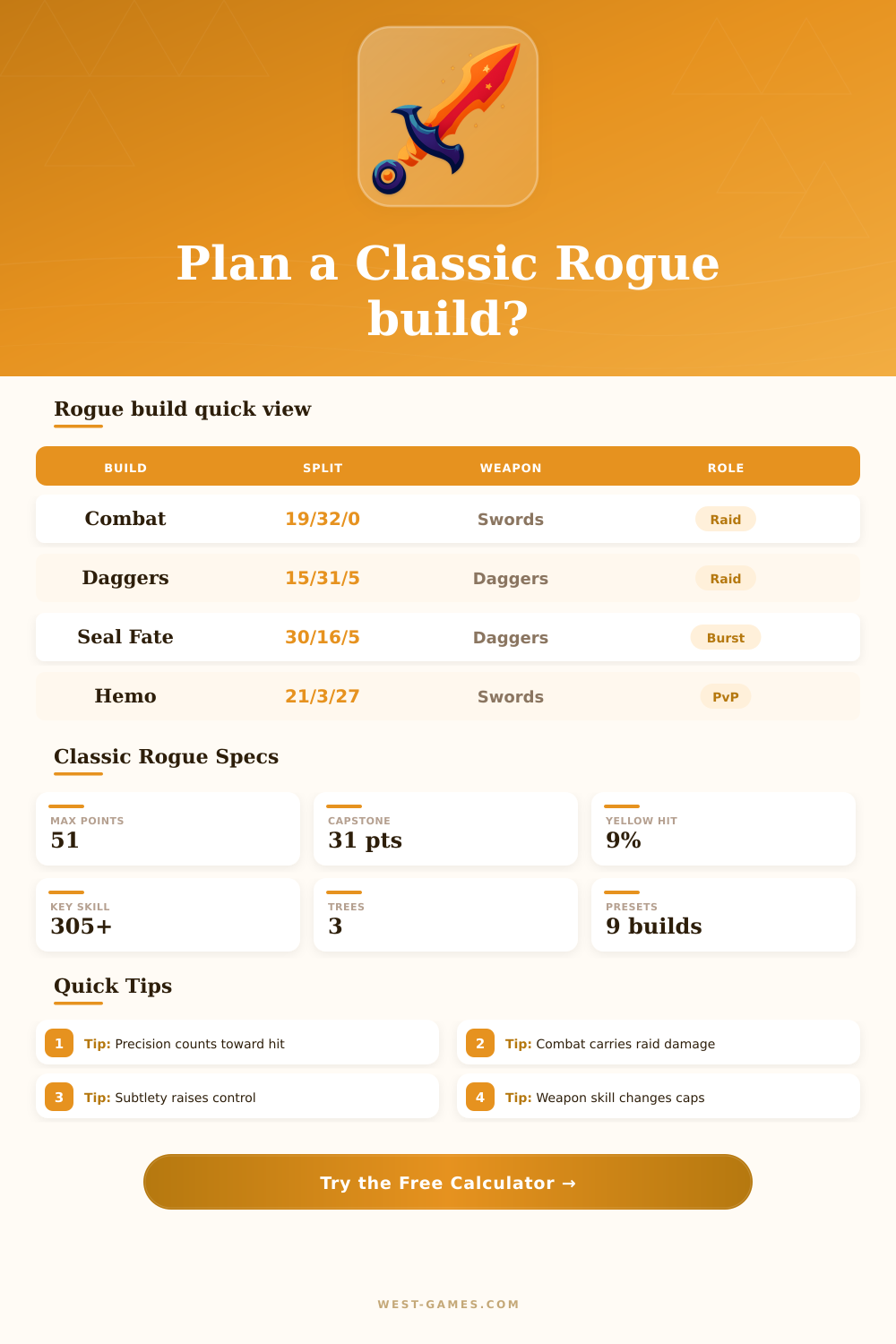
| Raid Combat Swords | 19/32/0 | Swords | Sustained boss DPS and cooldown windows |
| Raid Combat Daggers | 15/31/5 | Daggers | Backstab raid build with Combat core |
| Seal Fate Daggers | 30/16/5 | Daggers | Crit-fueled combo point generation |
| Hemo PvP | 21/3/27 | Swords | Cold Blood burst plus Subtlety control |
| Prep Daggers | 16/12/23 | Daggers | Stealth opener pressure and reset play |
| Leveling Swords | 5/31/15 | Swords | Reliable weapon damage and defensive utility |
| Metric | Core formula | Inputs used | Interpretation |
|---|---|---|---|
| Legal points | Level - 9, capped at 51 | Level and tree points | Flags over-budget talent plans |
| Effective hit | Gear hit + Precision | Hit %, Precision | Compared to 9% special attack target |
| Combo tempo | Builders + crit bonus | Weapon, crit, uptime, Assassination | Approximate combo points per minute |
| Control score | Opener + Subtlety + role bonus | Opener, Subtlety, weapon | Higher means stronger setup and reset value |
In Classic World of Warcraft, hitting level sixty is where the game realy starts. This is where spreadsheets comes out and the fun begins if you’re playing a Rogue. You have fifty-one talent points to split across three talent trees. Each choice will pull your style of play in different direction.
Once you plug all of these specs into the calculator above, it spits back numbers and runs the math for you, saving you the need to guess at how your hit rating and Precision stack on raid bosses. But that’s where the strategy come in: knowing what all of those numbers actualy mean in the heat of battle. Finding the one perfect build isn’t as important then knowing what you are sacrificing by putting that final point into Combat rather than Subtlety.
How to Build Your Rogue in Classic WoW
The first place most people look is at the big picture: solo survivability vs raid DPS. At thirty-one points, the Combat tree become the king of sustained damage in raids with Adrenaline Rush. You have a predictable burst window that both hits hard and heals well over the length of long fights. That’s all fine but it overlooks the fact that target swapping and movement exist. In dungeons where you need to pull adds fast, or if your boss moves every thirty seconds, a pure Combat build can becomes unwieldy because you lack the agility that Subtlety brings.
The key is knowing what a DPS log is realy measuring. It’s not necessarily how much energy you wasted running back into position or how many combo point you dropped because your cooldowns was out of line. The next twist that throws many newcomers off is the choice of weapons. On one hand, you have swords where Sinister Strike provides a stable stream of DPS. On the other hand, you have mechanics of Backstab combined with critical strikes via daggers.
This tradeoff is reflected in the tool below, where selecting your specialization talents adjust the rate at which you build combo points depending on how quick your weapon hits. Slow weapons produce points slower then faster weapons (such as daggers) but does greater damage per hit, which favors builds such as Seal Fate. Daggers also let you keep your damage high during short moments of stealth because they provide a quick flood of points followed by the chance for quick finishers. The combination of talent numbers plus underlying structure of the attack table is why it works.
Of all the stats for Rogues in Classic, hit rating may be the one with most misinterpretation. For raid bosses, you have to have a 9% chance to hit special attacks or else you might miss your entire Sinister Strike line. This threshold doesn’t come from gear alone; it comes from a combination of your weapon skill bonuses and the Precision talents you invest in the Combat tree.
People buy too much hit rating on their trinkets and rings without realizing that if they just invested some talent points into the combat tree, they’d get same hit reliability. They view hit as a purely gear question. In fact, it is a mixture of the talents you put in your build and how good your weapon skills are based off your gear. This calculator allows you to break out those inputs so you can see exactly how much each point of hit rating comes from gear compared to how much comes from talents.
Control is more important than pure damage per second when fighting other players. In PvP, high Subtlety investments gets access to Master of Deception and Preparation, allowing you to extend stealth duration or reset cooldowns mid-fight. While these are useful talents, they’re not going to appear in your raid log, they help you avoid an untimely death instead of securing victory.
If you spend any time playing Battlegrounds or Arena, you know that your opener sets the tone for the rest of the engagement. A good Cheap Shot or Sap will decide whose face gets eaten first. The above planner evaluates your opener potential using these control tools so that you’ll have a feel for whether your build is designed to burst down targets or outlast them through attrition.
But none of this is a perfect fit for any given situation; every playstyle require certain talents more than others for each fight. Your “raid” build might destroy bosses while leaving you helpless in an open world PvP situation. Your “leveling” spec may keep you alive against aggressive mobs but make you feel slow in a structured environment. You’re not looking for the magic bullet so much as the right fit for the moment.
Reference the breakpoint charts, try out some presets, and go from there, trust your gut when it’s go time. Talent points are flexible currency. Drop ’em where they do most good and see what happens, because at the end of the day, the most effective build is the one that keeps you breathing long enough to deliver the killing blow.
You should of tried this earlier.