⛏ Minecraft Resource Calculator
Estimate Minecraft build materials from dimensions, block palette ratios, crafting recipes, smelting yield, tool durability, shulker stacks, existing inventory, and survival gathering time.
| Block | Main raw input | Recipe or source | Smelting |
|---|---|---|---|
| Stone bricks | Cobblestone | 4 stone makes 4 bricks | 1 smelt per block |
| Glass | Sand | Direct block after smelt | 1 smelt per block |
| Brick blocks | Clay balls | 4 brick items make 1 block | 4 smelts per block |
| Concrete | Sand, gravel, dye | 8 powder per recipe | No furnace |
| Quartz blocks | Nether quartz | 4 quartz makes 1 block | No furnace |
The calculator converts finished block needs into raw gathering items, crafting actions, and smelting load for survival planning.
| Tool material | Base durability | With Unbreaking III | Best use |
|---|---|---|---|
| Stone | 131 | About 524 uses | Early bulk stone |
| Iron | 250 | About 1,000 uses | Routine building trips |
| Diamond | 1,561 | About 6,244 uses | Large quarry routes |
| Netherite | 2,031 | About 8,124 uses | Mega projects |
Unbreaking is modeled as an average multiplier. Real durability varies because each block has a chance to consume durability.
| Container plan | Stacks | Normal blocks | Use case |
|---|---|---|---|
| Inventory only | 36 | 2,304 | Short trips |
| Single shulker | 27 | 1,728 | One material run |
| Double chest | 54 | 3,456 | Base staging |
| Ender chest full of shulkers | 729 | 46,656 | Mega build haul |
Most building blocks stack to 64. Buckets, tools, beds, and special items should be packed outside this block-only estimate.
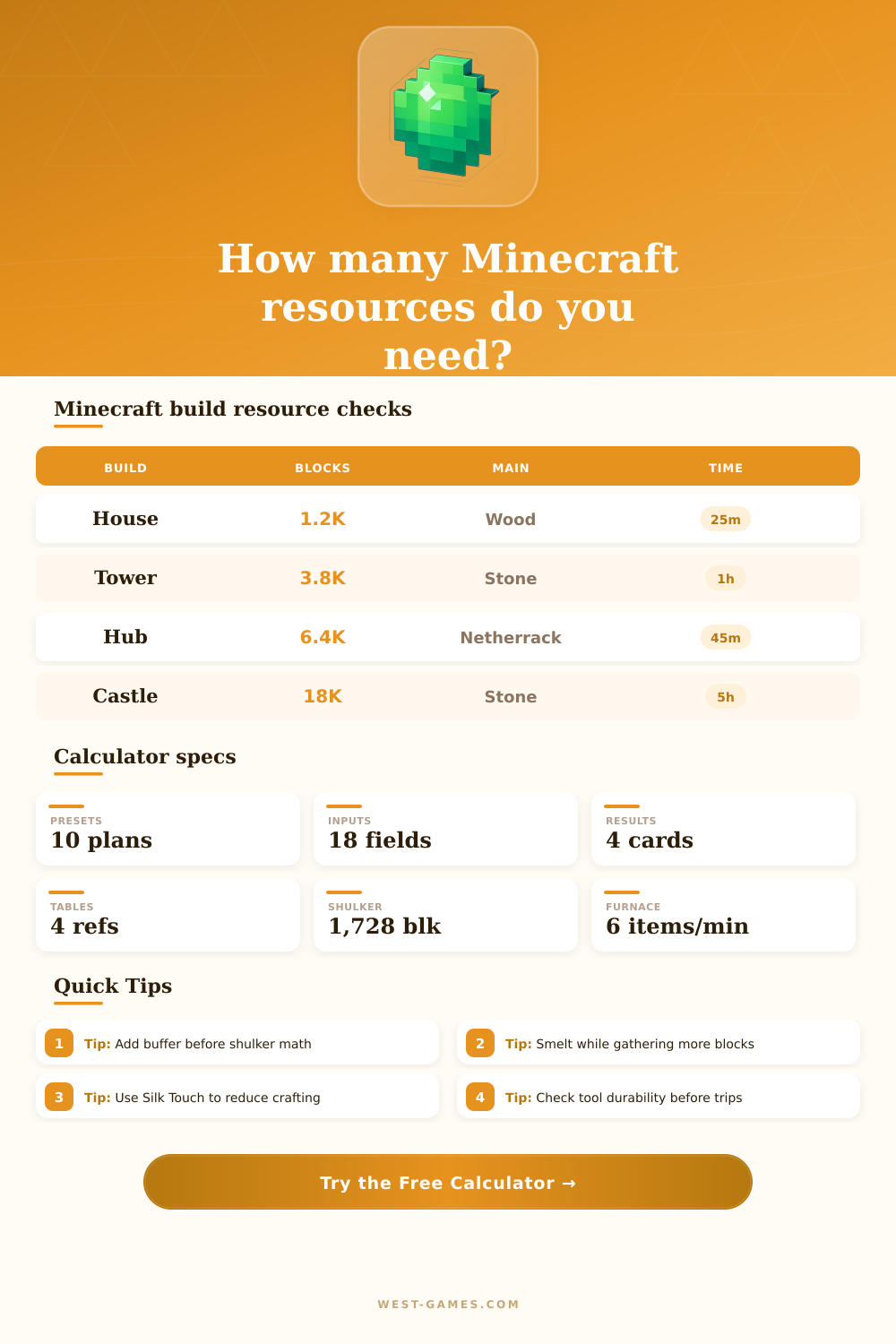
| Preset | Typical block range | Main bottleneck | Planning note |
|---|---|---|---|
| Starter house | 700 to 1,500 | Logs and glass | Bring extra roof blocks |
| Trading hall | 3,000 to 7,000 | Walls and work area | Leave room for beds |
| Nether hub | 5,000 to 12,000 | Tunnel repetition | Pack fireproof spares |
| Castle wall | 12,000+ | Stone variants | Quarry before detailing |
Presets are editable resource models. Match them to your blueprint, then tune dimensions and palette shares.
When building in Minecraft, it helps to view building as logistics rather than just an exercise in creative expression. “Oh no! I’m out of stone bricks by six!” That’s the kind of frustration that makes building stressful. You might mine up all the materials to build a huge house, only to run out of stair/slab inventory while building corners or walls. Account for waste before you start and you can avoid that frantic scavenger hunt.
Planning for waste mean knowing how much will be lost to corners, slabs, and inventories. That could of made the difference between a smooth project and a frantic scavenger hunt.
Plan Your Minecraft Build Like a Pro
Finished Blocks, Many players think about finished blocks. They look at a blueprint and see they’re supposed to build two hundred stone bricks so all they need is two hundred cobblestones. They’re wrong! Once you start building things it’s easy enough to put in your wall dimensions, press go, and a calculator will do the math for you. However, it’s better if you understand how the ratios changes.
The more detail you include, and the more room you leave for errors, the more raw materials you will need. Solid walls is efficient with materials. Decorative pieces such as stairs usually involve several different material for each block that gets placed. Not accounting for this mean you’re likely to be running out of scarce materials while having plenty of common ones.
Projects fall apart during storage planning. A single shulker box can hold a thousand seven hundred twenty-eight blocks. That sounds like more than enough room … right up until you attempt to fit four types of stone inside it. After that, the tool will subtract however many blocks you’ve previously acquired and estimate how many stacks you’ll require. It’s a way to force yourself to face your storage situation.
Want to know if you have space for three shulker box? What about three shulker boxes worth of diamond ore? How much of your haul do you want to spend sprinting back home to your base? That answer determines the tempo of your session. Get that ahead of time and you can plan accordingly, maybe give up some gear slots so you have room for empty shulker boxes. It is a small thing, but it has a big effect.
A second consideration most experienced crafters miss are how long tools last. Sure, you’ve got some Unbreaking III diamonds pickaxes that should lasts you a while, but after a few hours mining away at netherrack or deepslate, even those will become worn out. The calculator looks at your estimated gathering speed and current durability percentage to let you know when you should bring backups. It helps you decide if it’s worth a trip back to town for more tools or if you can bring an anvil along. That way, you won’t hit a promising vein only to realize your main tool is broke. You won’t end up swinging a wooden shovel just because you didn’t plan for wear and tear. By taking into account average use based off enchantments and block hardness, it provide a realistic estimate of how much longer your tools will last.
There’s another hidden cost of big builds: bottlenecks. Heat is one. You can’t make glass, bricks, terracotta, or smooth stone without heat. Furnaces are needed, and if you’ve got eighty furnaces running but only gathered enough fuel for forty then your progress halts. The tool uses your palette choice to calculate how much fuel you’ll need and how many smelting jobs it will do. It also flags which material, like sand or clay, will be in short supply.
Instead of discovering halfway through that you need to stop building and start collecting fuel, the tool gets you thinking about blaze rods or coal at the start, rather than during the smelt cycle. That change of mindset goes from annoying dead-end to something you can plan around.
A build plan is ultimately a resource management exercise: how do you trade your blocks in-place with minutes spent mining? How long will your equipment last? What fits in your inventory? Running those numbers ahead of time transforms a frantic free-for-all into a well-planned expedition. Tools go in bags, blocks get stored, and you precisely know how many minutes of mining to run to hit that final block at just the right moment.
That planning turns the panic of having no room for your next block into a sense of satisfaction when you set down the very last brick on time.