⛏ Delve Loot Calculator OSRS
Plan OSRS Delve sessions around claimed level, completion pace, common loot value, unique value, personal share, supply deductions, target quantity, and dry streak probability.
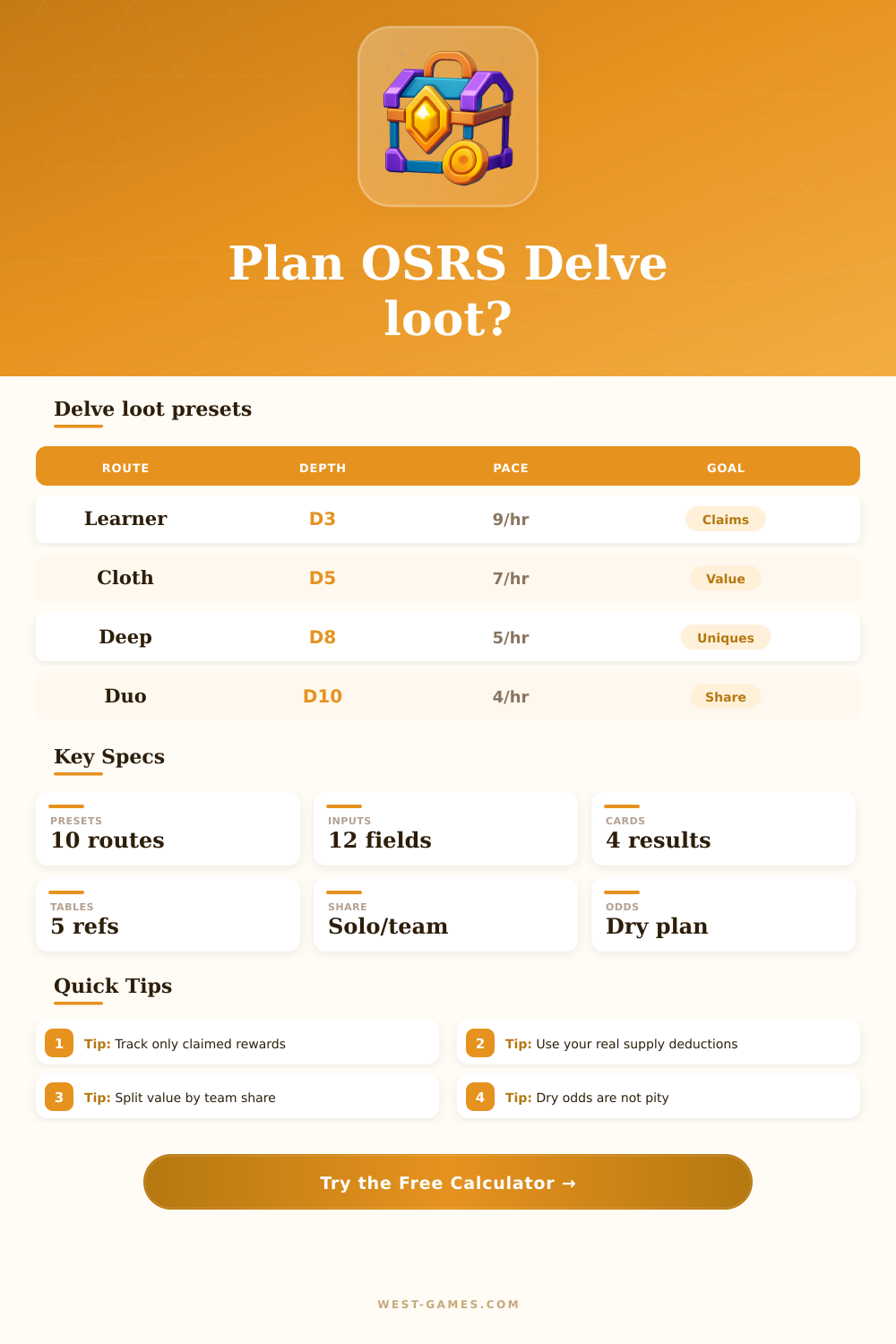
| Preset | Depth | Completions | Loot role |
|---|---|---|---|
| Learner D3 | 3 | 9 per hour | Quick claimed rewards with low unique reliance |
| Cloth D5 | 5 | 7 per hour | Single reward target with steady common loot |
| Deep D8 | 8 | 5 per hour | Better unique expectation with slower claims |
| Solo D10 | 10 | 4 per hour | High-value target planning and dry tracking |
| Duo D10 | 10 | 4.6 per hour | Shared loot plan with higher team pace |
Presets are editable planning profiles, not locked rules. Replace the completion pace and value fields with your log data.
| Reward type | Weight | Value model | Use case |
|---|---|---|---|
| Any unique roll | 100% | Entered unique value | General unique farming |
| Specific main reward | 33.33% | Specific target value | Cloth, Eye, or Treads chase |
| Two missing uniques | 66.67% | Average useful unique | Partial log completion |
| Manual special | 100% | Direct denominator | Separate special roll |
The calculator separates loot planning from pure drop-rate checks by adding common loot, share, and supply deductions.
| Band | Per completion | Typical use | Input approach |
|---|---|---|---|
| Low roll | 50k to 100k | Learner or shallow claims | Use conservative average |
| Steady roll | 100k to 200k | Repeatable mid claims | Use session log average |
| Deep roll | 200k to 350k | Riskier deep claims | Separate by delve level |
| Custom log | Any value | Your account data | Enter tracked average |
For mixed sessions, run separate calculations for each claimed level, then add the net loot outputs together.
| Deduction type | Best field | Example items | Planning note |
|---|---|---|---|
| Time-based | Per hour | Charges, upkeep, deaths | Scales with session length |
| Claim-based | Per completion | Food, potions, ammo | Scales with reward claims |
| Team split | Share divisor | Duo, trio, clan | Divides personal loot value |
| Manual cleanup | Either field | Extra restocks | Keep same value unit |
Supply deductions are subtracted after common loot and expected unique value are adjusted for personal share.
| Output | Formula | Inputs used | Meaning |
|---|---|---|---|
| Personal target chance | (1 / denominator) x reward weight / share | Reward type, denominator, share | Your target odds per claimed completion |
| Expected unique value | unique value x personal target chance | Target value, chance | Long-run value added by the target roll |
| Net loot per claim | personal common + expected unique - per-claim deduction | Common, unique, supplies | Claim-level planning result |
| Session net loot | net per claim x claims - hourly deductions | Hours, pace, supplies | Expected session result |
| Dry probability | (1 - p) ^ dry completions | Target chance, dry streak | Chance of seeing no target yet |
Expected value is a long-run planning average. A single session can land far above or below the calculated result.
Old School RuneScape’s Delve interface has an inviting look but it’s hard to run the numbers. I spent three hours digging deep and getting killed often, only to come up with one scrap of fabric. That barely covers supply costs. And yet that anger is not strictly due to bad luck. Most of the time, people fail to understand how changing drop rates combine with steady loss from consumption rates. Running things based off expected value instead of blind hope makes all the difference.
The tool above will do math for you. This lets you concentrate on strategy. That is where profit lies, instead of making expensive blunders.
How to Make Money from Delve
1. Gross estimate vs. Net deduction: Players assume that if you know how much a unique drop would fetch, you can just add it to their inventory and look at bottom line. That’s wrong. Gross value is irrelevent. Deduct the cost of obtaining that item before making any assumptions about its value. Your time is costly, as are potions and food and charges you burn through every hour you’re inside the Delve.
Those costs aren’t flat fees; they increases according to your kill rate and speed. If you go slow, then your hourly costs will also go up. Meaning more hours spent and thus higher hourly deducts. To reflect that, the calculator has a field where you can input your different deductions-per-hour and deductions-per-completion separately.
Why? Because certain items cost money based on actions while other items cost money based on time. For example, charges is time-based (you pay them regardless of whether or not you get a reward). Potions are action-based (you pay for each pot when you use them to try killing a boss). Get those mixed up and you’ll mess up your profit margins.
Finally, we have the question of uniqueness. There’s also probability, which means the odds of rolling any unique scales change based on your goals. For example, your odds may be better than others if you’re after something random to round out your collection versus specifically an Avernic Tread. The calculator handles this by adjusting its expected value to match the weighting. It knows that chasing down a single item is more difficult then trying to chase down the entire category.
That’ll prevent you from overestimating when you’ll obtain what you seek. You may believe you’ve got a one-in-thirty chance, but you actualy only require one of three items. Your effective rate falls off dramaticly at that point. Having awareness of that distinction helps stop you from burning through supplies because you thought you had an easy timeline.
Then there’s the added twist of team play and loot sharing. Splitting a drop between two or three adult-sized sofa reduces each person’s return while boosting total returns with shared efficiency. That divisor input automatically accounts for that split so your net personal return represent what actually happens. If you forget about the share divisor, you’ll overestimate things. You may find a trip profitable, on paper, forgetting that you had to divide the spoils and take away your part of the supplies. It doesn’t balance until you factor in everybody’s cut before measuring against expenses.
Few things are as frustrating as long dry streaks. More so than anything else, it test your patience, not your math skills. You start seeing a series of bad luck and somehow it becomes personal. Probability doesn’t give a shit about how you feel though. The tool has a dry odds checker too. It will tell you the odds of being on a dry run for a given number of completions. That’s helpful if you’re considering quitting and resetting yourself before you tilt even deeper into the red.
A five hundred completion dry streak? It is statistically rare, but possible. That kind of thing keeps things in perspective. Instead of getting frustrated, it becomes data.
But all that said, how do you farm Delve successfully? The answer is to manage whatever variables are within your control. To put it simply, you could of made something drop. But you can eliminate waste and improve efficiency. To that end, keep track of what you’re actualy getting and apply that knowledge in a consistent way. You’ll get better results if you know what works for you specifically based on your own logs. While the presets may be good starting points, nothing beats real numbers taken directly from your logs compared with general estimates.
Play around with various paces and depths using the calculator before investing any time. What you’ll discover is which routes pay off sustainably given realistic assumptions. It’s not so much about dropping things as it is making money doing so. It’s when you begin thinking in terms of net value instead of gross potential that you’ll find yourself feeling like the game isn’t nearly as random and therefore easier to manage. That mindset is the one that transforms an exercise in frustration into a viabel source of income.