💎 POE Drop Rate Calculator
Estimate Path of Exile farming odds from map tier, atlas quantity, atlas rarity, scarabs, fragments, pack size, base target chance, kill pace, map pace, and target copies.
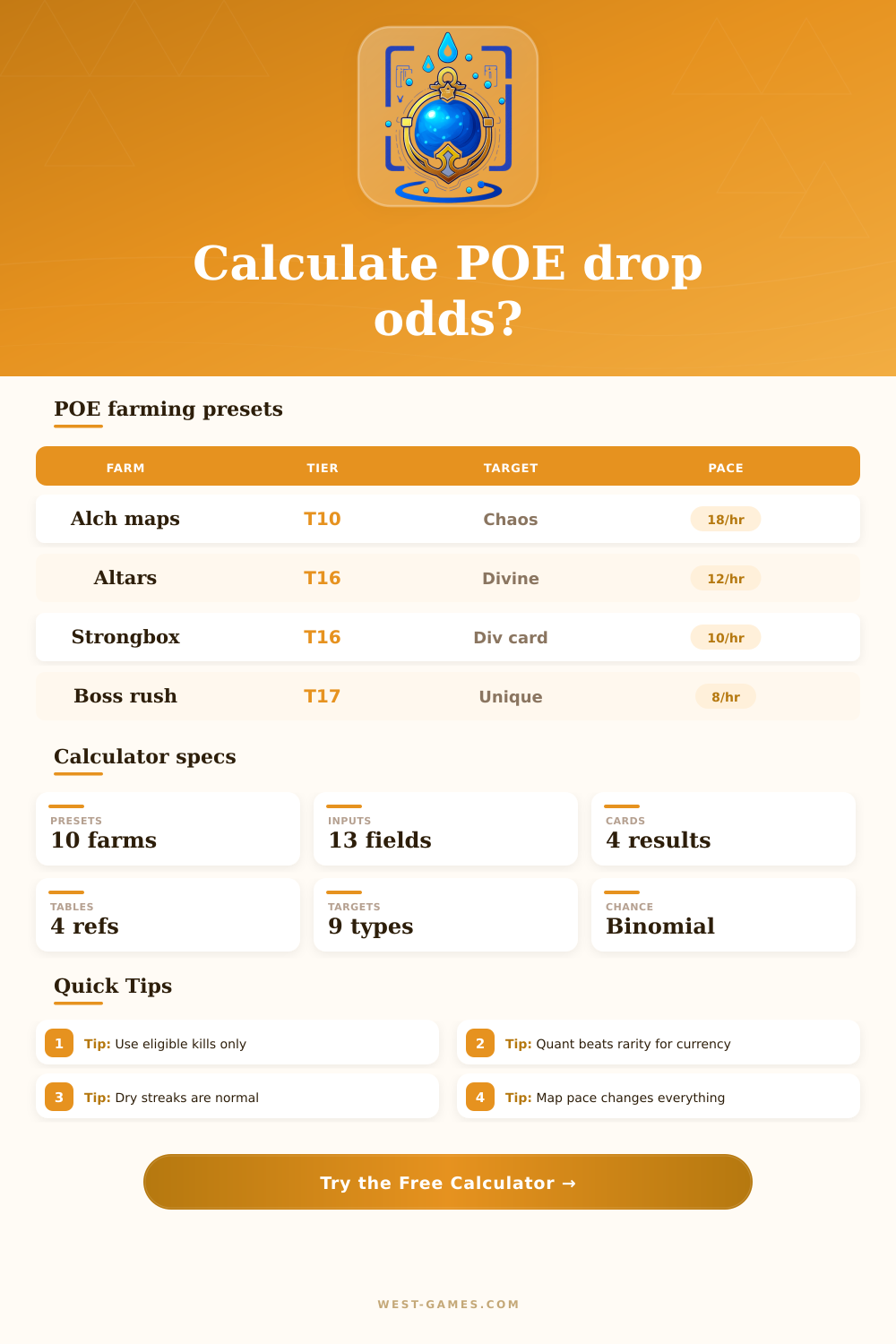
| Preset | Target | Base chance | Typical pace |
|---|---|---|---|
| Alch-and-Go T10 | Chaos and bubblegum | 0.040% | 18 maps/hr |
| T16 Altars | Divine or tier currency | 0.015% | 12 maps/hr |
| Strongbox Farm | Specific div card | 0.010% | 10 maps/hr |
| Boss Rush | Boss unique | 1.500% | 20 maps/hr |
| T17 Fragments | Fragment drops | 0.120% | 8 maps/hr |
Preset values are planning baselines, not official drop tables. Replace the base chance with your tracked or sourced rate for precision.
| Target type | Quantity | Rarity | Planning note |
|---|---|---|---|
| Raw currency | Full | Low | Speed and quant |
| Divination card | Full | None | Eligible source count |
| Specific unique | Partial | High | Quality checks matter |
| Fragments | Partial | None | Boss or map table |
| Scarabs | Full | Low | League weighting |
The model applies rarity softly because many POE targets use special tables or source-specific rules rather than simple global rarity.
| Layer | Chance role | Roll role | Common mistake |
|---|---|---|---|
| Map quantity | Raises chance | No direct count | Ignoring rerolls |
| Pack size | No direct | More monsters | Counting all mobs |
| Scarabs | Target weight | More sources | Overvaluing one scarab |
| Fragments | Extra quant | Sometimes none | Double counting |
| Altars | Can spike | Usually density | Forgetting danger |
If a modifier adds monsters, enter it as roll volume. If it boosts item drops from existing sources, enter it as quantity or target bonus.
| Chance level | Maps needed | Meaning | Dry risk |
|---|---|---|---|
| 50% | 0.69 x rate | Coin flip | 50% |
| 63.2% | 1.00 x rate | Expected mark | 36.8% |
| 90% | 2.30 x rate | Strong chance | 10% |
| 95% | 3.00 x rate | Very high | 5% |
| 99% | 4.60 x rate | Extreme grind | 1% |
Expected maps are averages. Even at the expected mark, a one-copy target still has a meaningful chance to miss.
Farming in Path of Exile can feel like watching paint dry, hoping something will pop out from it while you repeat same fights over and over again for hours. You kill hundreds of monster. You clear map after map. And yet there is still nothing in your stash tab.
Don’t worry; it wasn’t bad luck. Rather, it was a lack of understanding of mathematics behind the game’s drop tables. Probability connects the gap between hope and reality. And no, gut feeling doesn’t count; how various modifiers interact with one another is something intuition alone cannot predicts.
How Math Helps You Farm Better
Atlas passives is usually viewed by most players as simple multipliers. Add more and you add to your chances everywhere in a straight line. This is where most people go wrong with planning. While quantity typically increases the amount of stuff farmed and/or raw currency drops, there is no corresponding increase to the drop rate of specific fragments or unique item. These require their own checks against the tables.
Then rarity behaves differently still. Often it doesn’t enhance the underlying likelihood of something dropping at all. Instead, it just pads the chance of quality checks.
The first thing to understanding how to farm efficienty is knowing what lever moves which needle. Is your build even helping improve your odds? Or is it just making the process happen faster on a result that would of not dropped anyway? The calculator above simplifies this complex process by separating how much each modifier counts and which rolls qualify. It prompts you to set the base chance for each event, like “one strongbox opens” or “one monster dies”, without considering outside bonus modifiers. Then it adds your Atlas passive choices, scarab investments, and other mechanic-specific bonuses.
Understanding this… Where drops are separate from rolls. Is the insight. Adding more monsters to the screen add more events where the dice can be rolled. Changing pack size will change the number of rolls. Changes to Atlas quantity will change how many times those rolls succeeds in getting an item. Mixing up these two results in frustrated play session and inflated expectations.
For example, is it more like tracking down any ol’ piece of currency or tracking down an exact divination card? The first is heavily affected by how many there are (lots of potential currencies, but you only need 1). The second is a needle-in-a-haystack hunt where rarity might not matter as much than the total number of possible sources. That means if you’re trying to farm up cards via strongboxes, don’t worry so much about tweaking things that don’t increase your odds of getting a card out; instead, try your best to ensure all boxes open cleanly and add to the pool. The tool reflects this by weighing rarity/rarity modifiers differently based off the kind of thing you have selected as your target.
In any farming equation, there’s a hidden variable: time. Sure, that tactic may appear better on paper because it has a higher chance of working on each map, but does it actualy run slower than something else? Maybe one has a 1 percent chance but only costs three minutes per map while another has a 0.8 percent chance but wraps up within forty seconds. After hours of doing this, speed often trumps marginally higher chances. That’s why the calculator includes an estimate of expected amount of time needed for your farms.
You might wonder if spending an extra ten minutes on a high-investment map is worth the small increase in drop odds. It could be better to just run through a lower tier area with good modifiers instead.
There will always be dry spells no matter how well you set yourself up. No matter what the conditions, some nights you won’t get a single thing to drop. Sometimes those quiet nights feel like they’re against you personally. Looking at the overall chance output lets you know how likely you’ll do it within a given amount of maps so you can keep your expectations in check. If you know that on one-hundred maps you’ve got a 90 percent chance to hit your target, then you can rest easy knowing that those early quiet times are normal. They turn anxiety into patience, understanding that this is just the nature of the system.
It is not a bug. And, in conclusion, efficient farming is all about building for the math of what you want. Don’t tweak the things that aren’t going to change the drop. Instead, optimize the things that will. If it doesn’t feel like they’re paying attention to your efforts on the drop table, well, the numbers don’t care. They don’t lie.