🎯 Brawl Stars Drop Rate Calculator
Estimate Starr Drop rarity odds, event or chest-style reward models, credits, bling, coins, Power Points, target pulls, expected drops, resource progress, and cumulative chance.
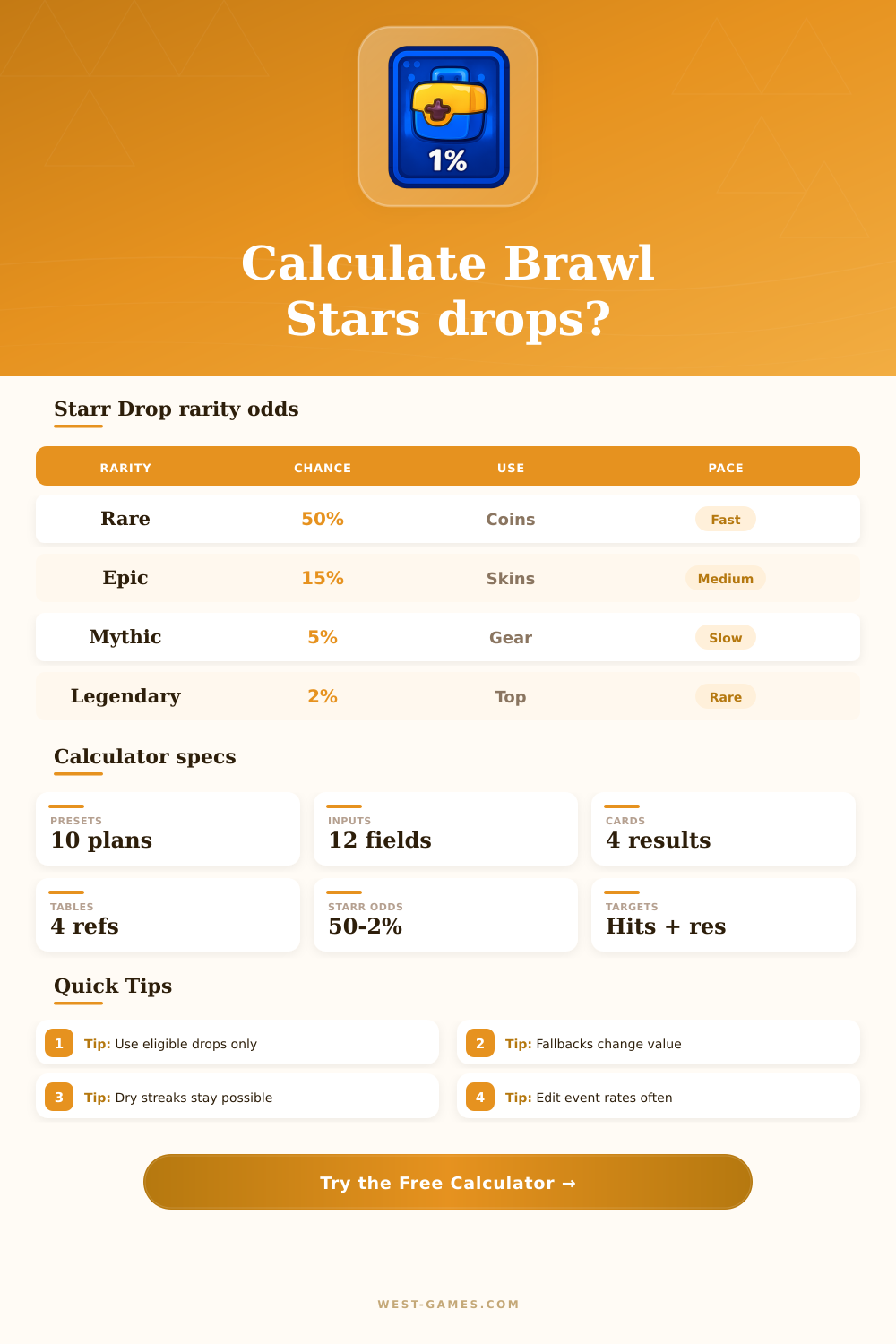
| Rarity | Chance | Common targets | Calculator use |
|---|---|---|---|
| Rare | 50% | Coins, Power Points | High-volume resources |
| Super Rare | 28% | Coins, Power Points, pins | Resource plus cosmetic rows |
| Epic | 15% | Credits, skins, pins | Mid-tier reward checks |
| Mythic | 5% | Gadgets, brawlers, bling | Rare category checks |
| Legendary | 2% | Star Powers, Hypercharges | High-value chase checks |
Normal Starr Drop math is rarity chance multiplied by the reward-category chance inside that rarity, then adjusted by eligibility.
| Reward | Rarity gate | Category rate | Fallback note |
|---|---|---|---|
| 150 Credits | Epic | 5.26% | Resource direct |
| Random Gadget | Mythic | 18.52% | 500 Coins fallback |
| Random Star Power | Legendary | 42.68% | 1000 Coins fallback |
| Random Hypercharge | Legendary | 18.29% | 1000 Coins fallback |
| Legendary Brawler | Legendary | 2.44% | 1000 Credits fallback |
Edit the category rate when a special event, box, or in-game info panel shows a different reward table.
| Chaos result | Chance | Split result | Chance |
|---|---|---|---|
| Super Rare | 52% | 1 reward | 70% |
| Epic | 28% | 2 rewards | 20% |
| Mythic | 12% | 4 rewards | 8% |
| Legendary | 6% | 8 rewards | 2% |
| Ultra | 2% | Expected | 1.58 rolls |
Chaos mode multiplies entered drops by 1.58 expected reward rolls before applying the target probability.
| Per-drop chance | 25 drops | 50 drops | 100 drops |
|---|---|---|---|
| 2.00% | 39.7% | 63.6% | 86.7% |
| 1.00% | 22.2% | 39.5% | 63.4% |
| 0.50% | 11.8% | 22.2% | 39.4% |
| 0.10% | 2.5% | 4.9% | 9.5% |
| 0.05% | 1.2% | 2.5% | 4.9% |
These examples show at least one hit. The calculator also supports multiple target pulls with the binomial distribution.
You look at a Starr Drop on your screen and know which Legendary item will complete it and make it worth having. So you tap it. The animation plays out. Sometimes you’ll get credits. Sometimes you’ll get coins. Rarely, however, do you get the actual gadget or Star Power that’s lingering in the back of that rarity pool.
And that’s frustrating, those colorful rarity rings has become probability gates pretending to be guarantee gates in our brain. We see a Legendary ring and think we’re one tap away from victory. When really, the game needs to choose a category first before it even thinks about giving us what we want.
How Stardrop Odds Really Work
After plugging in your desired rarity and source for the drop, calculator does all the math for you, so you don’t have to guess if it’s worth 10 more tries before you give up and do something else with your life.
People new to Fortnite greatly underestimate just how far down the rabbit hole of probabilities extends. When people considers the odds of getting something legendary, they’re only looking at top level of rarity chance. But really, what are the chances you’ll get something legendary today? In other words, what are the chances you’ll hit that two percent shot at a Legendary? And what are the chances that it will net you anything better then a thousand coins (the default fallback reward), or even something like Star Power or Hypercharge instead of a Legendary item?
Knowing the difference between falling through the rarity gate and choosing a category within that gate will help you plan out your farming sessions to match. To use an analogy: Imagine being in a warehouse and trying to pick the correct boxes off the shelves. There’s the rarity roll; you need to get by the security door just to be in the room. There’s the category chance: Even if you’re in the room, you’ve got to find the correct box out of a dozen more alike. And there’s the fallback reward, where the game forces you to take something different because you already own half the stuff in the pool… Meaning your chances are worse than ever of landing anything worthwhile.
Oh well, maybe it’s just coins. Those is good for powering up Power Points. However, they are less exciting as a cosmetic reward and feel like a loss on that front. That’s where the multiplier comes into play, and it’s critical to your long term plans. On paper, the base chance of getting anything doesn’t change when you’ve got a full inventory, but the actual rate of acquiring new stuff get smaller and smaller as your inventory grows.
Someone chasing their initial Legendary Brawler has a pretty obvious road ahead of them, with known expectations. Some people are looking to complete all skins, pins, and other items. They still have a grind ahead of them where the value leans more toward resources instead of duplicates. That’s what the tool is accounting for here: allowing you to lower the multiplier if you think a significant number of those things you’re targeting will be already taken.
The new wrinkle here comes from Chaos Drops, which divvy up their reward differently than regular Starr Drops. While they do have higher frequency (rolling multiple times per drop), weights are also very different and can vary wildly between positive or negative results. One drop could result in four rewards for you, then it turns out they’re all common coin drops, and the one rare thing you need isn’t there. The reference table on the page also shows this well. You can use it to compare how many times Chaos mode will multiply your expected rolls, even though it doesn’t necessarily increase the odds of getting anything valuable.
If you’re on a drop budget, it’s usually wiser to resource farm rather than chase cosmetics. Because resources like credits and bling are available in several different rarity groups and levels, their overall chances is much higher. To chase down an individual skin, however, you need to survive not only the rarity filter but also category selection. That’s two layers of bad luck. For credits or coin farming, all that matters is getting through one. The calculator helps you calculate which offers better value per drop earned, thus shifting your focus away from ‘what looks cool’ towards ‘what moves my account forward the most efficiently’.
But finally, understanding your numbers will save you from going on tilt. You know it takes two hundred pulls at 90% confidence for a single pull to go right? Great, now you can decide whether it’s worth grinding that out or changing what you want to achieve. You should of known the odds earlier.
You never wait for luck to happen. You plan based off probability. When you see that glowing Starr Drop icon next, know that ring color isn’t the end, but rather the beginning of the race.