🎮 MLBB KDA Calculator
Measure Mobile Legends kills, deaths, assists, match sample, role pace, hero class, MVP or medal rate, teamfight participation, target KDA, and the games needed to reach it.
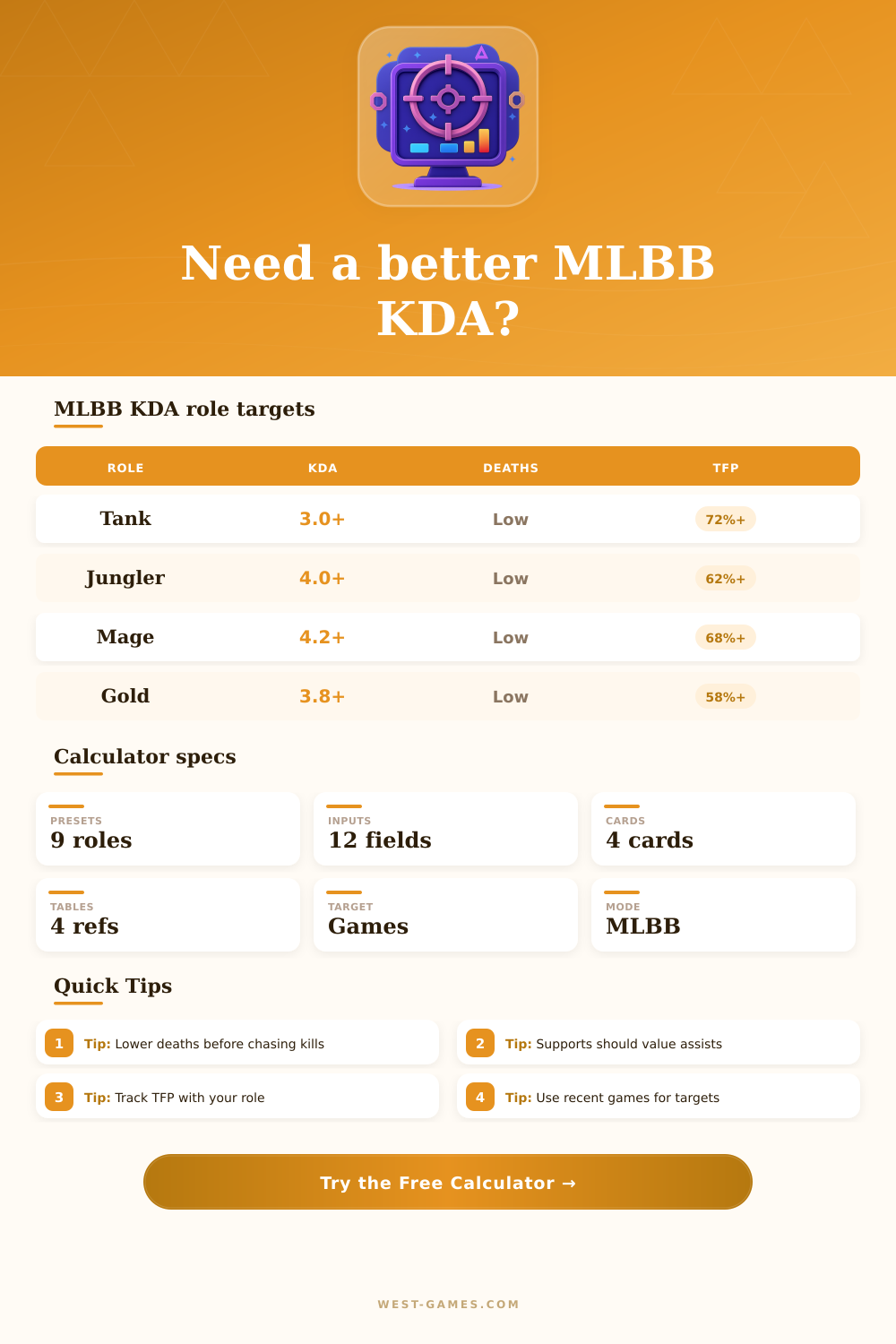
| Role | KDA target | Death cap | TFP target |
|---|---|---|---|
| Jungler | 4.2+ | 2.7 | 62%+ |
| Gold lane | 3.8+ | 2.8 | 58%+ |
| Mid lane | 4.4+ | 2.4 | 68%+ |
| EXP lane | 3.2+ | 3.1 | 60%+ |
| Roam tank | 3.1+ | 3.4 | 74%+ |
| Roam support | 4.6+ | 2.6 | 72%+ |
Targets are practical comparison bands for ranked analysis, not official MLBB scoring rules.
| Class | Best signal | KDA lean | Risk note |
|---|---|---|---|
| Assassin | Kills | Burst | Shutdown deaths hurt |
| Marksman | Late KA | Scaling | Early deaths slow farm |
| Mage | Assists | Control | Positioning decides value |
| Tank | TFP | Assist | Good deaths can happen |
| Support | Saves | Assist | Low kills are normal |
| Fighter | Pressure | Mixed | Split timing changes KDA |
Class profile adjusts the calculator grade so tanks and supports are not judged like assassins.
| KDA | Read | Typical issue | Focus |
|---|---|---|---|
| 0-1.9 | Struggling | Too many deaths | Map safety |
| 2.0-2.9 | Playable | Low conversion | Join fights |
| 3.0-3.9 | Solid | Role dependent | Clean exits |
| 4.0-5.9 | Strong | Protect pace | Objective fights |
| 6.0+ | Carry level | Sample quality | Keep deaths low |
A huge KDA over a tiny sample can be noisy. Use enough matches before judging your trend.
| Current | Target | Future pace | Meaning |
|---|---|---|---|
| 3.0 | 4.0 | 6.0 | Reasonable block |
| 4.0 | 5.0 | 6.5 | Needs clean deaths |
| 5.0 | 6.0 | 8.0 | Carry pace |
| 2.5 | 5.0 | 4.0 | Not reachable yet |
| 6.5 | 7.0 | 7.5 | Slow improvement |
Games needed rises sharply when your future pace barely beats the target KDA.
After a wild teamfight, you find yourself staring at the post-match screen. Two kills, three assists. Two deaths, too. A decent enough KDA, right? But then your teammates is furiously clacking out messages in the lobby before the game has concluded. That’s when it hits you: There’s a disconnect between what happens on screen and what these number say.
On paper, kills, deaths, and assists seem simple, but as anyone who plays an assassin knows, they mean something far different than a support who focus on peeling. When you plug in your latest results into the calculator above, the work is done for you. You can see how your particular role affect the judgment passed on the exact same number.
Why Your Role Matters More Than KDA Numbers
However, KDA are not a measure of ability across all players. KDA is a ratio of contribution to risk. If you are a marksman in gold lane, then dying often means you were out of position or unaware of incoming danger. If you are a jungler playing Fanny or Hayabusa, then death come with the territory, as long as you achieve an objective.
The system allow you to choose your hero class and primary role to adjust accordingly. Selecting tank or support will shift weight towards teamfights and assists. Assassin will weigh kills more heavily since your goal is to make sudden impacts.
Why? Because many player tend to underestimate their contributions compared to carry lanes. Someone with a three-point KDA may actualy be performing just as well or even better than someone with a five-point ratio. This is true if the three-point player was helping to enable fights, while the five-point player were sitting in the jungle farming minions.
But this is flawed logic. Kill count should of be secondary concern to most players. For every kill you chase, there’s a good chance you’ll die unecessarily. This hurts your KDA and drags average down too fast for it to recover quickly enough. Reducing deaths, on the other hand, almost invariably result in a higher KDA, even though it means taking no additional risks. Halving your death count while keeping assists constant will double your KDA without any increased danger.
That’s why we added the future pace projection section to the calculator: So you can use it to model what’ll happen if you just play safely instead of trying to play harder. Maybe you discover that playing safe (i.e., one less death per game) is an easier path toward your goal then pushing hard for two more kills (which inevitably means diving into enemy territory).
This brings us to the second layer of truth beyond a kill count: Teamfight participation. Sure, if you never fight in any skirmishes and farm your lane alone, you may end up with a nice KDA. But it won’t do anything for team win rate. When rotations occur, objectives spawn, etc., high impact players tends to be around. That’s why the tool requests an approximate participation percentage.
If a player has a low KDA, yet high participation, they’re likely doing something right when it comes to engagement, but might benefit from better timing or survival tools. However, if a player also has a high KDA with low participation, they’re most likely playing passively, taking no risks at all. Ranked improvement is all about finding the sweet spot between the two.
Your consistency is measured by how often you got MVP. What was your medal rate? If you’re getting gold frequently, that means you perform well according to the game’s own evaluation system, which tends to correspond to how much you contribute towards winning matches (not just vanity stats). There are some target rates outlined in the tool’s reference table, which reflect what reasonable expectations should look like by lane.
They aren’t meant to be hard-and-fast rules, but simply a good baseline derived from observing high-ranked players’ habits. Having a sense of where you should aim can help you establish real-world goals beyond perfectionism. Refining habits happens incrementally. Prioritize objective time management and staying alive. Everything else will come together if you let it. Don’t try to overhaul everything all at once.
Decrease your deaths. Engage more often when fights occur. The rest will sort itself out over time.