🎮 Dota 2 Win Rate Calculator
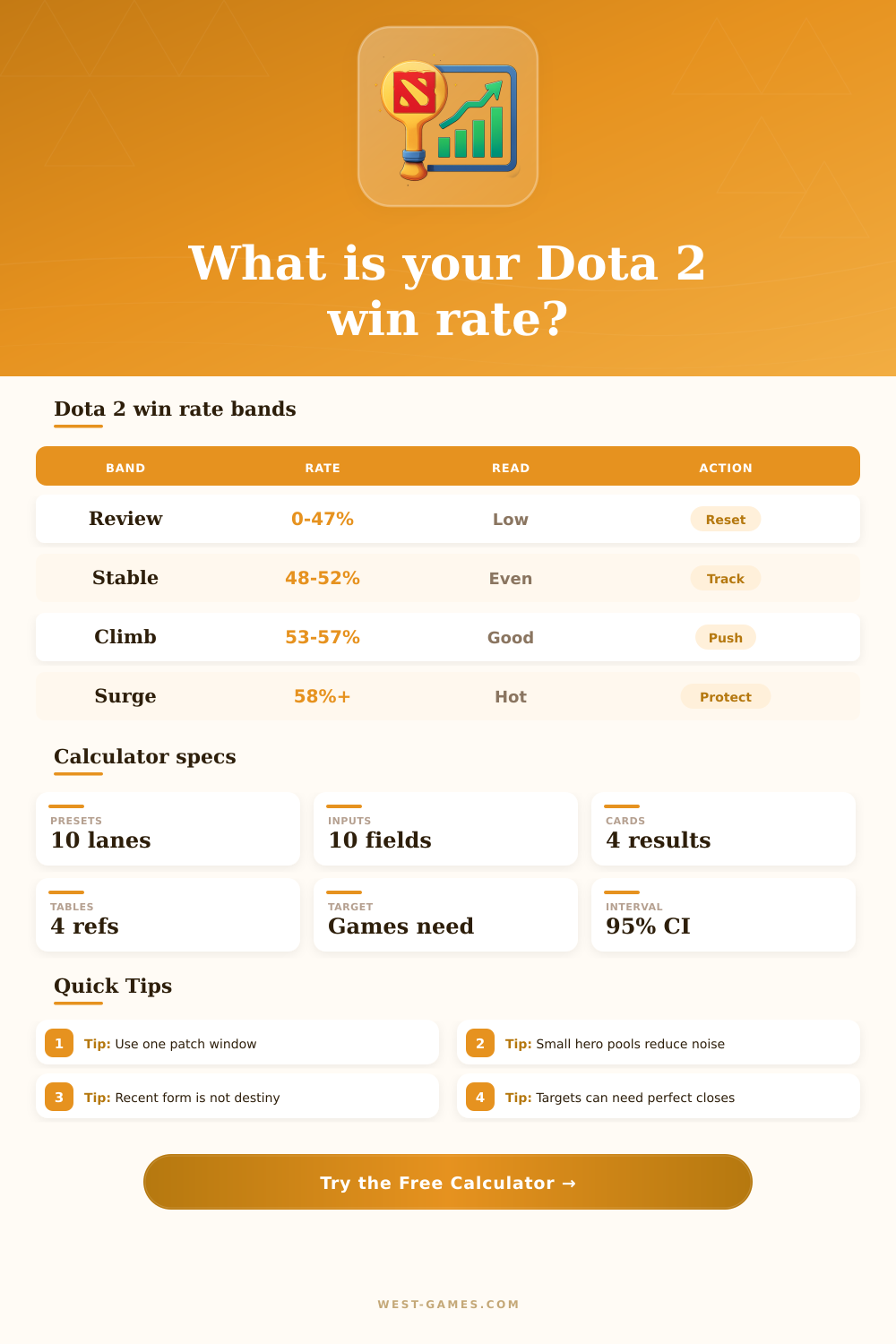
Estimate current win rate, role-adjusted form, hero pool stability, MMR bracket pressure, target games needed, and a 95% confidence interval for your ranked climb.
| Bracket | Approx MMR | Model pressure | Common read |
|---|---|---|---|
| Herald | 0 to 769 | Low | Execution swings |
| Guardian | 770 to 1539 | Low-mid | Lane habits matter |
| Crusader | 1540 to 2309 | Mid | Hero comfort shows |
| Archon | 2310 to 3079 | Medium | Draft and map timing |
| Legend | 3080 to 3849 | High | Power spikes matter |
| Ancient | 3850 to 4619 | High | Tempo errors punished |
| Divine+ | 4620+ | Very high | Small leaks compound |
Bracket ranges are planning bands. Exact matchmaking and seasonal calibration can vary by account and region.
| Pool | Typical heroes | Model effect | Use when |
|---|---|---|---|
| One-trick | 1 to 2 | High ceiling | Hero rarely banned |
| Focused | 3 to 5 | Best stability | Climbing one role |
| Meta pool | 6 to 9 | Draft coverage | Patch favors swaps |
| Wide pool | 10+ | Noisier sample | Flexible role queue |
| Learning | New picks | Penalty | Practice block |
The calculator rewards focused hero samples because the input wins and losses describe a cleaner skill profile.
| Matches | Example rate | Typical CI width | Reading |
|---|---|---|---|
| 10 | 60% | Very wide | Session noise |
| 25 | 56% | Wide | Early signal |
| 50 | 54% | Moderate | Useful role read |
| 100 | 53% | Tighter | Climb signal |
| 250+ | 52% | Stable | Account trend |
A high recent win rate can still be uncertain if the sample is only a few games.
| Target | Meaning | Needed pace | Planning note |
|---|---|---|---|
| 50% | Even record | Stabilize | Good reset goal |
| 52% | Slow climb | Small edge | Works over volume |
| 55% | Strong climb | Clear edge | Protect hero pool |
| 58% | Hot stretch | High edge | Often short-term |
| 60%+ | Smurf-like run | Dominant | Check sample size |
Games-to-target becomes impossible when your future expected win chance is not above the target rate.
Sometimes it seems that only reason for losing games in Dota 2 is because of bad luck, randomness. After ten straight losses, you might start to doubt yourself. You begin to question if there’s even anything you’re doing right mechanicaly. Every ranked game have variance, but by viewing your data through a win rate calculator, you’ll no longer see the emotion; you’ll see the numbers. The next time you get on a losing streak, just think statisticaly and maybe you won’t give up so soon to improving your rank.
Beyond wins and losses, the context of your games matter a lot as information for this tool. The impact of any given decision depend heavily on your role. There is less opportunity for a safe lane carry to impact the game during late stage. Because of limited time to catch up, an early mistake will likely result in a loss. Mid-late game fights provides more opportunities for supports, resulting in a more consistent measure for supports’ long term performance. If you plug in your primary role into tool, it will take that into account. 55% win rate on carry doesn’t mean the same thing as 55% win rate on support, the variables aren’t equal.
Why a Win Rate Calculator Helps You Play Better
But few players realizes that another factor complicating things is size of your own hero pool. You’ll perform well playing only a couple of heroes, but if they’re banned, you’re at risk. If you have a large number of hero, you won’t be affected by bans as much, but you’ll be less familiar with each individual hero. The calculator take this into account and tweaks its confidence intervals accordingly. With a small set of heroes, you get a clear signal about where you are now, whereas a wide-ranging set of heroes will introduce more noise in the dataset. Three to five is usually the sweet spot in terms of getting the best long-term information to improve quickly.
What does that mean? It means you get more room for error when it comes to MMR bracket pressure. You could have mechanical gaps that get overlooked in lower brackets like Guardian and Herald as long as your basic positioning holds up. Once you rise up through Ancient and Legend, your smallest miscues in draft strategy or map awareness is punished more consistently by opponents. The tool’s reference tables shows how pressure increases at higher ladder ranks. What seems like a decent win rate at mid tier might not hold up to well-coordinated teams at the very top of the ladder.
Remember that past performance do not predict future results. If you have won six in a row, chances are that you’ve just caught some lucky breaks, not that you magically turned into new player. Likewise, if you had a poor session, don’t let it define your true potential; you’re likely better than those results suggest. Recent matches will always be shown so the calculator can demonstrate current momentum, while still maintaining an accurate history of play. That way, you don’t get too high or low based off short term fluctuations. You’ll remain level-headed when on a win-streak, and stay calm when things aren’t going your way.
Players tend to set a target win rate that is too high. While it’s possible to get there with regular play (a 55% win rate is ambitious but achievable), players attempting to hit 60%+ will often experience burn out due to needing to make nearly perfect decision after decision after hundreds of games. Based off your current skill level, the tool tells you how many games you’d should of played if you wanted to hit this rate. It can be scary high, intentionaly so. It reinforces the idea that climbing takes time and consistency. It’s not a measure of perfection; it’s a way to manage expectations.
By understanding the numbers you can keep perspective and know that your value as a player isn’t tied to how each match turns out. Where intuition may let you down, the data gives you clarity. Instead of focusing on score, you can concentrate on development. If you learn how to tame variance by working with it, climbing will be far less stressful. This shift in mentality makes all the difference towards long term improvement.