🎮 Mobile Legends MMR Calculator
Estimate hero MMR change, rank star movement, medal impact, enemy strength adjustment, party-size pressure, streak effects, and protection-point outcomes after a ranked match.
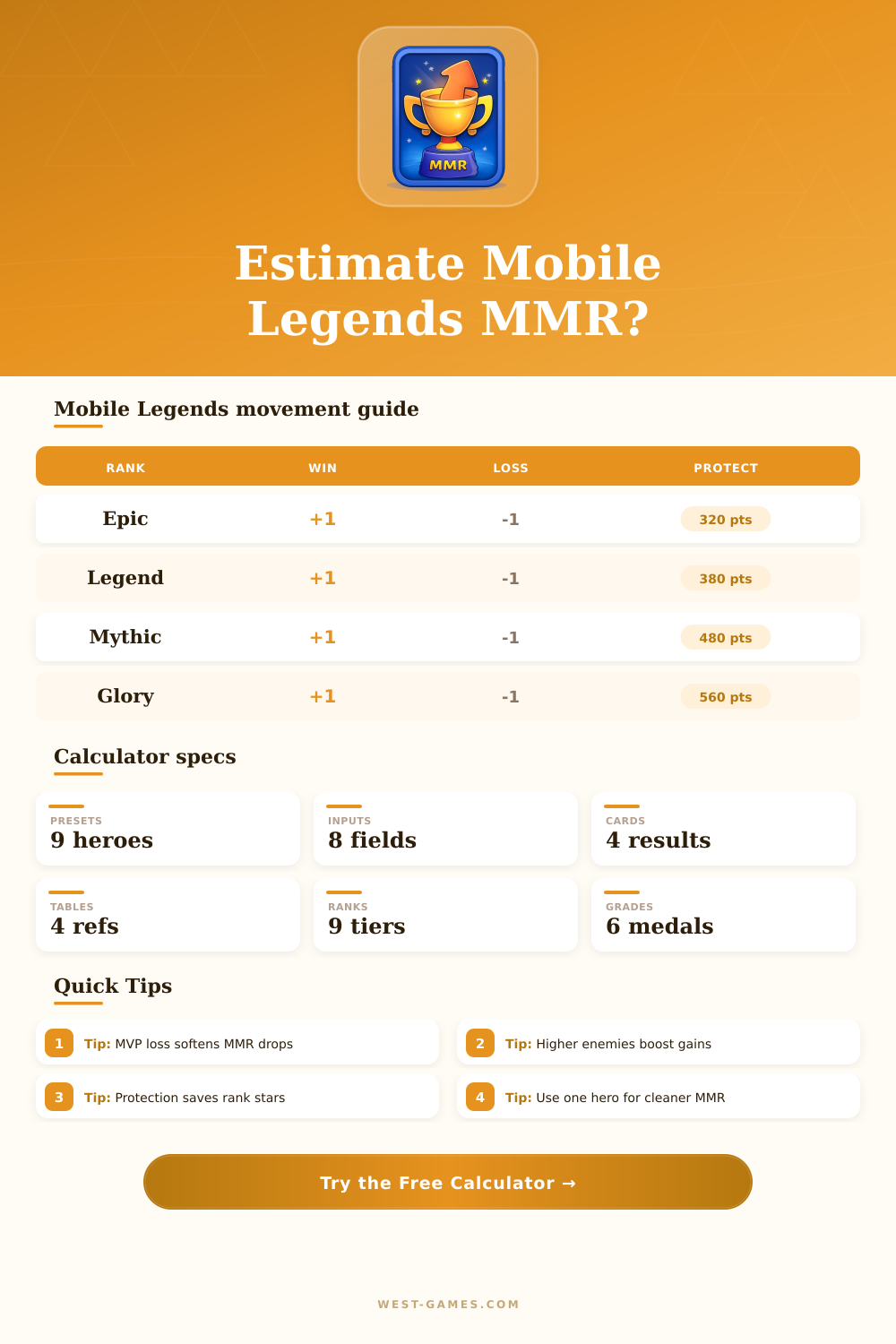
| Rank tier | Star win | Star loss | Protect need |
|---|---|---|---|
| Warrior to Master | +1 star | Often soft | 180-260 pts |
| Grandmaster | +1 star | -1 star | 300 pts |
| Epic | +1 star | -1 star | 320 pts |
| Legend | +1 star | -1 star | 380 pts |
| Mythic | +1 star | -1 star | 480 pts |
| Honor and Glory | +1 star | -1 star | 560 pts |
Actual star protection events can vary by season rules, queue type, penalties, and special events.
| Grade | Win effect | Loss effect | Best read |
|---|---|---|---|
| Bronze | -18% | Harsher | Low impact |
| Silver | -8% | Slightly harsh | Mixed impact |
| Gold | Baseline | Baseline | Useful impact |
| MVP | +18% | Softens drop | Top impact |
| Legendary | +25% | Softens drop | Carry impact |
| Penalty | -45% | Severe drop | Risk flag |
The medal model is tuned for hero MMR estimates, not official rank-star compensation.
| Factor | Win gain | Loss drop | Meaning |
|---|---|---|---|
| Lower enemies | Reduced | Harsher | Expected win |
| Even lobby | Baseline | Baseline | Fair match |
| Higher enemies | Boosted | Softened | Upset bonus |
| Solo queue | Baseline | Baseline | No party edge |
| Duo or trio | Slight trim | Slight trim | Coordination |
| Five-stack | Lower swing | Lower swing | Team expected |
Party pressure reduces volatility because organized queues have more predictable coordination.
| Hero MMR | Band | Movement | Interpretation |
|---|---|---|---|
| 0-1499 | Placement | Fast | Early sorting |
| 1500-2499 | Developing | Medium | Hero pool forming |
| 2500-3999 | Specialist | Steady | Reliable pick |
| 4000-5499 | Leaderboard | Careful | Strong hero record |
| 5500+ | Elite | Tight | Losses matter more |
Higher MMR bands are modeled with smaller easy-win gains and slightly sharper poor-loss penalties.
In Mobile Legends, you play well in a ranked match, but you lost. Your stars drops into nothingness as you stare at the screen and wonder what happened. You think to yourself “I held that lane,” or “I got those kills,” but the game system didn’t see it that way and punished you anyway. You had an MVP medal on your profile, but none of it mattered when it came down to rank result.
Most players don’t understand how the ladder function, which makes them mad so they put all of the blame onto their teammates. Now, thanks to calculator above, you’ll never need to worry about that again. Knowing exactly how it calculates will make you approach every queue different than before.
How Mobile Legends Ranking Works
Matchmaking Rating (MMR) is not Rank stars. Rank stars is shown; MMR is what matches use. Everyone just starting out and being bad will have breathing room while climbing from Warrior to Master. But then when you get to Epic and beyond, the system tightens up. As the reference table on the page display, there’s a large jump in protection point thresholds as you climb. Your Legend needs more points to protect its stars than it’s Grandmaster. It’s not punishment; it’s a stabilization mechanic that keeps the leaderboard accurate.
MMR moves all over the place if it wasn’t stabilized, which makes matchmaking unplayable. The medal system gets a lot of neglected attention until it’s too late. Getting gold is baseline… It just means that the game trust your MMR signal enough to think that you’ve done something adequate. If you end up with a silver or bronze medal though, the game will assume you didn’t carry as much weight as normal. Your wins won’t reward as much MMR and your losses will sting harder.
Rushing games when you’re feeling tilted can lead to the point where many people break their streaks and drop their performance score. They grab those lower medals and then lose more star in a downward spiral driven by invisible metrics. Because there are different role profiles, using one main hero help; the calculator recognize these differences. For instance, assassins like Fanny have very volatile MMR traits, while marksmen heroes like Layla has relatively stable MMR traits. Your carry roles is expected to have greater impact, so you’ll hurt yourself more with a mediocre performance on an assassin than with one on a tank.
The other thing that is surprising to some solo queue purists is party size does matter. Because the game treats these five-stacks as coordinated teams that should be playing equally well over time, it reduces the MMR swing. What that means is you don’t get as much of a reward on a win where you’re not supposed to but you also won’t get hit as hard with a loss that wasn’t likely. So it reduces the swings. Solo queue has higher variance if you want to climb quickly, you’ll make bigger jumps if you play well, but you’ll drop deeper if you don’t. But this allows you to toggle back and forth between group and solo settings to see what that coordination discount might mean in terms of where it could move you.
The other double edged sword is streaks. Momentum is rewarded with an increased following gain. A loss streak also protect you from catastrophic drops by softening the fall. That’s what makes going on tilt on a bad night feel like losing stars in triple digits. The system believes you deserve protection because those losses are probably not a true reflection of your actualy skill level.
Knowing that can save your account. Take a break if you’ve got two losses in a row. Let the loss streak helper do their thing instead of grinding harder and setting off penalty medals. Your insurance policies are protection points. These only kick in when you’ve reached your rank’s threshold and lose while achieving a decent medal. It feels good hoarding them but used well they keep you above demotion line when you’re in a slump.
You should of known that. Consistency beats out intensity as the real key to climb. Stop worrying about KDA and focus on getting gold or better each game. Manage your streaks. Win efficiently. Let the MMR find your true skill level. If you can understand what the inputs do then you’ll understand how the outputs work. Then the ladder doesn’t feel so much like a lottery and more of a puzzle to be solved.