🎮 Overwatch Elo Calculator
Estimate visible rank progress, hidden MMR movement, role queue adjustment, streak pressure, group effects, and expected division delta after a match.
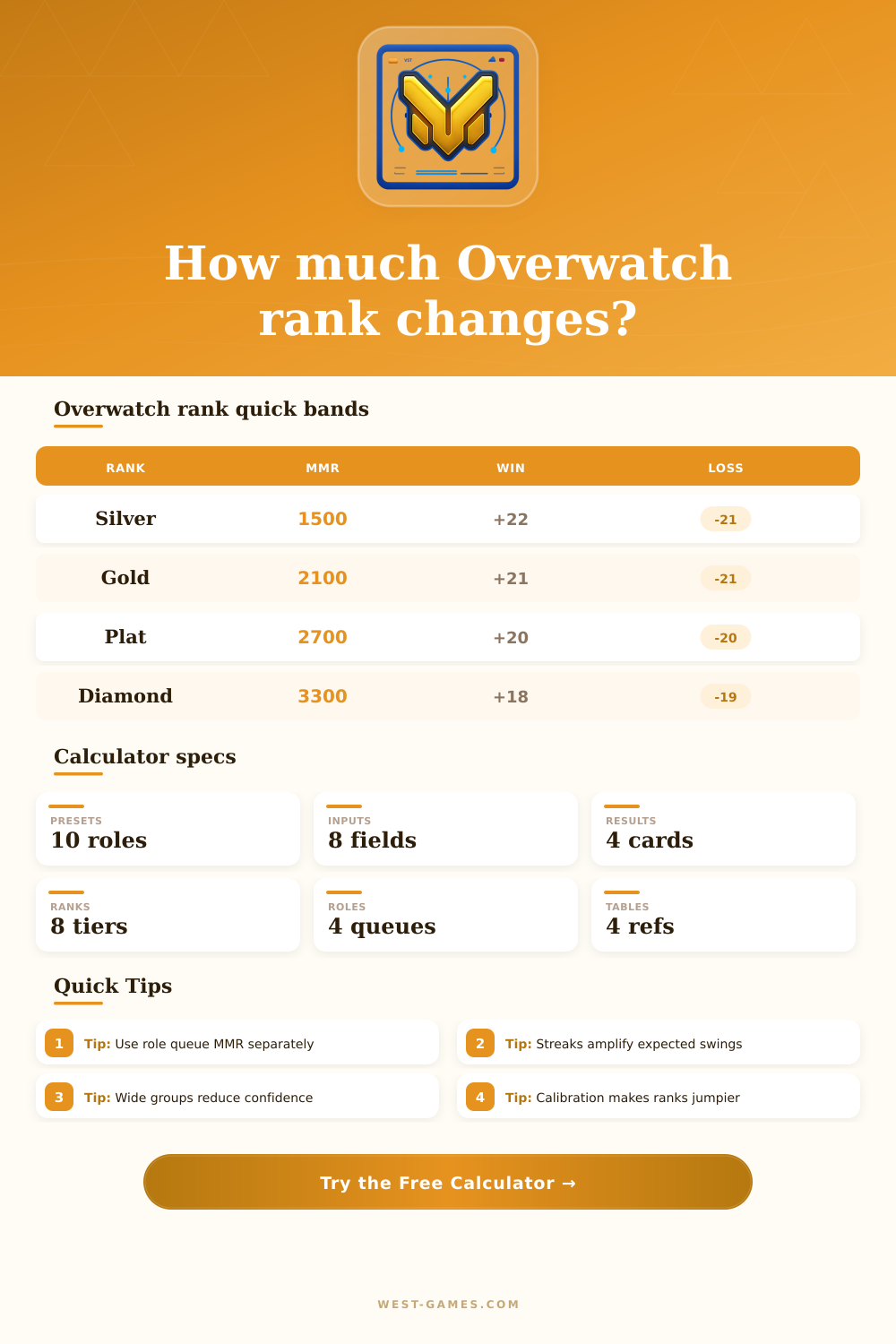
| Tier | Band | Midpoint | Typical Swing |
|---|---|---|---|
| Bronze | 1000-1499 | 1250 | 22-28% |
| Silver | 1500-1999 | 1750 | 21-26% |
| Gold | 2000-2499 | 2250 | 20-25% |
| Platinum | 2500-2999 | 2750 | 19-23% |
| Diamond | 3000-3499 | 3250 | 17-22% |
| Master | 3500-3999 | 3750 | 15-20% |
| Grandmaster | 4000-4499 | 4250 | 13-18% |
| Champion | 4500-5000 | 4750 | 10-16% |
Bands are calculator anchors for comparing visible progress and hidden MMR alignment.
| Queue | MMR Weight | Volatility | Use Case |
|---|---|---|---|
| Tank | 1.04x | 0.98x | Smaller role pool |
| Damage | 1.00x | 1.00x | Baseline ladder |
| Support | 1.02x | 1.03x | Teamfight swing |
| Open Queue | 0.96x | 1.08x | Broader role mix |
Track each role separately because a strong support streak does not prove tank MMR.
| State | Factor | Effect | Best Read |
|---|---|---|---|
| Settled | 1.00x | Normal movement | Trust trends |
| Returning | 1.15x | Wider swings | Play 8-12 games |
| Placement | 1.35x | Fast correction | Expect jumps |
| Fresh | 1.55x | Very elastic | Do not overread |
A streak does not guarantee bonus SR, but it can signal that visible rank is chasing hidden MMR.
| Group | Visible | MMR | Interpretation |
|---|---|---|---|
| Solo | 1.00x | 1.00x | Cleanest signal |
| Even Duo | 0.99x | 0.99x | Nearly neutral |
| Even Stack | 0.97x | 0.98x | Team synergy noise |
| Wide Group | 0.88x | 0.91x | Less certain read |
| Underdog | 1.06x | 1.08x | Bonus on wins |
Wide groups can make the post-match bar feel smaller than the same solo result.
| Scenario | Expected Win | Close Loss | Streak Win | Calibration Win |
|---|---|---|---|---|
| Silver support | +23% | -21% | +27% | +31% |
| Gold damage | +21% | -20% | +25% | +28% |
| Platinum tank | +20% | -19% | +23% | +27% |
| Diamond support | +18% | -19% | +21% | +24% |
| Master damage | +16% | -17% | +19% | +22% |
| Grandmaster flex | +14% | -15% | +16% | +19% |
Use the grid to sanity-check whether the calculated bar movement is in a believable range for your current tier.
The rank that is visible to player in Overwatch is not the same than the hidden ranking that Overwatch use to determine in what type of game you will play. Thus, these two different measures of ranking are not necessarily link with one another. Due to the fact that these two ranking system are not linked with one another, players often gets confused by the system.
The calculator that is provide for players on this page will provide an estimate of your rank progression within the game of Overwatch. The calculator will use several different data inputs to calculate your rank progression for you. Such inputs may include your current tier, the number of games completed within your division, your hidden rank progression, your role queue, and the shape of your game result.
Check Your Overwatch Rank Progress
Thus, the calculator will allow you to determine whether your visible rank and your hidden rank is moving in the same direction within the game. Your rank progression is largly dependent upon the amount of data that the ranking system has on your skill. If you are rotating in one specific role, your rank will tend to reflect your wins and loss.
However, if you are newly rotating into a role, the system will have less data on your specific skill, and thus will apply a more larger expected swing to your rank. This is one of the reason that your ranks may feel “unpredictable” after you return to play a role after a long time away from the game. If you win or lose a large number of games in a row, your rank will reflect that within the game.
The calculator apply a multiplier to account for either a streak of wins or losses for a player. Multipliers are applied to account for the fact that such streaks indicates a player’s skill. However, if you have a group of teammates of varying skill level, the impact of the games outcome will be reduced for you.
Thus, if you have many teammates of all division, you will have less impact from individual games. Your role queue will also impact your rank movement. Due to the fact that queues for tanks and supports have fewer player than the damage role queue, your rank movement within these queues may differ from your rank movement within the damage role queue.
Thus, the system applies multipliers to account for these difference in the queues. Therefore, two player may have the same performance on the same map, yet one player will experience a change in rank compared to the other. The reference tables included in this article provide information regarding the ranking system.
These tables indicate what rank swing will occur as players of the same skill level climb into higher tier of ranking, as well as the effect that different group composition can have upon rank movement. These tables dont need to be memorized, but can be used to evaluate whether your rank movement within the game is within the normal parameter for your ranking. If your movement is outside of those parameters, then one or more of the modifier to your ranking is having an impact upon your rank.
Use the calculator after a session of play Overwatch, not after every single game that you play. Observing three or four games will provide a better idea of your rank movement within the game than will one game alone. The calculator will not provide suggestion as to how to improve your gameplay, but will allow you to understand whether or not your rank movement within the game is within the expected parameter for your rank.
If the calculator and your experience within the game correspond to one another, your rank is behaving correct. If they do not match, then there is a potential mismatch between the data that you provide for the game and your perceived skill within the game. Overall, each movement of your rank is a data point that can be used to evaluate your performance over time.
Each movement of your rank does not need to be interpreted as a judgment of your skill as a player. Thus, the calculator is a tool that makes this data point more easier for players to read.