🛡 Minecraft Armor Toughness Calculator
Calculate Java-style armor toughness mitigation, compare diamond against netherite, test Protection EPF, and see how large hits change the effective reduction curve.
| Incoming Hit | Armor Only DR | Final Damage | Toughness Saved |
|---|---|---|---|
| Run calculator | 0% | 0 | 0 |
| Full Set Or Mix | Armor Points | Toughness | Calculator Meaning |
|---|---|---|---|
| Leather | 7 | 0 | Low armor and no toughness; large hits cut through quickly. |
| Gold | 11 | 0 | Moderate armor points, but no toughness protection against burst. |
| Chainmail | 12 | 0 | Slightly more armor than gold, still no toughness curve support. |
| Iron | 15 | 0 | Strong early set, but big hits shrink its effective armor factor. |
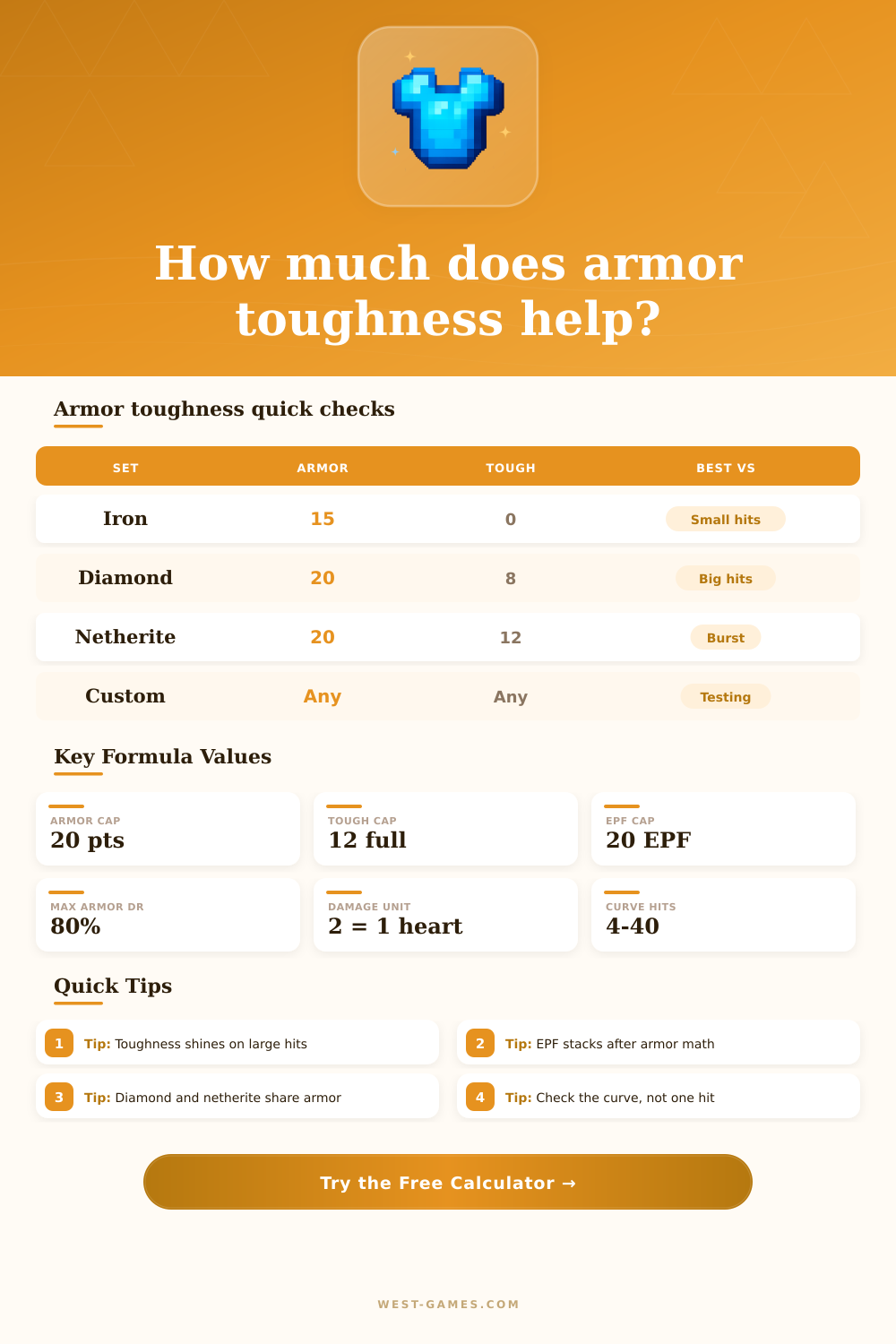
| Diamond | 20 | 8 | Maximum normal armor points with meaningful toughness. |
| Netherite | 20 | 12 | Same armor points as diamond with a stronger high-hit curve. |
| Turtle shell plus diamond | 20 | 6 | Example mixed set: 20 armor points with less toughness than diamond. |
| Step | Formula Piece | Cap Or Clamp | Why It Matters |
|---|---|---|---|
| 1 | Armor / 5 | Minimum armor factor floor | Prevents armor from collapsing completely on huge hits. |
| 2 | Armor - hit / (2 + tough / 4) | High-hit toughness term | Higher toughness makes the hit subtract less armor factor. |
| 3 | Max of step 1 and step 2 | Then limited to 20 | Chooses the stronger armor factor before converting to percent. |
| 4 | Armor factor / 25 | 80% armor layer max | Converts armor factor into the armor-only reduction layer. |
| 5 | EPF / 25 | 20 EPF cap | Applies enchantment mitigation after armor has already reduced damage. |
| Common Setup | EPF Input | Layer Reduction | Use In Calculator |
|---|---|---|---|
| No Protection | 0 | 0% | Shows raw armor and toughness performance. |
| One Protection IV piece | 4 | 16% | Good for testing a partial enchant setup. |
| Two Protection IV pieces | 8 | 32% | Useful when mixing specialized enchants. |
| Four Protection IV pieces | 16 | 64% | Common full-set estimate before the EPF cap. |
| EPF cap | 20 | 80% | Maximum value accepted by the calculator. |
| Hit Size | Diamond Armor DR | Netherite Armor DR | Takeaway |
|---|---|---|---|
| 6 damage | 74.0% | 75.2% | Small gain because both sets already have high armor factor. |
| 12 damage | 68.0% | 70.4% | Netherite starts pulling ahead as hit size rises. |
| 24 damage | 56.0% | 60.8% | Toughness protects more of the armor formula. |
| 40 damage | 40.0% | 48.0% | The high-hit benefit becomes easy to see. |
Armor toughness in Minecraft work to provide a reduction in the damage that a player may recieve while wearing armors. Armor points provide some reduction in damage to be took by the player, but the effectiveness of armor points decrease as the size of the damage that the player takes increase. Armor toughness is a value that prevents armor points from losing effectiveness when the player is hit with a large amount of damages.
Additionally, armor toughness dont provide a percentage of damage reduction for armor, but only change the way that the armor damage reduction formula work when the damage taken is a large number. For instance, armor with 20 armor points and 8 armor toughness will provide more damage reduction than armor with 20 armor points and 0 armor toughness. This is one of the reasons that netherite armor feels more different than diamond armor, as netherite armor include a higher level of armor toughness than diamond armor.
How Armor Toughness Works in Minecraft
Damage reduction in Minecraft occur in a specific order. The armor points and armor toughness for the player’s worn armor are applied to the incoming damage. After the player’s worn armor applies the armor points and armor toughness to the damage, any Protection enchantment on the armor are applied to the damage (known as Protection EPF).
Finally, any other modifiers to damage reduction are applied, such as the Resistance effect or any shield the player wears. The armor points and armor toughness are applied to the damage first, so armor toughness must protect the first layer of armor so that protection enchantment can have an effective layer of armor to defend. Different type of armor have different amounts of armor toughness.
Leather and gold armor has low amounts of armor toughness, which means the damage reduction from this armor will fail if the player take large amounts of damage. Iron armor have a medium amount of armor toughness. Armor made of diamond and netherite reach the maximum amount of armor points, but netherite armor has more armor toughness than armor made of diamond.
These two type of armor are the same in that their amount of armor points are the same, but the curve of the armor toughness will become more noticeable for armor made of netherite if the incoming damage is over 20 damage point. Armor should not be judged by how it handle one hit, but rather by the damage reduction curve. Armor should of been tested over a range of damage point to test if the armor toughness is performing it’s intended function.
Additionally, the damage type is another factor to consider when testing armor toughness. Damage from explosions, bosses melee attacks, and PvP attack can deal more damage than mob attacks. While the damage type will not change the damage reduction calculations, labeling the type of damage help to test the values that the player will take within the game.
Armor toughness is not visible in small amounts of damage, but it is important in large amounts of damage. A damage calculator can help players to understand how armor toughness will impact the damage that the player takes prior to making a decision about which armor set to use. With an understanding of armor toughness, players can make decision about whether to use armor made of diamond or netherite depending on the type of damage that they will take in the game.