PoE Armor Calculator
Estimate physical hit mitigation with armour, endurance charges, Basalt and Granite flasks, Determination, boss hit sizes, max hit, and effective hit pool.
Full Breakdown
| Scenario | Raw Physical Hit | Armour PDR | Total PDR | Damage Taken | Outcome |
|---|---|---|---|---|---|
| Run the calculator to populate boss scenario checks. | |||||
| Armour Compared To Hit | Example for 5,000 Hit | Formula Result | Use Case Read |
|---|---|---|---|
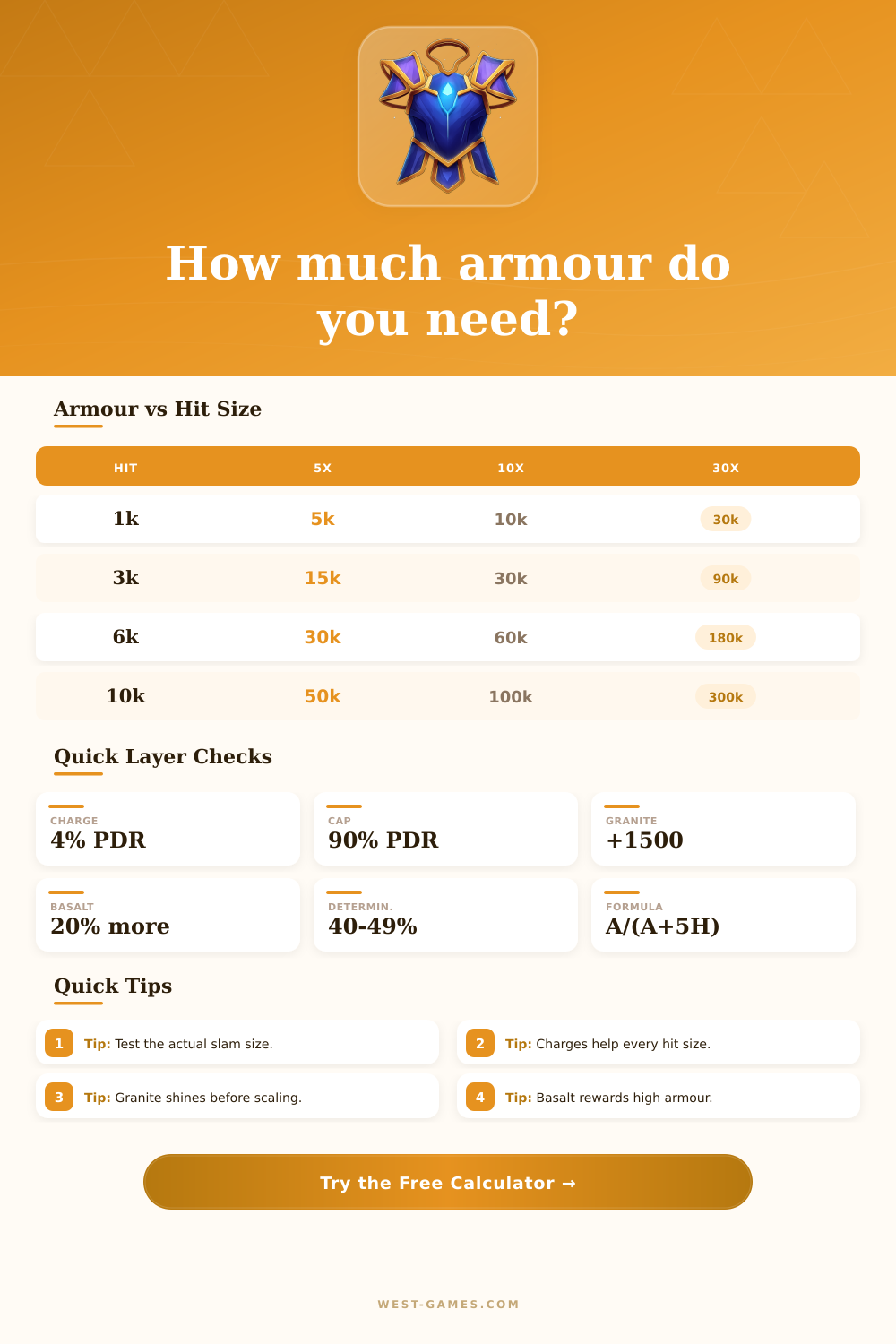
| 5× hit | 25,000 armour | 50.0% armour PDR | Solid for medium mapping hits |
| 10× hit | 50,000 armour | 66.7% armour PDR | Strong baseline before charges |
| 20× hit | 100,000 armour | 80.0% armour PDR | Good into large rare hits |
| 30× hit | 150,000 armour | 85.7% armour PDR | Near cap when layered |
| 90× hit | 450,000 armour | 94.7% before cap | Hits the 90% reduction ceiling |
| Build Style | Typical Armour | Charges | Frequent Layers | Best Hit Range To Test |
|---|---|---|---|---|
| Two-hand melee mapper | 15k to 35k | 3 to 5 | Granite, Determination, Fortify | 3k to 8k |
| RF or Aegis shield stacker | 35k to 90k | 3 to 6 | Determination, Basalt, shield recovery | 5k to 12k |
| Flask effect Pathfinder | 25k to 70k | 0 to 4 | Granite, Basalt, flask suffixes | 4k to 10k |
| Dedicated armour stacker | 120k+ | 3 to 7 | Aura effect, conversion, molten shell | 8k to 20k |
| Delve juggernaut | 70k to 180k | 6 to 9 | Charges, endurance scaling, guard skill | 10k to 25k |
More Armour
Basalt and Determination more multipliers improve every armour calculation, but the selected hit size still controls how much PDR that armour produces.
Flat Armour
Granite and Determination flat armour are strongest when the character starts from a smaller base and still scale with increased armour.
Additional PDR
Endurance charges add direct physical reduction after armour, making them valuable against both small hits and large boss slams.
Less Taken
Fortify-style less damage taken multiplies the remaining damage after PDR, so it usually improves max hit more than the card percentage suggests.
| Layer | Calculator Model | Where It Applies | What To Watch |
|---|---|---|---|
| Armour rating | A / (A + 5H) | Physical hits only | Large hits need much more armour |
| Endurance charges | 4% additional PDR each | Added after armour | Can be lowered by overwhelm |
| Granite flask | +1500 base armour | Before increased and more armour | Small base characters gain a lot |
| Basalt flask | 20% more armour | After base armour scaling | Better when armour is already high |
| Determination | Flat armour plus more armour | Before final armour formula | Aura effect changes both values |
| Overwhelm | Subtracts from total PDR | After armour and added PDR | Dangerous for charge-heavy setups |
When you use an armour calculator in Path of Exile, you are calculating an amount of damage that will reach your life pools from a physical slam. An armour calculator allow you to input your armour value, the size of the hit that will be landing on you, and your additional layers of damage reduction. Armour dont provide equal protection from all types of hits.
It provides more protection from small hits than it does from large hits because armour use a diminishing curve to provide protection. Thus, using an armour calculator allows you to see whether your armour will provide enough protection from a specific type of large hits. Endurance charge are an additional layer of damage reduction that occurs after the armour calculation has been performed.
How to Use an Armour Calculator in Path of Exile
Each endurance charge provides four percents physical damage reduction, and each of these charges occurs after your armour value has reduced the damage. Thus, endurance charges are effective against small and large hits. Other layers of damage reduction, such as pantheon bonuses or item modifiers, apply in a specific order.
The armour calculator account for this specific order so that the total value of damage reduction cannot go below a ninety percent cap. Certain items and skills will alter your total armour value prior to the armour calculation. Items like a Granite flask will add armour to your total armour value, and your modifier will apply to that added armour.
Basalt flasks will multiply your final armour value instead of add to it. Basalt flasks will be more effective the higher an armour value that you already possess. Determination will both add armour and an armour multiplier to your character; you can toggle this skill on and off with the armour calculator.
Finally, there are additional effects that will multiply the damage that you take after all other damage reduction layers have been accounted for. Fortify will be applied to your character last, meaning that even if the percentage of Fortify are low, it can still reduce the damage from your large hit. Overwhelm will work differently because it will subtract from your total damage reduction value before the ninety percent cap is applied.
Thus, this skill can be dangerous for characters who rely on endurance charges to provide there damage reduction. You can use the armour calculator to account for how each of these changes can alter your total damage taken by the game. The purpose of an armour calculator is to remove the guesswork from your damage reduction decisions.
If the armour calculator determine that increasing your base armour value will reduce the damage taken from your enemies more than an endurance charge will, you should of invest in increasing your armour value. You can use the information from an armour calculator to decide where to spend your passive points and item upgrades. If your damage taken from enemies are still high despite using as many damage reduction skills and items as possible, your problem is likely with your life pool or guard skill uptime.
Thus, the armour calculator will provide you with clarity on how to best prepare for the specific large hits that will kill your character.