Effective Armor Calculator
Model game mitigation from listed armor, formula type, penetration, resistance, guard or block, and health to estimate final damage, EHP, and next-armor value.
⚔ Generic Game Presets
🎯 Armor And Damage Inputs
Full Calculation Breakdown
📊 Comparison Grid
Armor Only
After Pen
With Resist
With Guard
🧮 Current Mitigation Snapshot
📘 Armor Formula Reference
| Formula Type | Generic Rule | Best For | Calculator Note |
|---|---|---|---|
| Linear rating | Armor divided by armor plus scale. | MOBAs, RPGs, and action games with smooth diminishing returns. | Scale controls how quickly armor reaches high DR. |
| Rating curve | Armor divided by armor plus K. | MMO-style ratings where K changes by level or content tier. | Use the current level's known K value if your game lists one. |
| Exponential curve | One minus decay raised to armor. | Games where every armor point reduces remaining damage by a tiny rate. | Use a decay such as 0.9995 for slow scaling or 0.995 for fast scaling. |
| Direct percent | Listed armor is treated as percent DR. | Simple survival, shooter, or tabletop-like systems. | Armor value is capped by the calculator to avoid impossible DR. |
🛡 Modifier Order Reference
| Order | Layer | What It Represents | Common Gameplay Meaning |
|---|---|---|---|
| 1 | Percent armor reduction | A debuff that lowers the defender's armor before penetration. | Often benefits all attackers, not only the character applying it. |
| 2 | Flat armor reduction | A fixed armor loss applied after percent reduction. | Strongest versus low and mid armor enemies. |
| 3 | Percent armor penetration | Attacker ignores a share of remaining positive armor. | Usually scales best against heavily armored targets. |
| 4 | Flat armor penetration | Attacker ignores a fixed amount after percent penetration. | Good for burst windows and finishing low armor targets. |
| 5 | Resistance and guard | Typed DR and block effects apply after armor in this model. | Final layers multiply remaining damage rather than replacing armor. |
🔮 Damage Type Reference
| Damage Type | Armor Relevance | Resistance Use | Typical Check |
|---|---|---|---|
| Physical strike | Armor usually matters fully. | Use physical resistance if the game has one. | Weapon hit, melee combo, bleed that scales from armor. |
| Projectile or ranged | Armor may matter, sometimes with ranged-specific DR. | Add projectile resistance or cover modifier as resistance. | Arrow, bullet, thrown weapon, turret shot. |
| Magic or energy | Some games bypass armor, others convert armor to general DR. | Use magic resistance and set armor low if armor is ignored. | Spell burst, beam, wand attack, energy cannon. |
| Elemental hit | Armor may only cover the physical part of a mixed hit. | Use fire, frost, poison, shock, or element resistance. | ARPG hit, dungeon affix, enchanted weapon swing. |
| True damage | Armor is ignored in many systems. | Set resist and guard to zero unless your game says otherwise. | Execute, scripted mechanic, fixed damage pulse. |
📈 Marginal Armor Value Reference
| Current State | Next Armor Value | Why It Happens | Build Read |
|---|---|---|---|
| Low armor, no guard | Often high per point. | Each added armor point cuts a large share of remaining damage. | Armor stacking can feel immediately noticeable. |
| High armor, no pen | Lower per point. | Diminishing returns reduce the EHP gain from each extra rating point. | Compare armor to health or resistance upgrades. |
| High enemy percent pen | Reduced value. | Part of the new armor is ignored before the DR formula. | Health, guard, or resistance may outperform raw armor. |
| Strong guard active | Can still help EHP. | Armor reduces the damage that guard later multiplies down. | Layered defense is strongest when every layer is reliable. |
💡 Effective Armor Tips
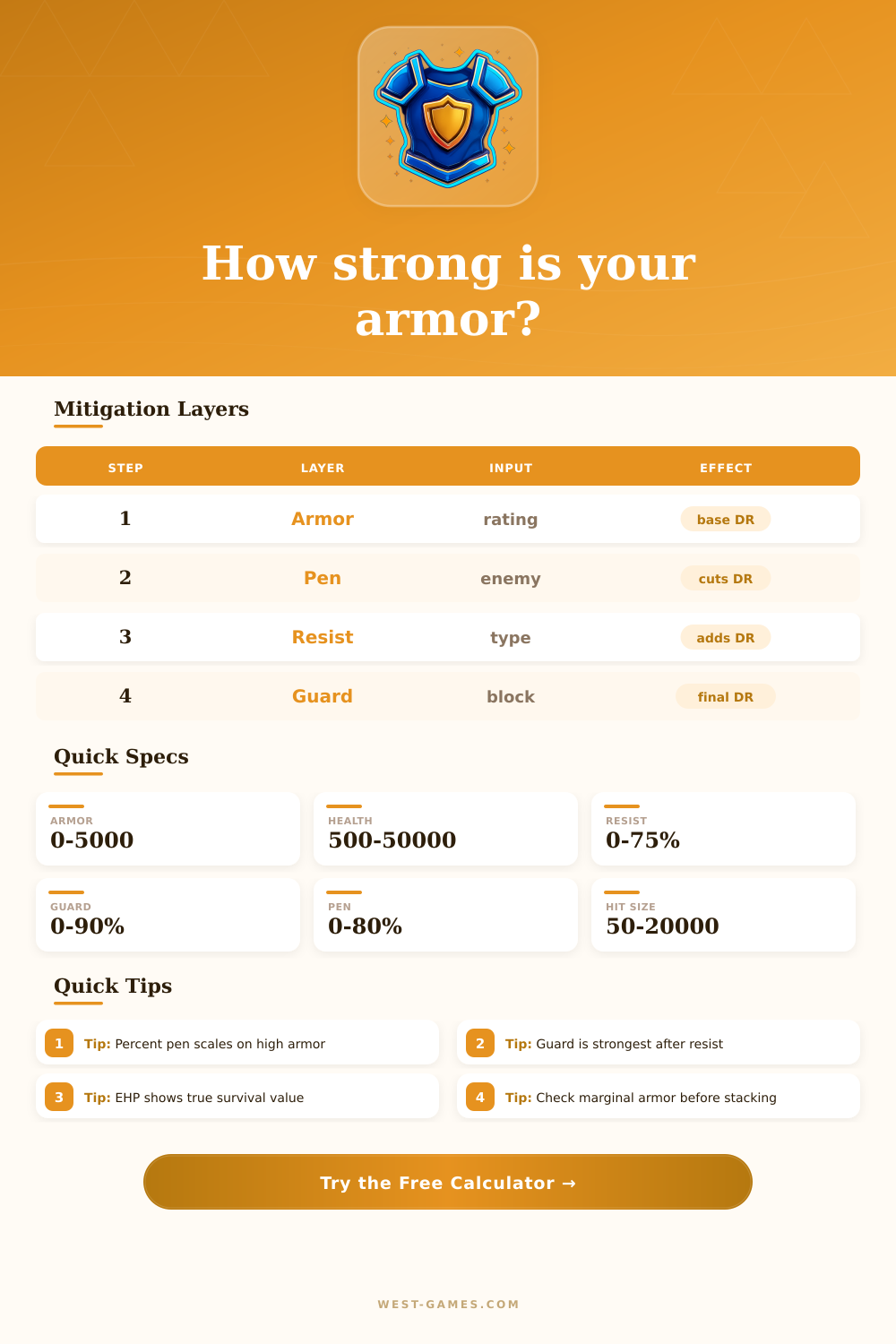
When the armor on a character do not provide the expected level of protection, the problem is rarely with the armor numbers on the character sheet. The problem is with the various reductions and penetrations that occurs before the armor number reaches the health bar. Most games use several layer of protection to contribute to the damage that a player will take.
Each layer of protection contribute to the next layer of protection. In order to determine the effectiveness of certain game upgrades, players must track the entire sequence of these layers of protection rather than just the armor value of the character sheet alone. The first layer of protection to be considered is the armor formula.
How Armor Layers Work
Some games use a percentage value for the armor formula, while other games use a formula that is based on a curve. Armor formulas that follow a curve reward characters for early game purchases of armor while later game armor purchases is rewarded with diminishing returns. Games may use an armor formula based on exponential decay which makes every point of armor provide some benefit to the character, even if that benefit are diminishing as the armor increases.
The armor formula has a specific value within the game that contribute to the percentage reduction of damage for a certain amount of armor. For instance, a certain armor formula may provide twenty percent damage reduction for every point of armor in one game while the same formula may provide forty percent damage reduction for the same amount of armor in another game. If players are not certain of the armor formula for their game, they cannot effectively determine how many additional point of armor will be purchased for the character.
The second layer of protection to be considered is penetration. Percent penetration is one type of penetration that scale with the amount of armor that is present on the enemy. For instance, ten percent penetration will remove more effective armor from an enemy with eight hundred armor than from an enemy with two hundred armor.
Flat penetration is a different type of penetration that removes a flat amount of armor after the percent penetration value has been applied to the enemy armor. Flat penetration values are stronger against enemies with low amount of armor but become weaker against enemies with high armor values. These penetration effects have a specific order within the game that most game developer create, and the order in which these penetration effects are applied can have a more powerfully effect on the character health than the penetration percentages alone.
The third layer of protection to be considered is resistance and guard. Resistance is a type of protection that are applied to specific types of damage. Guard, or block, is the last layer of defense for the character, and only apply if the character successfully completes a guard action.
Both of these values are considered multipliers, and as such, are more valuable when the armor reduce the amount of damage that is directed at the character. For instance, twenty percent guard will save the character more health if the armor has already halved the amount of damage that is applied to the character than if the character take that same amount of damage without armor providing its protection. Effective health is the value that combine all of the layers of protection for the character.
The effective health value indicate how much raw damage the character can take before their health reaches zero. The value of armor, resistance, and guard can all change the value of effective health. Marginal armor value is another value that exist next to the effective health value.
The marginal armor value calculate how many additional points of effective health the player will gain by purchasing ten additional point of armor for the character. If the marginal armor value is diminishing, it is more benefit to purchase health or resistance rather than armor for the character. Each of the layers of protection has an order in which they is applied to the character.
For instance, percent armor reduction from a debuff is applied before penetration while flat armor reduction is applied after percent armor reduction is applied. Additionally, the remaining armor after these reductions is the amount that is ignore by penetration values. Finally, resistance and guard are the last line of defense for the character, and only apply to the remaining damage after the armor values is applied.
Most players will make mistake when applying these layers of armor protection. For instance, many players will purchase armor well into the diminishing returns phase of the game for their character. Such players do not understand how each of these layers of defense interact with one another.
Some players will purchase resistance without regard to the armor value of their character; there resistance will have no impact if their armor is too low. Finally, many players will purchase guard values into the hundreds of percent while ignoring their armor value. Such guard will only provide protection for some of the attack that their enemies will use.
This calculator will handle the mathematics for each of these layers of defense as long as the player input the armor value for the character, the armor formula, the penetration that the enemy have, and the resistance and guard percentages for the character. The calculator will provide the player with the final damage that the character will take, the effective health of the character, and the marginal gain in health that the character will experience with the addition of ten points of armor. The calculator can compare the damage of a single hit at four different stage for the character; armor alone, armor with penetration, armor with resistance, and armor with guard.
The comparison between these four value will allow the player to understand which layer of defense is contributing the most to the character’s survival and which is providing the least protection. This calculator model is based off a generic game model that can be applied to various games as long as the armor formula and the order in which the layers of defense are applied are applied to the game that the player is using. If the character in the game take a different order of actions or if there is another multiplier to some of these stages, the player can still use this tool to calculate the impact of each of the layers of defense that this tool cover.
Thus, the goal of this tool is not to replace the player’s knowledge of the game in which they are playing, but instead to remove the math that some player utilize in their calculations. The armor value for the character is only one of the value that should of be considered in the creation of a strategy for the character. Overall, the most important value for players and developers is the value of the armor after all of the reductions, penetrations and defenses have been applied to that armor before it reach the health bar for the character.
The value of effective health will help players to understand the value of each of the upgrade for the character.