Elden Ring Attribute Scaling Calculator
Estimate weapon AR, grade contribution, two-handing STR gains, soft-cap efficiency, spell scaling, and build fit before spending levels.
🎯Build Presets
⚔Weapon And Build Inputs
Full Scaling Breakdown
📊Current Attribute Snapshot
⚖Affinity Comparison Grid
📘Reference Tables
| Grade | Calculator coefficient | Best interpretation | Planning note |
|---|---|---|---|
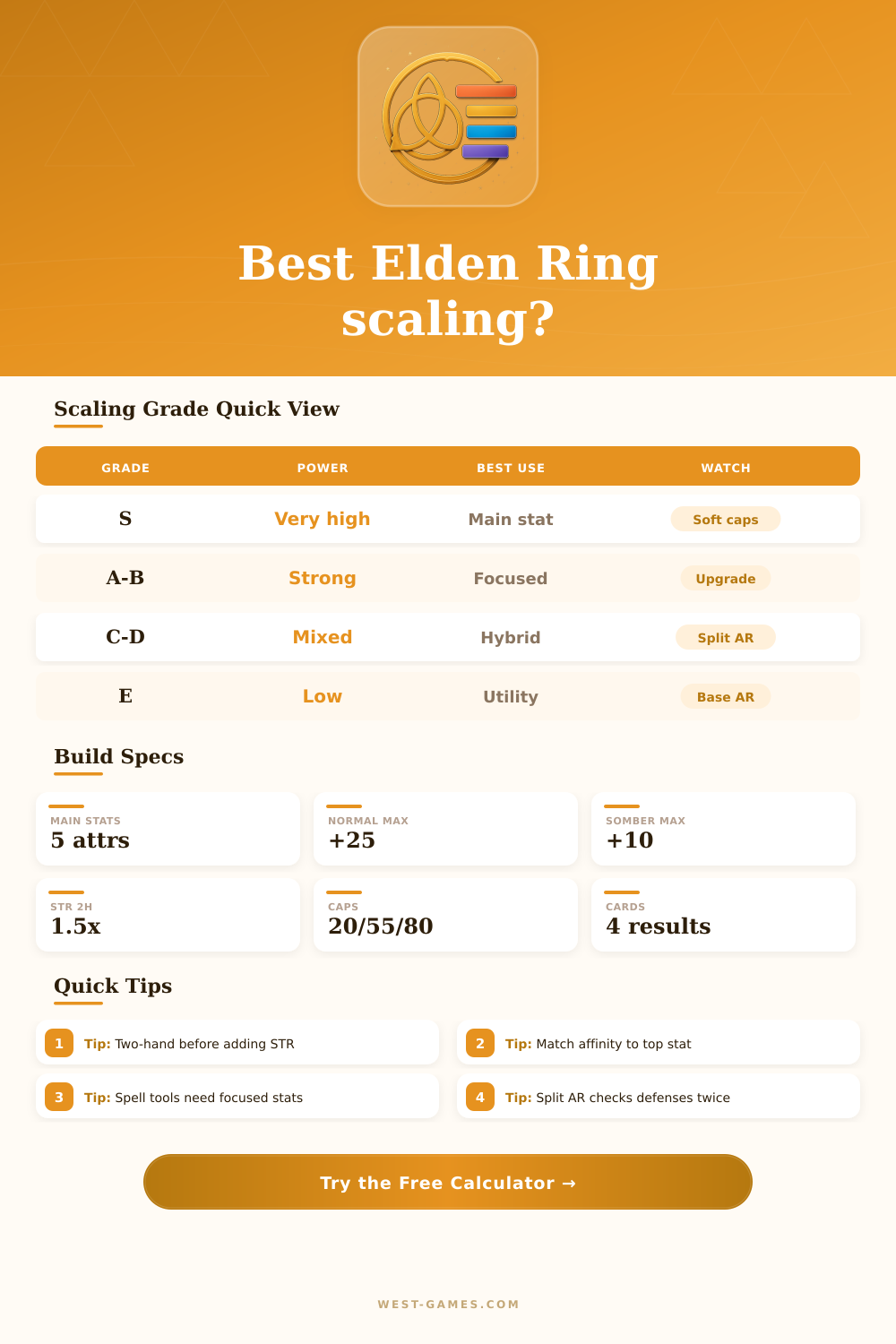
| S | 0.95 | Exceptional scaling | Make this your main damage stat |
| A | 0.78 | Very strong scaling | Excellent after affinity alignment |
| B | 0.62 | Strong scaling | Good for focused or hybrid builds |
| C | 0.46 | Moderate scaling | Usually supports a second stat |
| D | 0.30 | Light scaling | Often weaker than base AR gains |
| E | 0.16 | Minimal scaling | Only count it when stats are already high |
| Attribute group | Early cap | Main cap | Late cap |
|---|---|---|---|
| STR / DEX weapon damage | 20 | 55 | 80 |
| INT / FTH elemental weapon damage | 20 | 50 | 80 |
| ARC weapon and status scaling | 20 | 45 | 80 |
| Spell tool scaling estimate | 25 | 60 | 80 |
| Affinity | Primary lift | Secondary effect | Best build target |
|---|---|---|---|
| Heavy | STR grade boost | DEX grade reduced | Pure STR melee |
| Keen | DEX grade boost | STR grade reduced | Pure DEX melee |
| Quality | STR and DEX balance | Lower base AR in exchange | High total physical stats |
| Magic / Cold | INT scaling added | Split AR defense checks | Spellblade or frost hybrid |
| Flame Art / Sacred | FTH scaling added | Fire or holy split AR | Faith melee hybrid |
| Blood / Occult | ARC value increased | Status or occult damage focus | Arcane pressure build |
| Upgrade path | Max level | Calculator progress | Use case |
|---|---|---|---|
| Normal smithing | +25 | Level divided by 25 | Most standard infusible weapons |
| Somber smithing | +10 | Level divided by 10 | Unique weapons and special tools |
| Early upgrade | 25% progress | Base AR matters more | Grades are still developing |
| Late upgrade | 80%+ progress | Scaling matters more | Soft caps become clearer |
💡Scaling Tips
In the game Elden Ring, a player’s effectiveness with the game is dependent upon the attribute of the player and the requirement of the weapon. Many players selects the moves for their character and their level of investment into each attribute, but do not have a knowledge of the connection of those attributes to weapons. Thus, players who are unaware of the connection between these two aspect of the game may lead to the player’s attribute points being wasted, leading to weaker player and increased difficulty throughout the game.
Each of the game’s attributes (Strength, Dexterity, Intelligence, Faith, Arcane) can be converted to damage for the player’s weapon. The attributes can be added to the base attack value for the weapon. However, the player is unaware of the specific point of damage that each attribute may contribute to the player’s weapon.
Use a Weapon Calculator to Save Attribute Points
Thus, the player must make guesses as to whether the player should invest attribute points into Dexterity, for instance, if the player wishes to increase the damage that they contribute with their weapon, or whether they have already reach the point of diminishing returns for that attribute. A dedicated calculator for the game can remove such guesswork. Such a calculator would allow the player to input information regarding the weapon that they are using, their affinity, their stats, and their upgrade level for the weapon.
The calculator will output the player’s weapon’s attack rating, as well as the damage that comes from each of these attribute. The affinity that the player chooses is not a cosmetic change for their game; each affinity will change both which attributes increase the damage of the weapon and also the base damage of that weapon. For instance, each of the elemental affinities will enable the player’s weapon to also deal elemental damage, which the game checks twice against the enemy’s defenses.
Thus, the listed attack strength for the weapon may be higher then the actual damage that it can do in the game. Calculators adjust for this split damage, allowing players to compare weapons and affinities according. In addition, players can two-hand weapons to increase the damage that their weapons can deal.
If a player chooses to two-hand a weapon, the player’s Strength score is multiplied by 1.5. Such a multiplier will cause the player’s weapon to bypass a soft cap for Strength without needing to invest further level into that attribute. Thus, players can use such a calculator to activate the two-handing mode for a weapon to see if it is more beneficial to invest in an attribute rather than purchase another point for Strength.
Soft caps for attributes will cause the returns of using more levels for that attribute to diminish. For instance, players will gain the most returns from investing in attributes between level 0 and 20, the next soft cap will be at 55 or 60, and the final soft cap will be at 80. Players often make the mistake of purchasing additional levels for attributes after the point of diminishing returns.
Thus, calculators will help players avoid such a mistake in purchasing levels into attributes. Additionally, there are two other aspect of weapons that can be considered. The first is that weapons like staves and seals will scale their damage to attributes like Intelligence and Faith.
Furthermore, the scaling values of damage from staves and seals will include a portion of the weapon’s total power. Thus, should a player also purchase a melee weapon with requirements of Intelligence or Faith, those attributes will be dedicated to two different weapon. Calculators will make visible to players this conflict between melee weapons as spells.
There are three common mistake that many players may make for attributes. The first is focusing on the attack strength of weapons rather than the damage that is dealt with enemy defenses. The second is treating affinities as similar helpful, which they are not; some affinities will reduce the base damage that a player’s weapon deals.
The third mistake is ignoring the upgrade level for weapons. For instance, at the beginning of the game, players will focus most of their strength into base attack strength for their weapon to ensure that they are able to progress as quick as possible in the game. As such, for weapons with higher upgrade levels, the scaling damage that weapons can deal with attributes will become more important.
Thus, the calculator’s outputs will display these different phase of importance for attributes. A player can gain value with a calculator if they run the same weapon through several set of affinities and attribute combinations before committing to any attribute levels. Players can learn which combinations provide the best returns for their play style.
For instance, a player who focuses more on Strength will find that one of the affinities provides more damage to enemies than others. Additionally, a player who intends to focus on casting spells will find that investing in Arcane is less beneficial than investing in another attribute for spells. As a player becomes more experienced with the game, they will learn which weapons require attribute investments to be focused, and which weapons allow for the use of other attributes.
Thus, attributes are no longer seen as a single number but an input for the player’s damage. The calculator leaves the player’s arithmetic to the player, and allows the player to understand that each input will alter the damage of the weapon. Thus, once the player understands each input, the output of the damage will reinforce the player’s understanding of where to allocate their remaining levels.
Calculators for weapons allow for players to understand the scaling aspect of weapons to attributes. Additionally, they allow for a player to avoid mistake that players often make without a calculator. Thus, the value for these calculators can be understood to be the saving of the player’s time and effort, as well as the player’s knowledge of which aspect to consider for their weapons.