ZZZ Character Planner
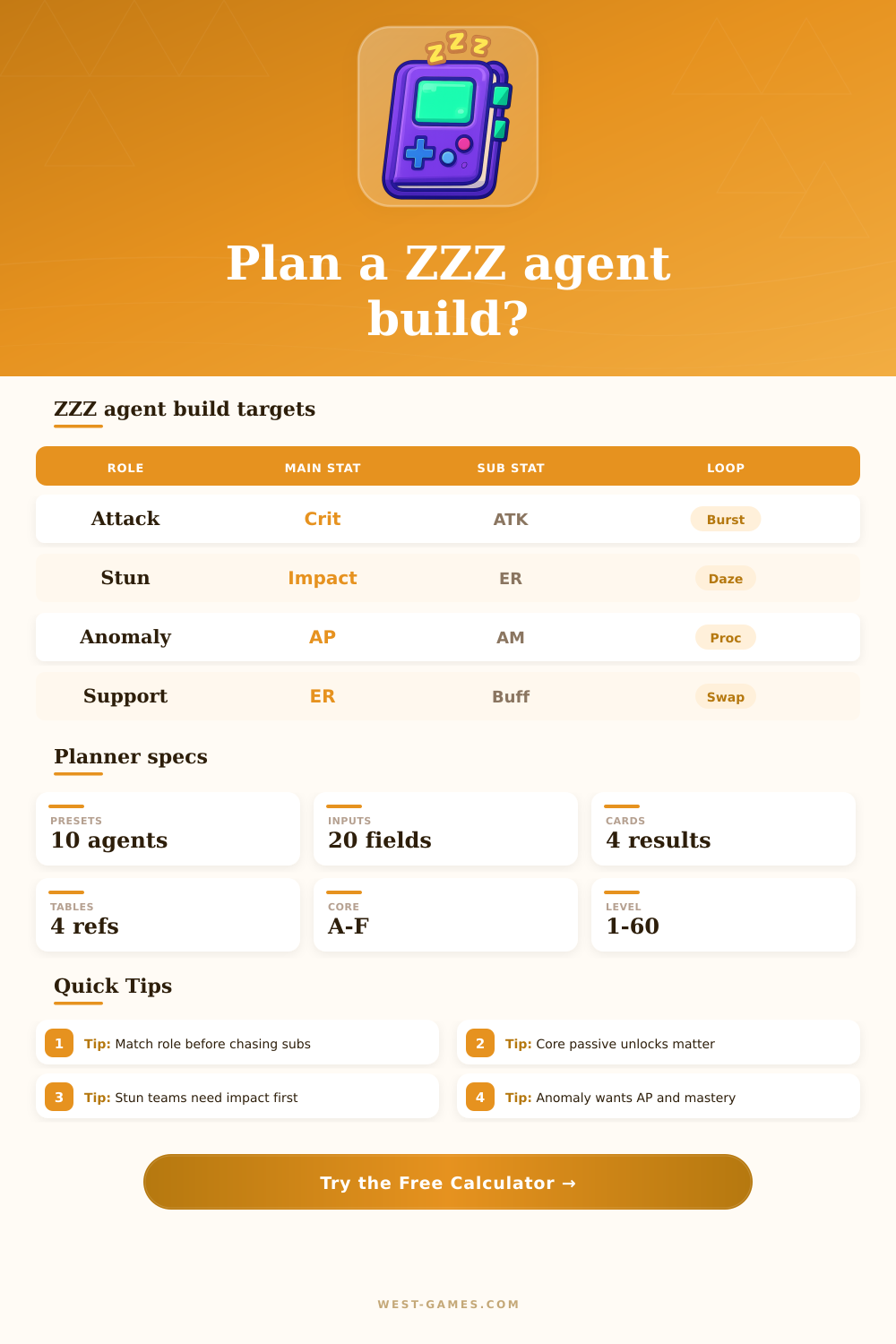
Plan Zenless Zone Zero agent rank, role, attribute, faction, skill targets, core passive, W-Engine, drive discs, team synergy, and EX rotation energy.
Formula Breakdown
| Agent preset | Rank | Role / attribute | Faction | Planning note |
|---|---|---|---|---|
| Hoshimi Miyabi | S | Anomaly / Frost | Section 6 | Prioritize anomaly scaling, core passive, and disorder-friendly allies. |
| Astra Yao | S | Support / Ether | Stars of Lyra | Energy regen and buff uptime are more important than crit rolls. |
| Evelyn Chevalier | S | Attack / Fire | Stars of Lyra | Crit balance and W-Engine fit drive burst consistency. |
| Jane Doe | S | Anomaly / Physical | Criminal Investigation | Assault planning rewards anomaly proficiency and fast proc rotations. |
| Qingyi | S | Stun / Electric | Criminal Investigation | Impact, daze uptime, and chain timing raise team damage windows. |
| Ellen Joe | S | Attack / Ice | Victoria Housekeeping | Crit damage, crit rate, and burst windows matter most. |
| Caesar King | S | Defense / Physical | Sons of Calydon | Plan shield utility, impact support, and compatible faction links. |
| Tsukishiro Yanagi | S | Anomaly / Electric | Section 6 | Disorder teams need AP, AM, and a clean energy loop. |
| Role | Primary target | Good working range | Disc slot focus | Formula used here |
|---|---|---|---|---|
| Attack | Crit profile | 60-75 CR / 140-190 CD | Slot 4 crit, slot 5 element, slot 6 ATK | Average of crit rate and crit damage targets. |
| Stun | Impact and daze | 160-190 impact with useful regen | Slot 6 impact, plus daze-friendly set | Impact / 180 with energy support bonus. |
| Anomaly | AP and AM | 350-500 AP / 130-170 AM | Slot 4 AP, slot 5 attribute, slot 6 AM | Average of AP and AM target completion. |
| Support | Energy and buff uptime | 150-190 energy regen when possible | Slot 6 energy regen or role utility | Energy regen plus support coverage weight. |
| Defense | Utility uptime | Impact, regen, shield scaling as needed | Slot 6 impact, regen, or defensive scaling | Impact and energy mix with team coverage. |
| Rupture | Crit or special scaling | Use role text and kit-specific stat needs | Match kit, then set completion | Crit profile with extra W-Engine weight. |
| Drive disc slot | Attack lead | Stun lead | Anomaly lead | Support lead |
|---|---|---|---|---|
| Slot 4 | Crit Rate or Crit DMG | Crit or utility if damage matters | Anomaly Proficiency | Buff scaling or utility stat |
| Slot 5 | Attribute damage or PEN | Attribute damage or utility | Attribute damage, PEN, or ATK | Attribute, ATK, or defensive utility |
| Slot 6 | ATK or energy if burst starved | Impact | Anomaly Mastery or ATK | Energy Regen |
| Substats | Crit, ATK, PEN | Impact support, ATK, crit | AP, ATK, PEN | Energy, ATK, utility rolls |
| Team shell | Best for | Synergy inputs | Energy behavior | Planner signal |
|---|---|---|---|---|
| Carry + Stun + Support | Attack and Rupture leads | One stunner, one support, faction or attribute link | Bursts inside daze windows | High role fit and high stun coverage. |
| Anomaly + Anomaly + Support | Disorder and Assault lines | Disorder pair, support, attribute variety | EX windows follow proc timing | High AP, AM, and anomaly pairing. |
| Stun + Burst + Buffer | Short boss phases | Impact plus support coverage | Energy must be ready before chain window | Rotation card should be ready or tight. |
| Defense + Carry + Flex | Stable clears and shield uptime | Defense utility plus matching faction | Longer cycles are acceptable | Synergy can offset lower damage stats. |
Building an agent in Zenless Zone Zero requires that you manage many differently parts of the agent build. You have to make a decision about the role that the agent will play in the team, you have to decide which stats you want to seek for that agent, you have to choose a W-Engine and a disc sets for the agent, and, finally, you have to assemble a team of agent for that agent. Each of these decisions has an impact upon the other decisions that you make regarding your agents build.
A planning tool is a valuable tool in that it displays which part of the agent build is preventing the rest of the agent build from performing as well than it could. To use the planning tool, you must enter data about the agent that the game is calculating for you. The role that the agent will play will determine which stats are the most important for that agent; an Attack unit will require critical hit rate and critical hit damage stats, for example, but a unit that is meant to function as a Stun unit will not require those same critical hit stats.
How to Build an Agent with the Planning Tool
An anomaly agent will require stats related to anomaly proficiency and anomaly mastery, but those will not be the same as the stats required of a support agent. Support agents requires stats related to energy regeneration, which is, therefore, the most important stat for that type of agent. Thus, by selecting the role for which you intend to use the agent, you indicate to the planning tool which stats are the most important for that agent.
Beyond selecting the role for the agent, you must enter the level of the agent, the level of each of the agents skills, and the rank of the agents core passive skill. These are all factors that will influence the power of the agent. An agent with a high rank for his or her core passive skill and whose skills are of a high rank will be stronger than an agent that does not have these stats as high as the other agent.
Thus, the planning tool calculates the readiness score for the agent based off these stats. For these stats, the higher the score, the better. Furthermore, because these stats are used to calculate the readiness score for the agent, agents that have the same disc may have different readiness scores for the agent.
In addition to the factors related to the agent that you have selected, other factors that are used to calculate the readiness score for that agent include the W-Engine that you choose for that agent, the percentage of how well the passives for that W-Engine fit the role of the agent, the drive disc quality for the agent, and the skill in connecting that agent to the other agents in the players roster. Factors that relate to the other agents in the players roster include the number of allies that share a faction with the agent or that share an attribute with the agent; allies of both of these categories provide bonus to the players team. Additionally, the number of support and stun abilities included in the team are also factors that relate to that agent; support and stun abilities are required to enable the damage dealer in the team to deal with damage with the teams enemies.
Thus, an agent that appears to be strong on paper could still perform poorly if the team does not include the abilities that enable the damage dealer to do its damage to the enemies in the game. Finally, while many players may disregard energy rotation as one of the factors that goes into building an effective agent, energy rotation is actualy one of the most important factors. The energy rotation calculator considers how long the energy rotation will take to complete in relation to the energy that each agent regenerates, how many attacks the agent can perform in a row, and the cost of using the EX Special skill for that agent.
The outcome of this calculation will determine if the agent will have enough energy to complete the rotation that the player desires for the agent. An outcome of “Ready” will indicate that the rotation that is designed for that agent is comfortable with the stats of that agent. A result of “Tight” will indicate that the agent will need more energy regeneration stats for the agent to be successful in performing its rotations.
Finally, a result of “Starved” will indicate that the agent is asking for more energy from the player than the player can provide with the current stats of that agent. Tables on the game provide information regarding the stats that each role seeks. These tables are useful in determining whether you should seek critical hit rate or energy regeneration, for example.
Thus, while these tables will not change the players judgment about the agent that is being built, they will limit the players need to make guesses about what type of agent to build. Despite the planning tools abilities to calculate readiness scores and factor in numerous element of an agent build, many players make mistakes when they build their agents. For example, some players may seek high critical hit damage but not critical hit rate, which will make their agent weak.
Furthermore, some players may attempt to use a four-piece disc set that is not for the agent, or their team may contain two stunners which will lead to low damage output by the team. The planning tool will not prevent these mistakes, but the readiness score and role fit number for the agent will make these mistakes visible to the player. The value of using this planning tool is that it forces the player to envision the agent as a system of components and skills.
Each weak component of that system will lower the performance of the agent as a whole. Thus, if the player receives a low readiness score for their agent, the breakdown of the agent will show which component of the agent is creating that low score for the agent. The player can then use that information to decide whether to upgrade the discs for that agent, the W-Engine for that agent, or the core passive rank for that agent.
Thus, the planning tool will help the player decide which components of the agent require upgrades or improvement.