🎮 WoW Skill Tree Calculator
Balance class tree and spec tree points for raid, Mythic+, arena, battleground, and delve builds with a faster scoring workflow.
| Level Band | Typical Points | Capstone Goal | Suggested Split |
|---|---|---|---|
| 10-29 | 10-16 | 0 | 60% offense / 25% defense / 15% utility |
| 30-49 | 17-24 | 0-1 | 55% offense / 25% defense / 20% utility |
| 50-69 | 25-29 | 1 | 50% offense / 30% defense / 20% utility |
| 70-80 | 30-31 | 1-2 | 45% offense / 30% defense / 25% utility |
| Profile | Throughput Mult | Survival Mult | Pacing Factor |
|---|---|---|---|
| Raid Single Target | 1.12 | 0.94 | 0.92 |
| Mythic+ Route | 1.06 | 1.02 | 1.00 |
| Arena 3v3 | 0.94 | 1.18 | 1.10 |
| Rated Battleground | 0.96 | 1.14 | 1.06 |
| Delve and Solo | 1.00 | 1.08 | 1.02 |
| Open World Loop | 1.04 | 0.98 | 0.96 |
| Node Type | Low Efficiency | Stable Efficiency | High Efficiency |
|---|---|---|---|
| Offensive Nodes | Below 35% | 35-55% | 56-65% |
| Defensive Nodes | Below 15% | 15-30% | 31-40% |
| Utility Nodes | Below 10% | 10-25% | 26-35% |
| Cooldown Nodes | 0-2 points | 3-5 points | 6+ points |
| Capstones Taken | Expected Spend | Best Use Case | Risk Check |
|---|---|---|---|
| 0 | Up to 24 points | Early leveling and quick swaps | Low burst ceiling |
| 1 | 25-30 points | Balanced raid or Mythic+ setup | Moderate flexibility loss |
| 2 | 30-31 points | Late-game focused build | Tighter utility budget |
| 3-4 | Specialized pathing | Niche encounters only | High counter-build risk |
Talent tree are complex systems of nodes that players must decide which node to select within the class trees and the spec trees for there character. A player’s selection of nodes impacts how their characters perform in different types of gameplay. If the player select too many nodes that provide offensive abilities to there character, then they will not have the defensive nodes that will help them to survive in difficult encounters within a game.
Additionally, if they select too few capstone nodes, then their character build will lack the power that the capstone nodes provides to their character build. All players receives a limited number of talent points that they must distribute between their class tree and their spec tree. At level 80, players receive 31 talent points to allocate between their character trees.
How to Build a Balanced Talent Tree
These points will determine how many offensive, defensive, and utility node that the player chooses for their character. Offensive nodes increases the damage that a player deals with their character. Defensive nodes increase the chances of the player and their character survive in the game.
Additionally, utility nodes provides additional functions to the character. Player skill tree calculator can assist players in managing their talent points as these calculators can calculate the trade-offs between the different nodes for their character trees. The requirements for talent nodes also differ depending upon the type of gameplay that the player is performing.
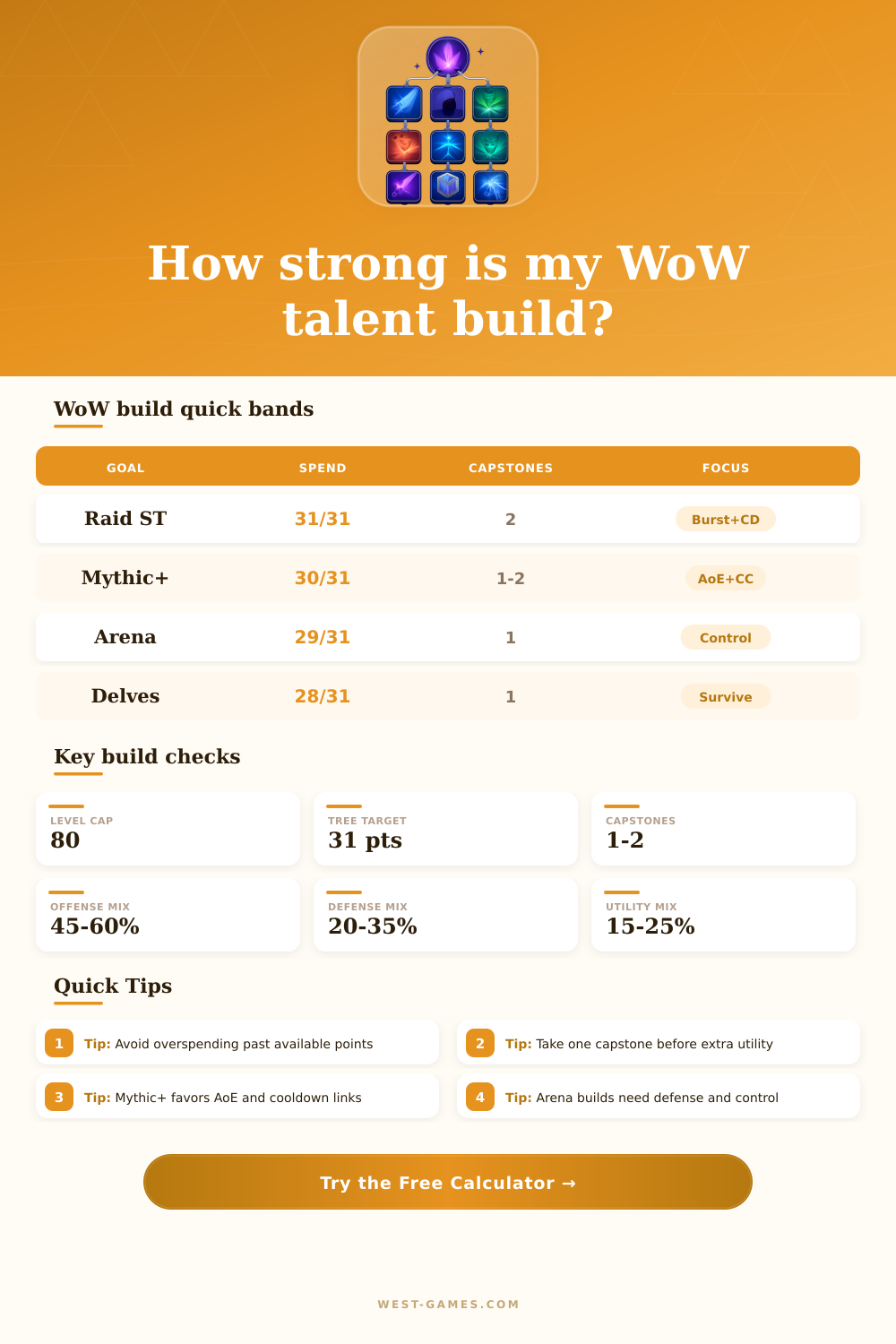
For example, if a player is playing Mythic+ content, then they require more nodes that provide abilities to deal with area-of-effect damage and to reduce the cooldown of their abilities. However, for raid content, they will require more nodes that provide abilities that allow them to deal with high amount of single-target damage. Additionally, player versus player combat will require more utility and defense nodes as survival is more important in these situations.
Another important metric for players to consider when selecting nodes for their character trees is the efficiency of their nodes. If players select their nodes in a way that is inefficient for their character to use, then their character will be unable to perform at their best. Players should aim to distribute their nodes in a way that create a balanced distribution of their nodes to ensure high efficiency from their character.
A balanced distribution for players should aim for 45% to 60% of their nodes being offensive and 20% to 35% of their nodes being defensive. If players have a focus on the offensive nodes for their character, they may find themself with a ratio of 65% of their nodes being offensive. Such a high percentage for offensive nodes, however, will inevitably lead to decrease efficiency for their character.
Nodes at the end of the trees of talents for characters are known as capstone nodes. These nodes provide large amount of benefit to the players and their characters when selected. Players must plan when to acquire these nodes for their characters.
For example, players can acquire one capstone node when they reach between 25 and 30 talent points. Players should of been cautious, however, about acquiring too many capstone nodes. If players acquire three capstone nodes too soon in their character progression, they may commit to a niche ability for their character that will only be useful in specific situation.
Player skill tree calculators allows players to preset their characters for the selection of specific nodes. These presets will allow players to load their characters with talents that are optimal for specific roles in the game. These presets will show players how the same number of talent points can lead to different scores based off the role of the player.
Skill tree calculators cannot account for every variable within the game. For example, the skill tree calculators cannot account for the gear that players use or the specific mechanics of the encounters that they face within the game. For players to ensure that their character is prepared for the content that they will face at higher levels of the game, they can utilize the calculators to ensure that they have adequate score within certain categories for their characters.
Players should aim for a readiness score of 90% or higher, a throughput score in the high 40s, and a survival score of 30 or higher. If the players can achieve these scores with their characters, then their character build is optimized. Additionally, the scores can help to ensure that the player has a balanced and efficient talent tree for their character.