🐵 Black Myth Wukong Skill Tree Calculator
Plan your Sparks by stance, spell route, transformation, and boss pressure so each chapter and NG+ cycle has a clear path.
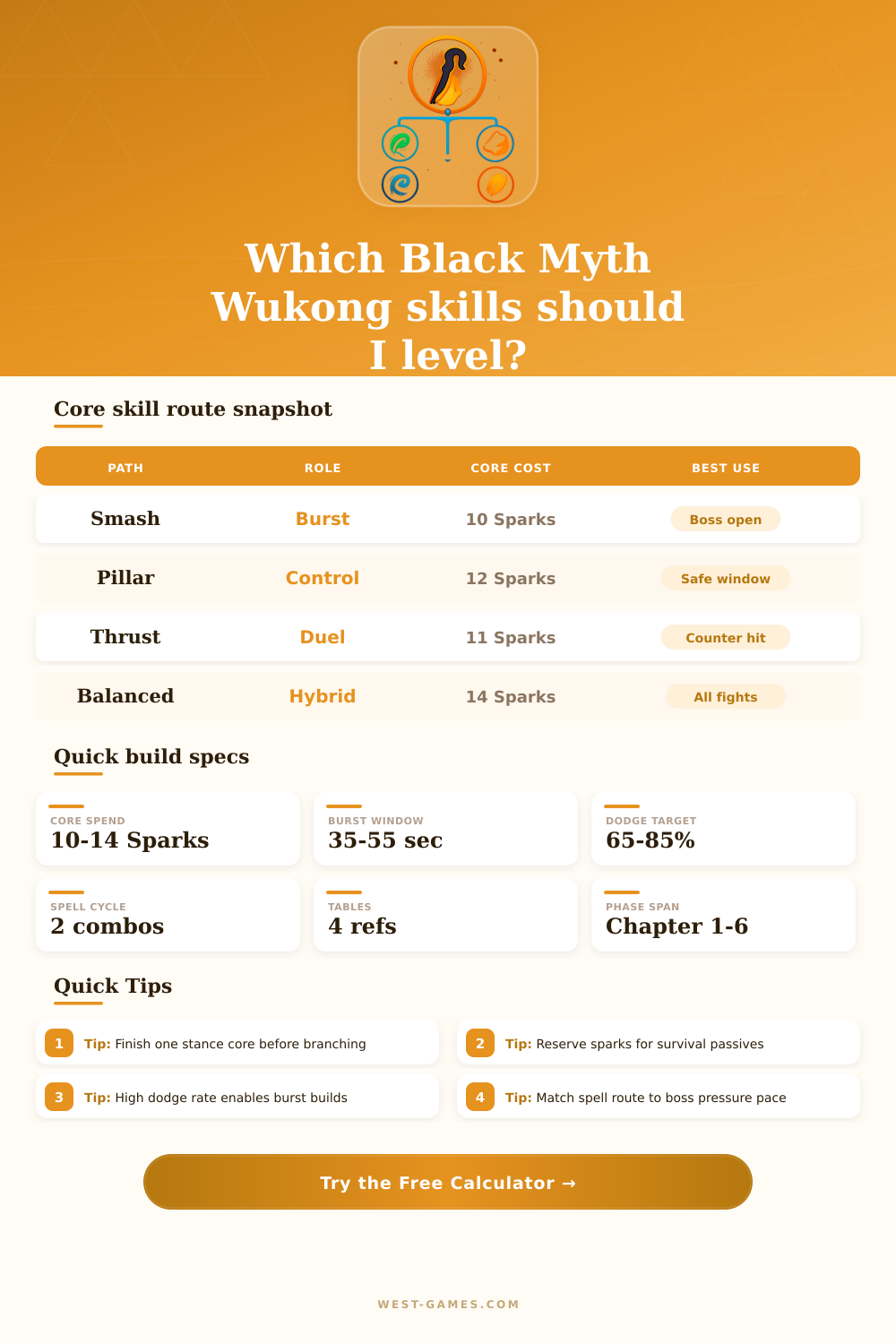
| Stance Path | Core Spark Cost | Burst Weight | Best Boss Use |
|---|---|---|---|
| Smash | 10 Sparks | High | Openers and punish windows |
| Pillar | 12 Sparks | Medium | Control-heavy encounters |
| Thrust | 11 Sparks | High | Duel and counter pressure |
| Balanced | 14 Sparks | Medium-High | Mixed chapters and NG+ |
| Spell Route | Spark Cost | Control Value | Rotation Role |
|---|---|---|---|
| Immobilize | 8 Sparks | Very High | Guaranteed setup windows |
| Ring of Fire | 7 Sparks | Medium | Sustain and tempo stabilization |
| Cloud Step | 9 Sparks | High | Reposition and burst safety |
| Spell Binder | 10 Sparks | Low | Maximum direct damage route |
| Pluck of Many | 11 Sparks | Medium | AOE control and spacing reset |
| Path | Spark Cost | Defense Gain | Burst Gain |
|---|---|---|---|
| Red Tides + Rare Spirit | 10 Sparks | Medium | High |
| Azure Dust + Epic Spirit | 11 Sparks | High | Medium |
| Ebon Flow + Legendary Spirit | 12 Sparks | Medium | Very High |
| Umbral Abyss + Epic Spirit | 13 Sparks | Very High | Medium |
| Scenario | Suggested Sparks | Dodge Goal | Stability Goal |
|---|---|---|---|
| Chapter 1-2 | 20-28 | 60%+ | 55+ |
| Chapter 3-4 | 32-44 | 68%+ | 65+ |
| Chapter 5-6 | 46-62 | 75%+ | 72+ |
| NG+ cycles | 58-85 | 80%+ | 78+ |
The skill tree is a system that allow players to spend Sparks on improving their character’s combat abilities. Players earns Sparks, which they use to unlock different node within the skill tree. Each node within the skill tree provide advantages to the characters’ combat capabilities.
Players must use Sparks to choose the combat style that they will use for there character. There are three main stance within the skill tree. The Smash Stance is used to unleash heavy attacks on the enemy.
Focus Your Sparks on One Stance and Use the Right Spells
However, players must time their use of the Smash stance to be effective with the enemy. The Pillar stance is used to unleash a series of attacks to control the enemy’s combat. This stance is helpful against enemies that is inclined to be aggressive.
The third stance is the Thrust stance, which is used to precisely counter the enemy’s attacks. This stance is mainly used in duels against a single opponent. It is recommended for players to focus their Sparks on one primary stance at a time.
If players spread their Sparks to many stances, they wont have enough Sparks to fully power any one stance to effective handle the numerous attacks from difficult game bosses. There are also three spells within the skill tree. The Immobilize spell will freeze the enemy, giving the player time to use a stance to damage the enemy.
The Ring of Fire spell will provide the player with sustain to fight long fights. Finally, the Cloud Step spell allow the player to reposition the character, which can help avoid damage from other characters during aerial battles. Players must ensure that they have the proper spell selected for the type of boss that they are fighting.
A spell that works against one boss may not work against another boss of a different type. Two additional feature for the player are Transformations and Spirits. Transformations allow players to choose between a character that has high burst damage or high defensive capabilities.
For example, the Red Tides transformation allow high burst damage at the cost of medium defense. In comparison, the Umbral Abyss transformation allows high defense at the cost of a portion of the players maximum health. Spirits provide additional passive scaling for the character, which work in conjunction with the player’s relics to increase their strength in combat.
There are three different combat styles within the game. For a safe combat style, players will have a focus on defense skills to increase the character’s survivability. However, this style will result in lower burst damage.
For a glass cannon play style, players will focus on dealing the maximum amount of damage to enemies. However, this play style is risky as the player can easily make a mistake that will cost their character’s life. Lastly, players can focus on mobility to avoid getting cornered by there opponent.
Many players will make the mistake of using their Sparks too thinly across the skill tree. By thinning out their Sparks too much, players will find that their combat rotation will not be developed proper, and they will find that their character will fail against game bosses with high attack rates. Players should of focus their Sparks on mastering one stance before they begin to invest in other area of their skill tree.
Additionally, they should still save some Sparks for survival passives, which will allow them to survive in cases where they fail to dodge an attack from their enemies. Each boss has a specific profile that require a specific focus from the player’s skill tree. For example, duelist bosses require the player to use the Thrust stance.
Additionally, bosses that require players to be aggressive with their opponents will require the use of the Pillar stance. For bosses that last longer than others, the player will require the use of the Ring of Fire spell or a transformation that offer sustain during long battles. In New Game Plus, the games requirements of players are higher so that players will have to maintain higher dodge and stability rates in order to survive the tougher game bosses.
The player can manage the skill tree by focusing the player’s Sparks on their character’s combat rhythm. Players should finish their stances before focusing on other areas of their skill tree. Additionally, players should ensure that their spells match the type of combat that they will have with the bosses.
Other pres settings can be tested to see what works best for the player. These can then be fine-tuned as the player continues forward through the game. By focusing players’ attention on one aspect of the skill tree at a time, players will find it easier to overcome the challenges of the bosses.