🧟 7 Days to Die Skill Tree Calculator
Plan attribute gates, perk ranks, mastery timing, and role balance before spending hard-earned skill points.
| Rank band | Cost each | Gate use | Plan note |
|---|---|---|---|
| Rank 1 | Free | Starter access | Default character rank |
| Ranks 2-5 | 1 point | Early perks | Best value for hybrids |
| Ranks 6-8 | 2 points | Mid perks | Commit to a main tree |
| Ranks 9-10 | 3 points | Deep perks | Save for focused builds |
Servers and mods can change costs. Use this as the default planning baseline.
| Tree | Common focus | Weapon lane | Build fit |
|---|---|---|---|
| Perception | Looting, rifles | Rifles, spears | Scout, sniper |
| Strength | Mining, base work | Clubs, shotguns | Builder, bruiser |
| Fortitude | Health, farming | Fists, machine guns | Tank, farmer |
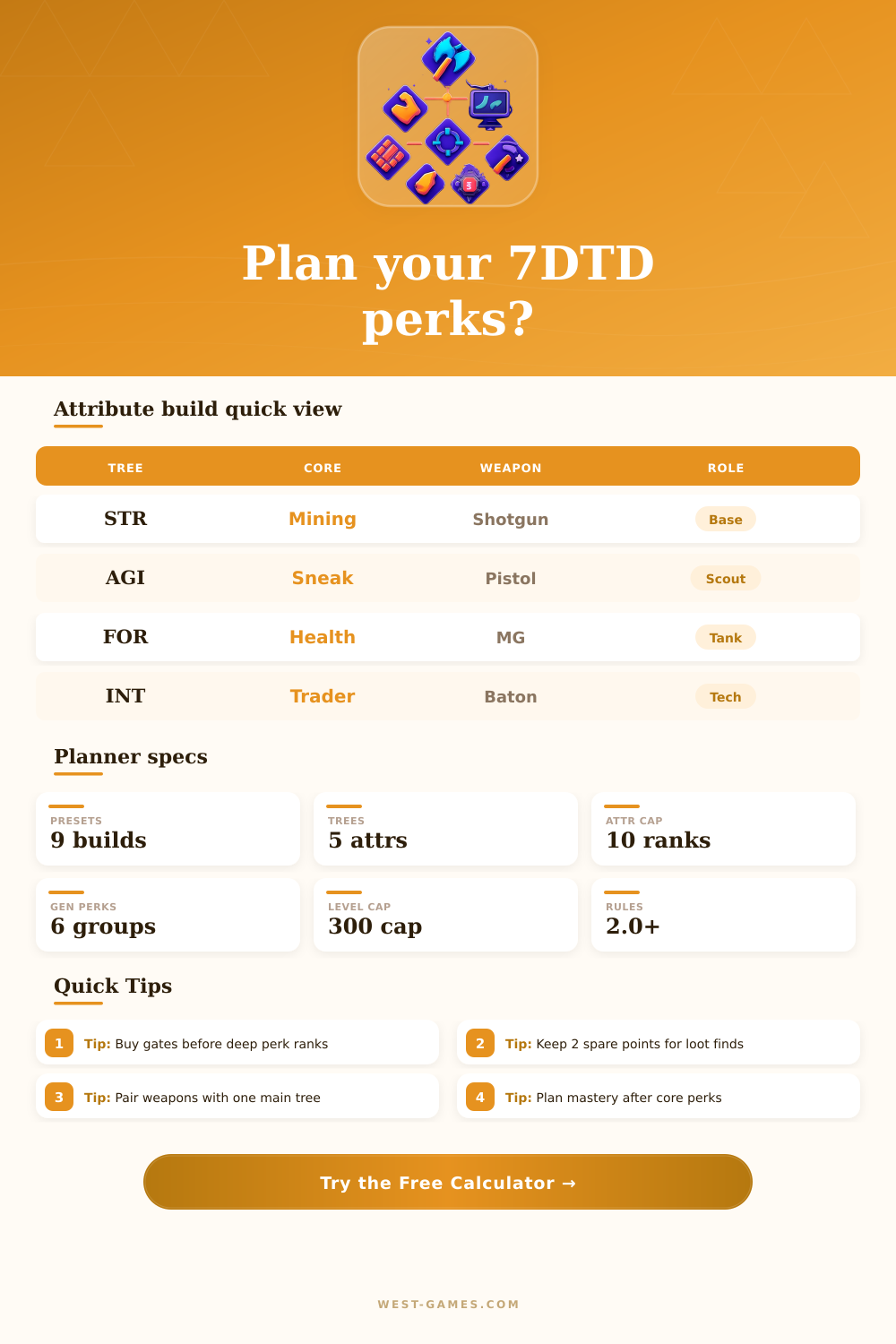
| Agility | Stealth, mobility | Bows, pistols | Scout, assassin |
| Intellect | Trading, crafting | Batons, turrets | Tech, support |
The calculator scores role fit by matching your chosen role to these lanes.
| General area | Why it matters | Early ranks | Late ranks |
|---|---|---|---|
| Mining | Base materials | High | High |
| Cooking | Food stability | Medium | Medium |
| Lucky looting | Gear progress | Medium | High |
| Vehicles | Travel speed | Low | High |
| Armor | Damage control | Medium | High |
General perks help every build, but rushing too many can delay weapon power.
| Stage | Target level | Point focus | Risk check |
|---|---|---|---|
| Day 1-7 | 10-20 | Weapon 2-3, utility | Ammo and stamina |
| Day 8-14 | 20-35 | Main attr 5-6 | Armor and healing |
| Day 15-28 | 35-60 | Core perks 4-5 | Horde DPS |
| Day 29+ | 60+ | Mastery, hybrids | Special infected |
Use the levels remaining card to decide if the plan fits your next blood moon.
In the early stages of a new 7 Days to Die game, each skill points is important because each skill point will determine what the player can do within the game. At the beginning of the game, the player must choose between invest their skill points into weapon perks (which offer immediate benefits) or investing their skill points into attribute ranks (which offer long-term benefits). This decision has to be made repeatedly throughout the game, but the type of choice that players must make change as the game develops.
More specifically, there is a series of “gates” within the skill tree that will determine the type of survivor that each player can become. In order to understand how to beat the game, it is necessary to understand the actual cost of each skill tree gate. Each of the early attribute ranks is relatively inexpensive, which can tempt the player, but these early ranks will define what long-term perks each player is able to gain that scale with that player’s main attribute.
How to Plan Skill Points in 7 Days to Die
Additionally, if a player does not decide on a specific way to spread their skill points early in the game, that player will likely develop a delay in reaching their desired weapon that can be relied upon throughout the game. If a player chooses to ignore the secondary attributes of the player, they may face difficulty caused by the blood moon or specific biomes within the game. However, the calculator that is provided can help a player calculate exactly how many skill point are needed to reach the next rank in the game, removing the guesswork that goes into calculating that value.
A persons chosen role within the game is another that determines the skill point plan that they utilize. For example, a player that chooses the role of stealth scout will have more skill points invest into agility and silent weapons skills. In contrast, a miner builder will have more skill points invested into strength-based skill gates.
Though each of these two roles may have a similar amount of days required to reach the same level within the game, the skill point spreads that each role requires are different. Another factor that will influence a player’s skill point allocation is there team size. Teams of large sizes allow for each player to specialize in specific roles within the game, as others on that team can complete specific tasks.
However, if a player becomes separated from their team, such specialization becomes an issue. Therefore, both the team size and the server pressure inputs is included within the calculator to indicate how many skill points each player should allocate to their attributes. Timing is another of the most common reasons for which player’s plans fail.
Many players will invest their skill points too early into the attempt to gain mastery ranks, which makes surviving the subsequent blood moon more difficultly. The readiness score can be used to determine if a player’s character is ready for the next blood moon or if they need to continue investing into their survival skills. Though not a guarantee that the player will survive the blood moon, the readiness score will indicate whether or not the player’s plan will be effective when the enemy begin to appear in the game.
A low readiness score indicates that the player should abandon their attempt to reach the next mastery rank, and begin focusing upon the basic perk for their character. The pace at which the player’s loot and experience points advance will also have an impact on how they use their skill points. On fast progression servers, players will reach attribute ten more quickly, meaning that deep perks for their weapons will be purchased sooner.
On slow progression servers, more balance is provided to the general utility skills for players, ensuring that they are effective even if the player does not have as many skill point ranks within their skill tree. The pace setting within the game will allow a player to adjust their plan according to the skill point level required to reach their target level within the game. Common mistakes within the game 7 Days to Die involve the same errors.
For example, many players place too much value on the early skill tree gates due to the low cost of each of these skills, but often do not have enough skill points to continue after rank six and beyond the player’s main attribute. Additionally, many players feel the need to purchase every general weapon perk, which prevents the player from performing other tasks required of the player to complete quests. Though the calculator will not prevent these mistakes, it will help to show the total cost of each of these choice before any skill points are spent within the game.
The reference tables included within the game will provide additional context to players that elect not to run the full skill point plan within the game. These reference tables will show which attributes cost how much skill point, what type of weapon can be found within which attribute trees, which general perks are helpful during the early game, and which general perks are helpful during the late game within the game. Though the reference tables do not have to be memorized, reviewing the role map prior to choosing their main attribute will ensure that players do not choose a weapon that belongs to another attribute than their main attribute.
Though ambition may be appealing to players when selecting their character and their skills, the best use of skill points is for demonstrating patience in the selection of skills. The best builds for players on day sixty of the game were likely not the builds that attempted to take each perk on day ten. The strongest builds are for players that have selected their role at the beginning of the game, committed to their chosen role, and learned how to utilize the loot that was killed in their journey within the game.
Thus, the calculator ensures that each of these decisions are made prior to any skill points being spend within the game.