🛡 Resource Calculator Travian
Estimate Travian wood, clay, iron, and crop production from fields, oasis bonus, hero bonus, crop upkeep, storage limits, NPC trade, and the time needed for a building or troop target.
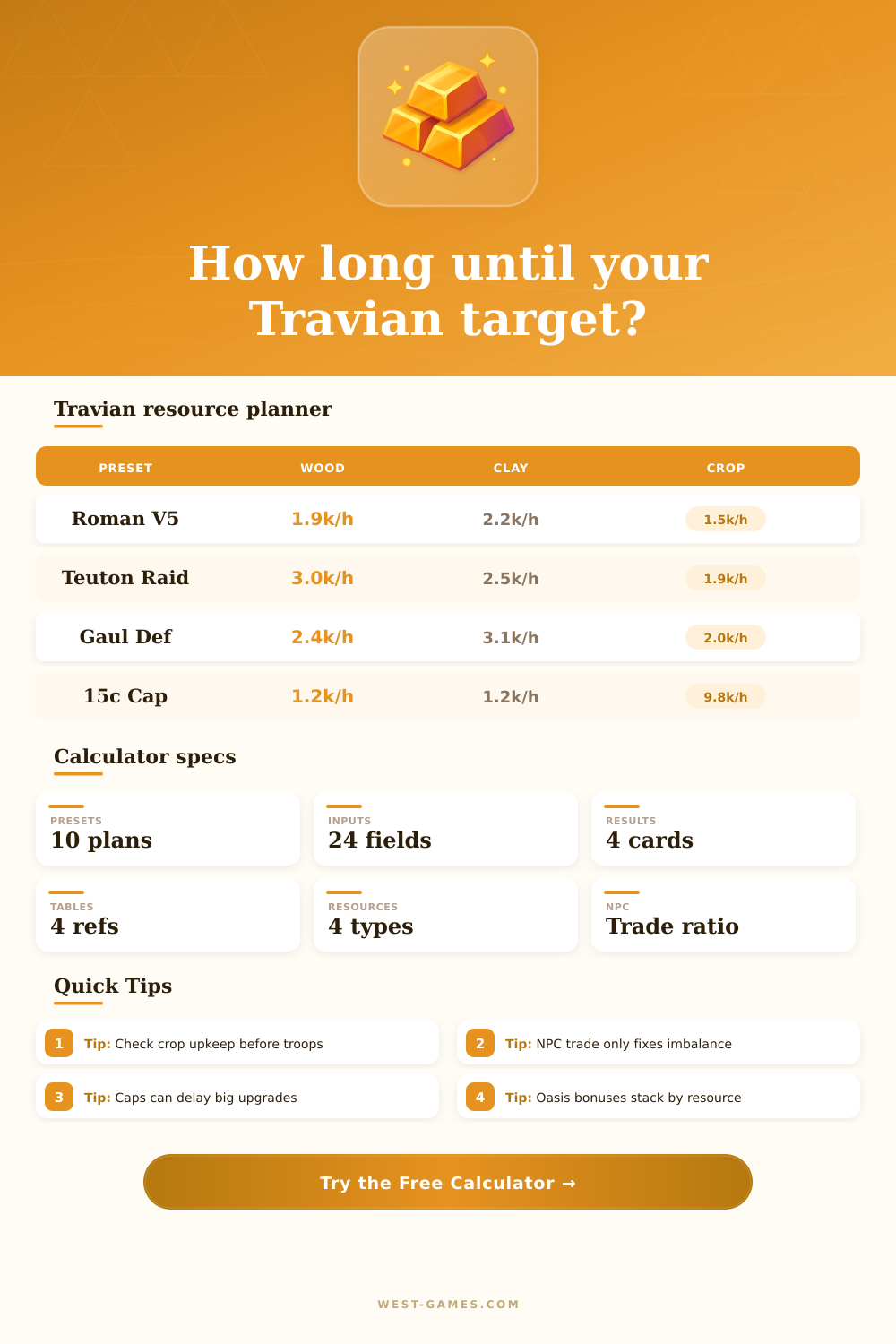
| Preset | Village role | Main pressure | Planning use |
|---|---|---|---|
| Roman Village Level 5 | Balanced start | Clay and wood | Early building queue |
| Teuton Raider Queue | Offense feeder | Wood and crop | Club and scout batches |
| Gaul Defense Pump | Defense village | Clay and iron | Phalanx and infrastructure |
| 15-Cropper Capital | Crop capital | Granary and crop | Capital fields and troop upkeep |
| Settler Push | Expansion | All resources | Settlers plus residence slot |
Preset requirements are editable baselines. Travian servers and versions can differ, so copy exact costs from your village screen when timing matters.
| Level | Base per hour | 3x server | With 25% boost |
|---|---|---|---|
| 5 | 135 | 405 | 506 |
| 8 | 495 | 1485 | 1856 |
| 10 | 1200 | 3600 | 4500 |
| 12 | 2800 | 8400 | 10500 |
| 15 | 7500 | 22500 | 28125 |
The calculator interpolates between level anchors so uneven average field levels still produce a smooth estimate.
| Bonus source | Applies to | Typical value | Formula effect |
|---|---|---|---|
| Single oasis | One resource | 25% or 50% | Adds to that resource |
| Double crop oasis | Crop | 50% | Before upkeep subtraction |
| Hero production | Selected output | 5% to 30% | Global multiplier here |
| Resource building | Matching resource | 5% to 25% | Modeled as average bonus |
| Plus bonus | All resources | 0% or 25% | Stacks with production |
| Check | Good sign | Warning sign | Fix |
|---|---|---|---|
| Warehouse cap | Need fits cap | Wood, clay, or iron exceeds cap | Upgrade warehouse |
| Granary cap | Crop need fits | Crop exceeds granary | Upgrade granary |
| NPC trade | Total stock can balance | Total resources still short | Wait or raid more |
| Crop upkeep | Positive net crop | Negative net crop | Raise crop or reduce troops |
| Target timer | Starts after resources ready | Long queue blocks next plan | Plan overlap |
| Target type | Wood | Clay | Iron | Crop | Planner note |
|---|---|---|---|---|---|
| Resource fields | Medium | Medium | Medium | Low | Usually pays back through hourly output. |
| Residence or palace | High | Very high | Medium | Medium | Storage capacity often gates expansion levels. |
| Barracks troop batch | High | Varies | Varies | High | Crop upkeep matters after the batch finishes. |
| Stable cavalry batch | Medium | Medium | Very high | High | Iron bottlenecks become more common. |
| Celebration or party | Medium | Medium | Medium | High | Crop and granary planning are important. |
With wood all-but-full and troops queued up, you feel confident starting to upgrade your Residence. You fire off a message to your alliance chat letting them know it’s go-time for the next phase. Then you reload the page five minutes later and discover that, once more, youre waiting on clay. Nothing starts until you get there. We’ve all been there at least once in our initial week of serious play.
The difference between stagnant player and the ascending player isn’t often determined by how frequently they raid or what kind of raw attack power they can throws around. It’s almost always determined by how well they manage the slow process of gathering resources compared to how fast they spends them.
How to Plan Your Resources and Time
People get it wrong when it comes to how much production you should of have. Most players think production is fixed. They assume it is just what you see on village screen, which lists an hourly output. That’s not true! You don’t always produce at that level: production changes depending on various factors including server speed multipliers, hero bonuses, field levels, etc. The calculator takes all of those and combines them together into a net hourly figure. This accounts for facts like your crop oasis not saving you if you are overextending your troops and starving anyway, or your sawmill bonus doing nothing for your clay pits.
So take a moment to reflect on your buildings’ purpose when laying out your field. Early on, wood and clay will tend to be the bottleneck for infrastructure since they’re much harder to upgrade different than iron. Once you begin training heavy infantry or cavalry, iron will become the pressure point. Crop is the wildcard that feeds into everything else. If you have insufficient output of crop to keep up with your population upkeep, you’re basically paying rent to the game engine to even exist.
One of the most common mistakes made by aggressive raiders is to neglect their croplands until they reach a storage cap; you can’t hoard what you don’t produce efficient enough to fit into the granary before spilling over and burning. Fewer people realize that one of the factors that determine your approach is storage space. If your warehouse is level ten, you have a hard ceiling on how much wood and clay you can hold. Whenever your production speed outpaces your storage room, you’re losing resources every couple of hours for no reason other than having nowhere to stash ‘em. That silent tax chews up your gains with nothing to show for it except an empty spot on the floor.
Luckily, the thing on screen also automatically checks this constraint for you. It measures your existing inventory vs. Your warehouse cap so you never plan to upgrade something beyond what you’ll be able to store. Knowing how far in advance to line up a warehouse upgrade is a subtle trick learned by veterans versus casual players.
Finally, adding NPC trading makes things more complex, and most newcomers treat it like magic, which levels out the difficulty. You’re still paying a premium to turn excess resources into what you lack (meaning you lose some total resources in the process), and it’s not free; using trade judiciously is good (to fill in a tiny gap) but bad (as a way to bankroll your whole build queue). Is your overall resource pile big enough to pay for what you want once you account for the inefficiency of the trade? That’s why the calculator lets you adjust the trade ratio to reflect how much you have left, so it shows you the actual time-to-target (not some theoretical best case).
That means planning ahead, too, as upgrades don’t normally pay for themselves all at once (though they usually boost output enough that the next-tier upgrade is within reach eventually). Your buildings’ production goes up, too. If it takes three days to get enough clay for an upgrade, and then you wait three more days before moving onto the next, you’re going to be a couple steps behind everyone else in your village. You can avoid this by keeping your idle time around zero.
This means training troops when you have no other work to do. To do this, you must overlap your queue by knowing exactly how long things take on your server. For example, a ten-hour timer is very different depending on whether you play on a standard or ten-speed rush server. You also need to have some idea of how much real-world time that represents.
But at its heart, Travian isn’t about being able to click faster; it’s about understanding the value of time, not by mere seconds but in terms of minutes. What you spend now is an hour of future production denied until you earn it back. And it all comes down to numbers: running those numbers against your own village stats with this planner removes a lot of guesswork from the equation, so you stop scrambling to respond to shortages and start anticipating them. Knowing exactly when your next batch will be ready helps you plan your raids accordingly, not having them control your whole afternoon. That change of mindset goes from playing a game of waiting to a game of strategy.