🎯 Overwatch MMR Calculator
Estimate role queue MMR, visible rank alignment, calibration uncertainty, streak pressure, group modifier, match quality, and expected next-match movement.
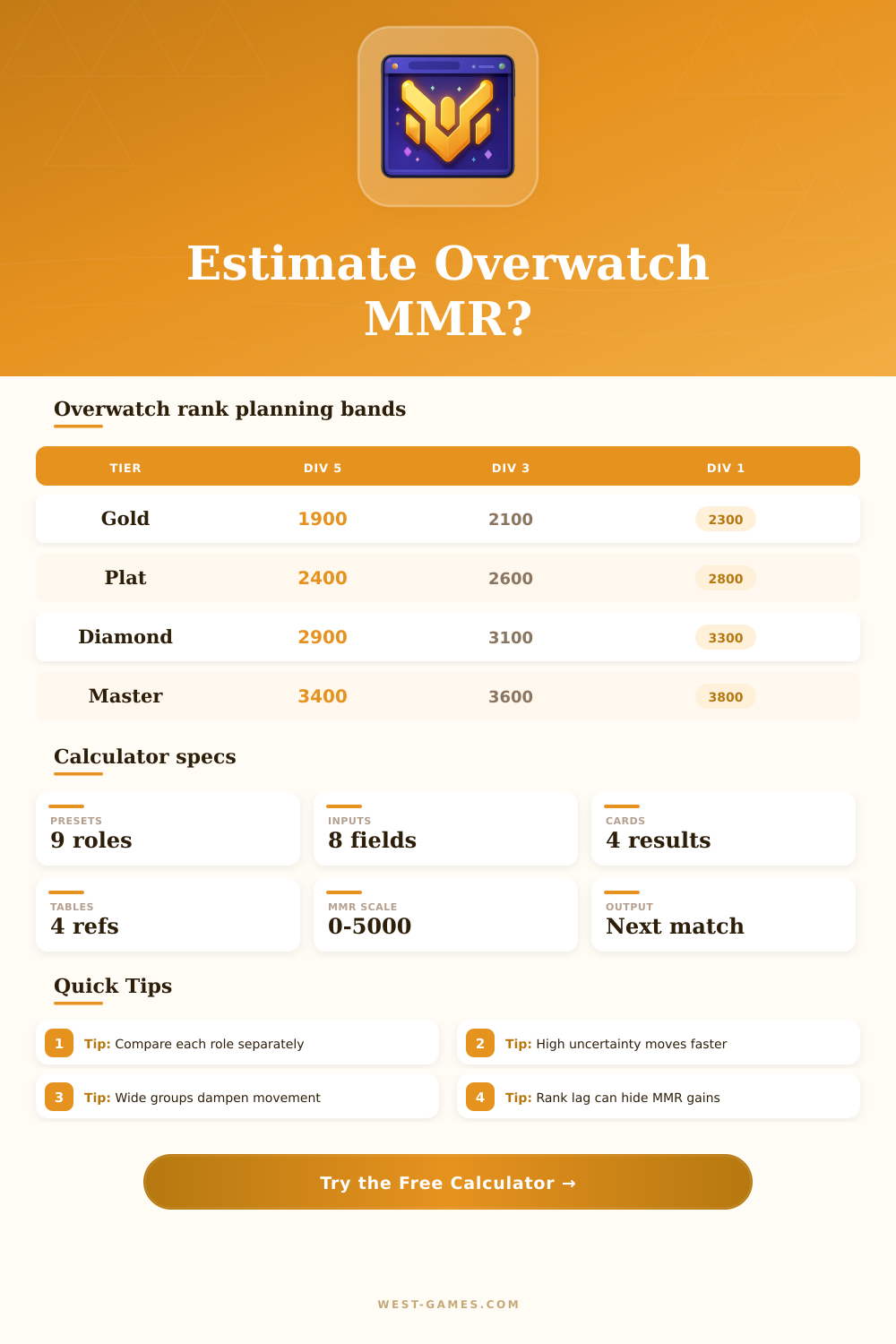
| Tier | Division 5 | Division 3 | Division 1 | Planning note |
|---|---|---|---|---|
| Bronze | 900 | 1100 | 1300 | Wide beginner spread |
| Silver | 1400 | 1600 | 1800 | Basic consistency check |
| Gold | 1900 | 2100 | 2300 | Common middle ladder |
| Platinum | 2400 | 2600 | 2800 | Role fundamentals tested |
| Diamond | 2900 | 3100 | 3300 | Small mistakes punished |
| Master | 3400 | 3600 | 3800 | Queue quality matters |
| Grandmaster | 3900 | 4100 | 4300 | High-rank precision |
| Champion | 4400 | 4600 | 4800 | Elite visible tier |
The table is an estimator scale for calculator output, not an official MMR conversion table.
| State | Move factor | MMR band | Use case |
|---|---|---|---|
| Settled | 0.80x | +/- 70 | Many games played |
| Normal | 1.00x | +/- 110 | Stable sample |
| Recalibrating | 1.30x | +/- 170 | Season reset or role return |
| Fresh role | 1.65x | +/- 240 | Placement-style volatility |
Higher uncertainty creates a wider hidden MMR band and larger projected movement.
| Recent signal | MMR nudge | Move effect | Meaning |
|---|---|---|---|
| 8-2 last ten | +90 | Boosted gain | Hot role sample |
| 6-4 last ten | +35 | Slight gain | Positive trend |
| 5-5 last ten | 0 | Neutral | Expected result |
| 4-6 last ten | -35 | Slight drag | Negative trend |
| 2-8 last ten | -90 | Loss pressure | MMR slide risk |
The streak input adds a separate short-term modifier so a 5-5 run with a current streak still changes the projection.
| Modifier | Gain | Loss | Interpretation |
|---|---|---|---|
| Solo queue | 1.00x | 1.00x | Cleanest signal |
| Narrow duo | 0.96x | 0.98x | Small group dampening |
| Narrow stack | 0.92x | 0.95x | Team context matters |
| Wide group | 0.78x | 0.88x | Noisier evaluation |
| Uphill win | 1.18x | 0.94x | Tougher lobby reward |
Match quality is modeled as a transparency-style modifier, separating this tool from a simple Elo calculator.
This season you’ve played twenty games, and you’re pretty certain your aim has improved from last month. You feel like you’re positioned cleaner, yet your public ranking remain firmly stuck at Gold 4. Despite perceived progress, you can’t seem to claw out of Gold and into Platinum. It’s an impatience lurking just behind the curtain of unspoken Matchmaking Rating (MMR), a construct intended to both calibrate your skill and guard against cheating.
All too frequently, however, it resembles form of punishment for patience, pitting you against a system that doesn’t give a hoot about your recent history so long as it has sufficient statistical confidence in your actualy skill level.
How Your Hidden Skill Score Works
To do this, we’ve created a calculator (above) that does all the math for you. It stops the guesswork by telling you exactly how far above or below your visible division your hidden rating likely falls. Because there’s an element of not knowing at the heart of this system, it’s important to just look at the immediate impact of winning/losing but understand how those numbers move.
For example, let’s say you change roles or begin a new season. The system doesn’t know much about you yet. It will cause big changes to your profile, which basically means each match are weighted heavily. You’re going to get more points then normal from a win; it’s being aggressive with its attempts to place you. Over time, as you continue to play, that uncertainty narrows and things level out… Wins and losses settle into a groove. The first 10 games of a season can feel like climbing and those final 10 games feels like a grind, because you’re trading volatility for precision.
Most players fail to take into account role queue. This complicates things because it treats the whole account as though it’s one skill bracket. Your Tank rating have no mathematical relationship whatsoever to your Support rating, nor does being Diamond on one mean you can’t be Platinum on the other. That’s because they’re measuring two different thing. Tanking is measured on space denial and tempo control; support is measured on uptime and survival. It makes sense for the tool to treat those as separate contexts.
The reference table on the page shows how center of each MMR band shifts with tier. You can use that to see that Gold 1 isn’t just “better” than Platinum 5 in an absolute sense; instead, they represent different levels of expected performance. If you’re underranked and your hidden rating is at or near top of Gold while your visible rank is still lower, the system will reward you more generously until your internal score matches up with what visual badge says.
The psychological pressure of streaks twists our perception of movement in ways that tend to distort interpretation. Five consecutive victories feel momentous; the algorithm view it as a correction. If you’ve been winning steadily, each win increases your hidden rating faster than your public ranking can keep up. This means a later defeat will sting harder because the system already expects you to play at peak levels. Likewise, a slump reduces the rate at which your predicted ability decrease… And lowers the bar required for future success. It’s a self-correction loop: consistency earns reward; inconsistency incurs punishment.
Teaming up with buddies shifts everything. You should of seen that coming.