🎮 Anime Vanguards Pity Calculator
Plan Anime Vanguards summons from banner type, target rarity, current pity, gems, event currency, tickets, VIP discount, multi-summons, luck boosts, and target odds.
| Rarity | Default rate | Luck boost | Calculator use |
|---|---|---|---|
| Rare | 75.496% | No target model | Reference only |
| Epic | 20% | No target model | Reference only |
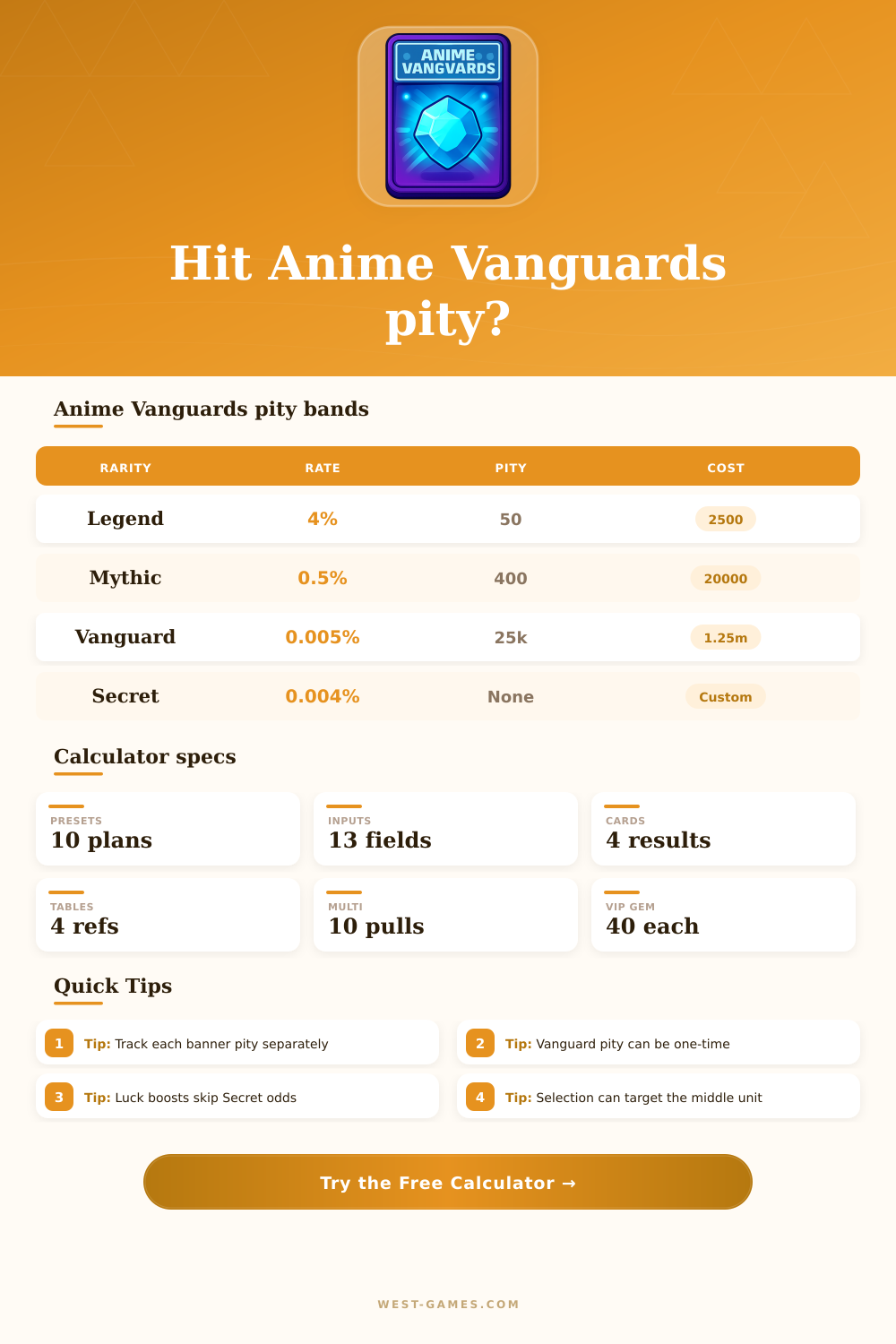
| Legendary | 4% | Boostable | 50 pity default |
| Mythic / Exclusive | 0.5% | Boostable | 400 pity default |
| Vanguard memoria | 0.075% | Not boosted | Large one-time pity |
| Vanguard unit | 0.005% | Not boosted | Large one-time pity |
| Secret unit | 0.004% | Not boosted | No pity default |
Luck boosts are modeled only where they are described as affecting Legendary or Mythic style units.
| Banner | Legendary | Mythic | Vanguard |
|---|---|---|---|
| Special / Selection | 50 summons | 400 summons | 25,000 unit |
| Special Memoria | 50 summons | 400 summons | 20,000 memoria |
| Event unit | 50 summons | 400 summons | 20,000 unit |
| Event memoria | 50 summons | 400 summons | 15,000 memoria |
Legendary and Mythic pity normally resets after that rarity appears; Vanguard pity is treated as one-time when selected.
| Resource | Per summon | VIP option | Used by |
|---|---|---|---|
| Gems | 50 | 40 with VIP | Special and Selection |
| Event currency | 150 | No VIP discount | Event banners |
| Tickets | 1 ticket | Same value | Any matching banner |
| Multi-summon | User entered | Usually 10 | Batch planning |
The calculator floors currency into whole summons, then adds tickets as direct pulls.
| Target plan | Input share | Best preset | Watch result |
|---|---|---|---|
| Middle Mythic | 50% | Special Middle | Expected pulls |
| Side Mythic | 20% | Special Side | Resource gap |
| Chosen Selection | 100% | Selection Chosen | Chance to target |
| Secret hunt | 100% | Secret Unit | Secret odds |
| Shared pool | Custom | Custom banner | Target share |
If you only care about any unit of a rarity, set the target share to 100%.
Whether it’s saving to buy that next unit or burning some cash trying to hit a Mythic drop, that nagging question of “to save or spend?” is something we’re all familiar with. When pool sharing and pity systems mix into that, answer isn’t always clear. Unless you have an account where everything is locked in, most people will keep fishing aimlessy until they land what they want or their funds are depleted. Accounts gets thrown off balance before they ever settle.
That doesn’t mean that planning take away the element of chance; rather, it enables you to calculate the odds to avoid taking a blind risk. To start, understand that pity isn’t just a safety net; it’s the baseline for your budgeting. If you open up the calculator (above), you’ll see that it break out types of banners very rigidly. A lot of times, Selection & Special banners actualy share a pity count. Every pull you make on one counts toward the guarantee on the other.
How to Use the Gacha Calculator Wisely
What’s important to know is that a lot of people think they’re two distinct thing and overestimate their distance from the guarantee. If you’ve been pulling at both, combined total applies rather than each banner individually. The calculator recognize this shared status, so you won’t waste resources chasing something you’ve already hit. The tool accounts for this shared state so you don’t double count your progress or waste resources chasing a guarantee you already triggered.
And then there’s the issue of target specificity. Pulling a Mythic isn’t the same as pulling the particular Mythic in the center slot. If you’re trying to fill out a set, it matters if you’re looking for a specific Mythic unit or just any rare item at all. The twenty percent target share reflect the fact that your pull could be anything, not just what is in the center slot. Fifty percent target share implies you only want the main prize. In some cases, this change the expectation of how many pulls are necessary, potentially by a significant amount. This is the difference between being certain you’ll recieve a premium item versus being certain you’ll receive the right item.
And then there’s the issue of managing currencies. Gems are simple, as is event currency provided they don’t expire with the banner. Tickets take some thought, though, as you’ll need to account for them alongside your gems and any VIP discounts. The calculator also lets you input both gems and tickets, along with any VIP discounts that lower cost per summon.
Here’s where most plans start to unravel. Because a 10-pull isn’t just ten separate pulls when it comes to probability structure, compounding the odds means that your chances won’t increase at the same rate. The model takes care of those transformations so you can determine whether or not you have enough resources for anything more than a slim chance of success.
Units from vanguards also pose an interesting problem. Because of their different pity mechanics (or lack thereof) compared to other rarities, they needs to be considered separately. There are some who grant pity only once (you reach the threshold, the bonus gets used up). Then there are others that don’t provide any pity at all, and your chances is purely based off low base rates. These include secret units as well, which will take an enormous number of pull just to stand a chance.
The difference between those unit is spelled out plainly in the reference tables provided with the tool… Which ones get pity and which ones do not. Not paying attention here might cost you time/money on banners where the odds will never work in your favor.
Complicating this matter even more, luck bonuses change some rarity odds and not others. For instance, it may increase your chance of pulling a Mythic twice over, but leave a Vanguard unscathed. This will tell you if you should of held off on that next pull, or take the plunge. Once you choose your boost status, multiplier is accounted for automatically in the calculator, giving you a better idea of where you stand. It’s a slight tweak to the input, but makes a world of difference when you’re near one of the pity thresholds.
To conclude. This tool is about setting realistic expectations. It won’t predict exactly what happens, it’ll give you a statistical range and help determine whether or not a pull plan is viable. Often times, if the probability is too low and the resource gap is too large, it’s best to save up for a banner with a more favorable pity structure or wait for one with better odds altogether.
Understanding your chances is half the battle. That’s why gaming is about making informed choices. Next time you’re tempted to drop all of your gems in an impulse, run the numbers first. You just might find out that waiting pays off better than hoping ever could.