🛡 Armor Penetration Damage Calculator
Model base damage against armor with flat penetration, percent penetration, armor reductions, mitigation curve choices, resistance caps, effective damage, DPS, and hits to defeat.
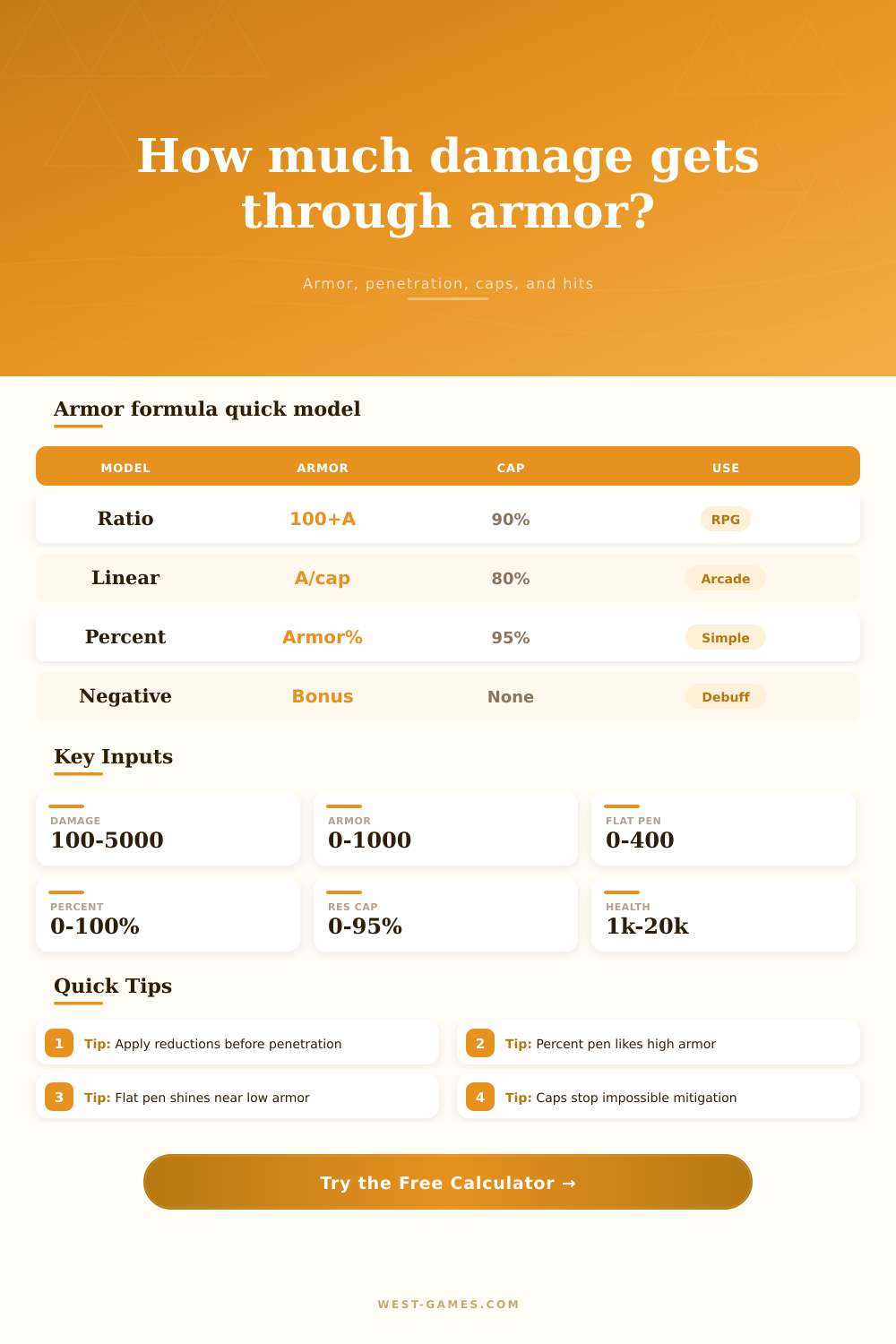
| Model | Damage multiplier | How penetration is applied | Good fit | Limit to remember |
|---|---|---|---|---|
| Ratio curve | constant / (constant + armor) | Reduce final armor before calculating the curve. | RPG and MOBA-style armor where each armor point adds effective health. | Very high armor has diminishing returns on damage reduction. |
| Linear cap | 1 - min(cap, armor / full-cap armor) | Penetration lowers armor before the linear percent is found. | Arcade, shooter, and simplified action damage models. | Must use a cap, or armor can reach impossible 100% reduction. |
| Sheet percent | 1 - listed armor percent | Armor input is treated as mitigation percent, with pen reducing it. | Games that show damage reduction directly on the character sheet. | Flat pen becomes percentage points in this simplified model. |
| Custom scale | scale / (scale + armor) | Same order as ratio curve, with your own scale constant. | Homebrew systems or games with known armor constants. | Choose a scale matching the game or patch you are modeling. |
| Order | Layer | Who benefits | Calculator treatment | Practical read |
|---|---|---|---|---|
| 1 | Percent armor reduction | Usually all attackers | Multiplies base and bonus armor by the remaining percent. | Team shred is strongest before individual penetration. |
| 2 | Flat armor reduction | Usually all attackers | Subtracts armor before penetration and can create negative armor if enabled. | Good when the target is already in a modest armor range. |
| 3 | Percent total penetration | This attacker | Ignores a percent of remaining positive total armor. | Best against high armor and frontline targets. |
| 4 | Percent bonus penetration | This attacker | Ignores a percent of remaining armor above base armor. | Good when armor mostly comes from gear, buffs, or shields. |
| 5 | Flat penetration | This attacker | Subtracts from armor after percent penetration layers. | Efficient when it pushes final armor close to zero. |
| Final armor | Ratio constant 100 | Linear cap 80% at 500 | Damage on 1000 base | What it means |
|---|---|---|---|---|
| -50 armor | 150.0% if negative enabled | 110.0% if negative enabled | 1100 to 1500 | Some games reward debuffs below zero with bonus damage. |
| 0 armor | 100.0% | 100.0% | 1000 | No armor mitigation remains. |
| 50 armor | 66.7% | 90.0% | 667 to 900 | Flat penetration has visible impact here. |
| 100 armor | 50.0% | 80.0% | 500 to 800 | Ratio curves are harsher at low constants. |
| 300 armor | 25.0% | 40.0% | 250 to 400 | Percent penetration usually beats more flat penetration. |
| 800 armor | 11.1% | 20.0% at cap | 111 to 200 | Caps prevent armor from reducing damage to zero. |
| Preset | Main question | Best metric | Watch this input | Useful comparison |
|---|---|---|---|---|
| Assassin Flat Pen | Can flat pen punch through a soft target? | Final armor near zero | Flat penetration | No modifiers vs full setup. |
| Percent Pen vs Tank | Does percent pen beat flat pen? | Damage gain on high armor | Percent total penetration | Percent pen row vs full setup. |
| Team Armor Shred | How much does shared shred add? | Reduction-only damage | Percent reduction | Reduction row before personal pen. |
| Boss Cap Check | Is mitigation capped? | Mitigation cap row | Resistance cap | Final damage with cap enabled. |
| Raid Burst Window | Will a timed burst defeat the target? | DPS and time to defeat | Hits per attack | Hits to defeat vs attack rate. |
A huge boss monster stands in your way. A red mountain range of a health bar stretches across the screen. Then you swing your sword, but the damage numbers makes it look like you’re just tapping it with a wet noodle.
If this sounds familiar, it’s because it should: It’s a common source of frustration for any player of a tactical shooter or role-playing game. How armor penetration works with armor often determine victory or defeat. Most players concentrate on boosting their raw damage output without paying attention to the invisible math that tells them how much of that might land.
Understanding Armor and Penetration
The thing most folks gets wrong? If the mitigation curve consumes it first, all that raw power doesn’t amount to much at all.
Each game has its own math when calculating defense. Some games have diminishing returns: as you add armor, you get less and less return on investment, meaning the first hundred points of armor matter far more then the next hundred. Other games has linear reductions with a hard cap.
The calculator up top takes into account this wide range of math models and lets you know what’s going on in yours so you can see just how it impact your result. Knowing the curve can alter how you approach optimizing your builds or characters.
Flat pen might seem great against a target who has tons of armor because at first it’ll take off big chunks…but then it hits a wall and suddenly there’s no way to subtract any more because their armor is already too high! Then we have percent penetration which increases based off the target’s defense. In other words, if enemy has strong armor then the higher your % will be. This little detail determines what kind of equipment isn’t being wasted and what kind is.
But it’s not just about value; the order also have a significant impact. In most games, reductions go before penetration. This means any team-wide armor shred debuff will be very valuable because it reduces base amount that your own personal penetration ignores.
Apply 50% penetration against an enemy with 1000 armor? You’re ignoring half of their armor. Now apply a teammate’s 20% shredder on them beforehand and you’re ignoring 400 against 800 instead. It sounds silly, but because each layer multiplies with the others, using coordinated debuffs usually removes more armor than just stacking up separate penetration stats. Put it into a calculator and test out sequence for yourself.
Endgame content is another area where caps are important. A lot of games have a max mitigation percent so no one gets too tanky and impossible to kill. At that point any more armor are wasted. However if you can drop their effective armor below that cap then it makes your damage count again. That’s when the resistance cap comes into effect. It shows you the ceiling on what you can reduce someone to and whether or not it might of make sense to invest in more pen at the expense of something else.
Similarly, it will model the number of hits required to kill the target, which is something else you ought to think about. Having a super-high damage one-shot sounds great, but if it’s going to take a long time for you to get that off, it might not actualy outperform a more moddern multi-hit attack whose duration adds up to less total time to kill. That can prove particularly valuable when seconds makes the difference between life and death in PvP trades or raid windows. It shifts the conversation from theoretical math to real-time planning.
In the end though, it’s all about efficiency. It doesn’t matter how much damage rolls across your screen, you’re only worried about how much of that damage gets through armor. With some practice in your chosen game’s mechanics, you’ll be able to adjust your inputs accordingly and begin optimizing rather than guessing. A couple percent of correct mitigation can make the difference between clean kills and stalled fights.