🛡 PoE Effective Hit Pool Calculator
Estimate Path of Exile effective hit pool from life, energy shield, armour, evasion, block, spell block, resistances, incoming damage split, guard skill absorption, and one-shot max-hit survival.
| Layer | Calculator formula | Cap or boundary | Applies to | Important interpretation |
|---|---|---|---|---|
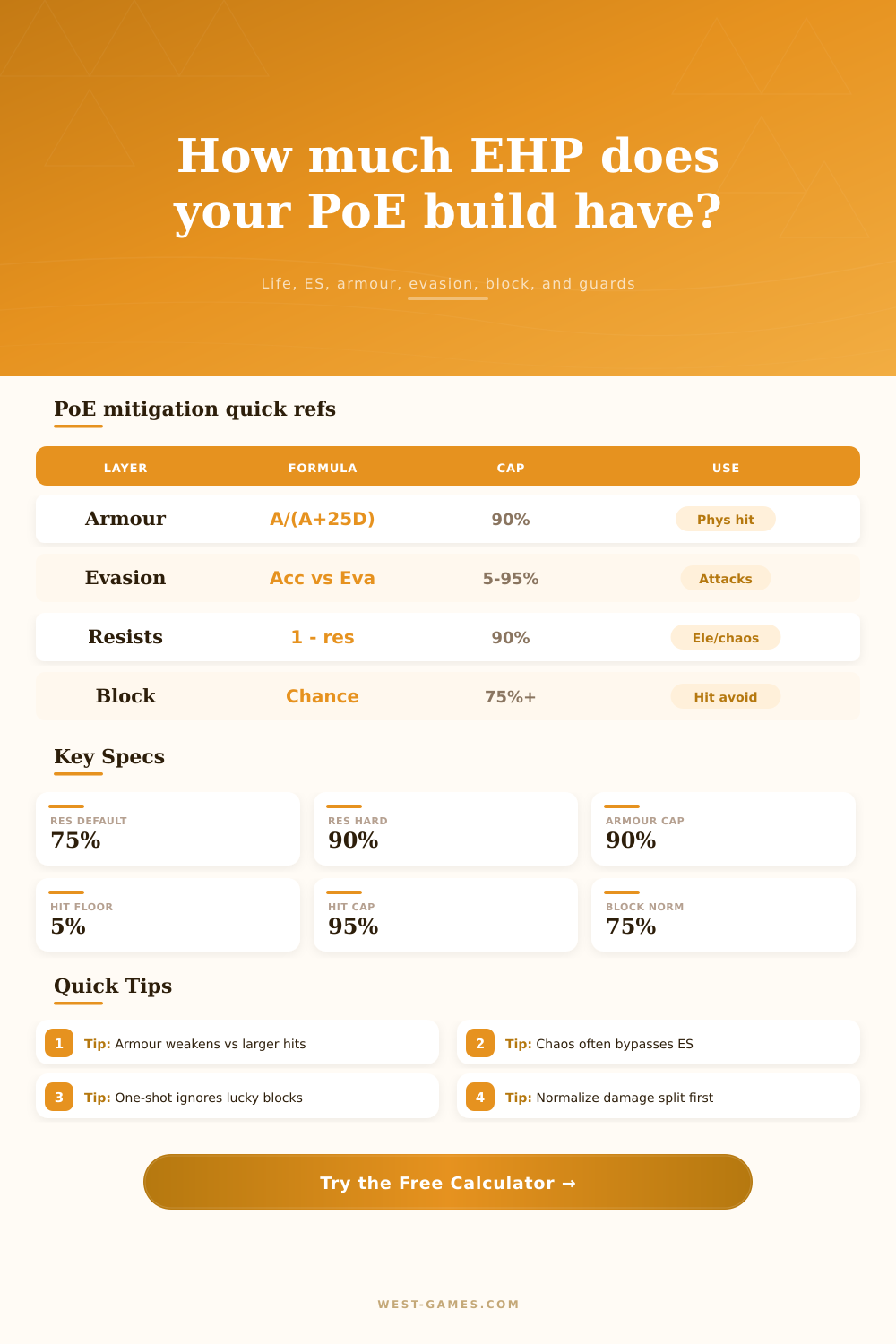
| Armour | Physical reduction = Armour / (Armour + 25 x physical hit) | Total physical reduction capped at 90% | Physical hit damage | Large physical hits get less percent reduction from the same armour value. |
| Extra PDR | Total physical reduction = armour reduction + added PDR | Still capped at 90% | Physical hit damage | Use endurance charges or other generic physical reduction in the extra PDR field. |
| Resistance | Damage taken = raw type damage x (1 - resistance) | Normally 75%, hard cap 90% | Fire, cold, lightning, chaos | Enter the actual effective resistance after map and character modifiers. |
| Less taken | Post-mitigation damage x (1 - less taken) | Input capped at 90% | Hit damage after armour and resistances | Use for Immortal Call style or custom less-damage hit layers. |
| Guard absorb | Player damage = after less - min(guard pool, guard share x after less) | Guard pool can fully deplete | Guard skill active hits | Guard share models effects such as damage taken from a buff before life or ES. |
| One-shot EHP | Binary search largest raw hit where life does not reach zero | Ignores lucky avoid rolls | Any selected damage split | Useful for max-hit checks because armour depends on raw hit size. |
| Layer | Formula or field | Default cap | Attack hit | Spell hit | Calculator result |
|---|---|---|---|---|---|
| Evasion | Hit chance = 1.25 x accuracy / (accuracy + (evasion / 5)^0.9) | 5% to 95% hit chance | Used | Not used by default | Converts enemy accuracy and your evasion into a chance for attack hits to connect. |
| Attack block | Min(attack block, block cap) | 75% unless raised | Used after hit roll | Not used | Blocked hits prevent damage when blocked-hit taken is 0%. |
| Spell block | Min(spell block, block cap) | 75% unless raised | Not used | Used | Spell block handles the selected spell-hit source. |
| Glancing-style check | Blocked hit damage taken field | 0% to 100% | Optional | Optional | Use 65% when blocked hits still deal 65% damage. |
| Average attempt EHP | One-shot EHP / average hit damage multiplier | Approximate | Evasion plus block | Spell block only | Shows repeated-hit durability, not guaranteed max-hit survival. |
| Preset | Guard pool field | Guard share field | Less taken field | Best use | What to adjust |
|---|---|---|---|---|---|
| None | 0 | 0% | 0% | Baseline max hit | Use before comparing active buffs. |
| Steelskin style | Manual absorb value | 70% | 0% | Generic guard absorb | Enter your in-game buff value. |
| Molten Shell style | Armour-scaled value | 75% | 0% | Armour stacker hit checks | Set pool to your displayed or calculated buff amount. |
| Manual burst guard | Manual absorb value | 75% | 0% | Temporary burst survival | Enter the displayed guard value if it differs from Molten Shell. |
| Immortal Call style | 0 | 0% | Manual less value | Less-damage comparisons | Enter the relevant less damage taken from hits. |
| Custom guard | Manual | Manual | Manual | League mechanics or unusual effects | Keep values to what applies to hits, not damage over time. |
| Preset | Main layer | Typical incoming hit | Damage split | Why it is useful |
|---|---|---|---|---|
| League Armour Starter | Life, armour, capped resists | Mixed map hit | Mostly physical | Checks early mapping before expensive defensive scaling. |
| Evasion Mapping Ranger | Evasion and modest spell block | Attack projectile hit | Physical plus elemental | Shows how attack avoidance boosts repeated-hit EHP. |
| Block Duelist Check | Attack block and armour | Melee attack hit | Physical heavy | Separates one-shot max hit from block-weighted average EHP. |
| CI Spell Hit Audit | Energy shield and spell block | Elemental spell hit | Elemental mix | Uses ES as the main pool and disables normal chaos bypass pressure. |
| Boss Physical Slam | Armour and guard timing | Large physical hit | Pure physical | Demonstrates why armour reduction falls as boss hit size rises. |
| Glancing Blows Setup | High block with partial blocked hits | Repeated map hits | Mixed hit | Uses blocked-hit taken to compare partial block behavior. |
In Path of Exile, there’s a certain level of panic that hits you while you’re mapping when the boss whacks you for a hit that you couldve survived. You’re covered in all this armor. You’re sitting on six thousand life, wearing heavy armor, and standing still, yet your health bar vanish in a single frame. But now your health bar is just completely gone, and it happened in one frame.
Did that happen? Like, was it a bug? No, not usually. Most often it’s because you don’t understand how damage mitigation work against high raw numbers. While your armor value might be a big static number on screen, it’s dynamic in terms of how well it can protects you. And it changes with each and every hit you recieve. So checking your max life isn’t as important than figuring out your effective hit pool.
How Armor and Defense Work
After plugging in your character’s stats, the calculator (above) will crunch the numbers. No more guesswork about conversions or coefficients. You don’t have to work out the formula yourself. Just know what it represents in terms of real world.
The armor reduction isn’t a flat percentage. It’s a ratio based off the size of the incoming hit. The bigger the hit, the less effective your armor is. For gamers used to games with a flat armor modifier, this is counter-intuitive. Armor does not protects you from the size of a single hit; it protects you from total amount of damage taken. A thousand armor rating means nothing when a boss slams you for forty thousand physical damage. But if that same boss hits you ten times for four thousand, your armor is steel. That’s where folks go wrong.
To evaluate your build, there are two metrics you need to split up. Your first metric is your one-shot survival. This is the biggest hit you could possibly ever receive while still surviving. Your second metric is your average effective hit pool. This incorporates how well you can evade/block and not recieve any damage at all. These two metrics can often tell very different stories.
For instance, you may have a really high one-shot survivability with small hits (e.g. This is a pure armor tank. But because armor is less effective against high damage hits, your average EHP might be pretty bad. Or maybe your block build has low one-shot survivability since you can literally just get super unlucky and take 3 hits in a row. But then your average EHP might be huge since you dodge most attack. If you’re trying to optimize for both, you can’t do so without giving something else up.
Energy shields make matters even more complicated. It is not additional life. It is a resource that behaves different depending on damage type. By default, chaos damage ignores energy shields. Unless you have certain mechanics that modify this rule, your shield will do nothing to protect you from hits that deal chaos damage. Resistances also change the amount of damage that hits your shield. They mitigate fire, cold, and lightning damage, but their interaction is linear. Seventy five percent fire resistance? You’ll receive a quarter of the raw amount. Zero chaos resistance? You’ll get all of it. The calculator will adjust these fractions so you can see exactly what fraction of the damage hits your shield rather than your life pool. This difference becomes important when considering builds that play with low life totals.
Then there are the Guard skills. These will take some of the damage before it hits your shield (or health). Why does this matter? Because it actualy lowers the raw damage that’s getting dealt before resistance and armor is considered. Armor is scaled by how large the hit was to begin with, so lowering the hit early means your armor is that much stronger further down the line. Small stuff, sure, but still worth it. A properly timed guard skill can mean the difference between being chipped and dying. Know when they’re coming up and know when they’re down. Sometimes they’re not active at all.
These trade-offs are illustrated by the presets available in the tool. How does having high evasion change the way a ranger builds? What about a standard armor starter character? How do partial blocks impacts your average damage taken? Try out a block build to find out. There’s no reason to max everything out. Find a mix where you won’t be panicked when you suddenly die. Know what your limitations are. Do I get to tank this slam, or should of I rolled?
A good pool isn’t one where you’re impossible to kill; rather, it’s one where you can guess with some confidence how much damage you’ll suffer from any given source. You’re no longer guessing, you’re executing. With the math out of the way, all you have left are your skills, now you’ve got something to worry about. And that’s what the defense actualy is.