Forza Spring Rate Calculator
Estimate front and rear spring rates from sprung axle weight, static weight distribution, motion ratio, target ride frequency, unit conversion, and front/rear balance.
Calculation Breakdown
| Preset | Weight | Front % | Unsprung F/R | Hz F/R | MR F/R | Aero F/R |
|---|
| Step | Formula | Inputs | Units | Why it matters |
|---|
| Use case | Front Hz | Rear Hz | Rear split | Setup feel |
|---|
| Item | Typical value | Calculator use | Effect | Check |
|---|
| Rear Hz split | Front spring bias | Likely feel | Use case | Watch point |
|---|
In Forza, you start by tweaking suspension to get better handling, but instead of improving corners, it feels like you’re driving on a trampoline. Sounds familiar? In most cases, driver isn’t the problem. It’s the spring rate. And most drivers simply guess. They pick a number they read in some forum thread that maybe worked for somebody back three years ago, they miss physics completely.
There is no such thing as a magic prop known as springs. Spring rate is a precise tool that turns weight into controlled motion. If you don’t match the spring rate to your car’s specific mass and motion ratio, you’re simply rolling dice session after session.
How to Choose the Right Spring Rate
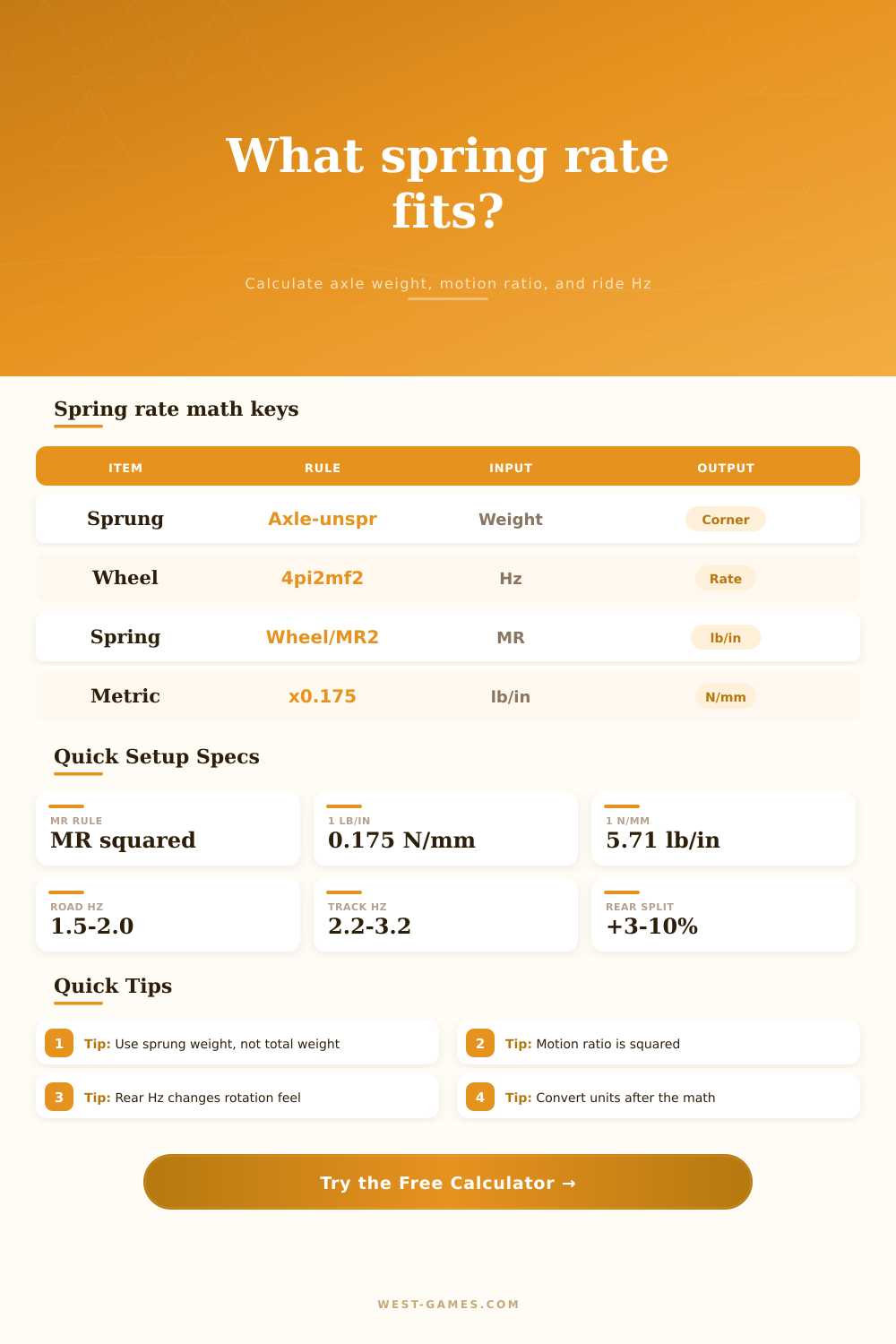
The mass was sprung. This is the weight the spring actualy supports. Subtract the unsprung weight from total corner load. What is unsprung? Wheels, tires, and brakes. Why does this matter? Because they want to remain still. The body move. Treat entire car weight as sprung and your springs will be way too soft.
How do you divide by four and track pounds on each corner? You shouldn’t of need to with the calculator above. It subtracts for you and isolates mass that actually flexes spring.
Then there’s ride frequency. This is its natural bounce rate. The higher the frequency, the stiffer it will be. Because comfort is key for road cars, they tend to be in that 1.5-hertz range. For track cars, where grip is everything, you push up into the 2.5-hertz or above range. That’s what makes it hard.
Bumps are skipped over rather than rolled through with stiff springs. On an off-road surface, you’ll also sacrifice traction. Frequency is only starting point. Before you ever choose a part, this set how stiff your car is supposed to be.
Most folks trip up at motion ratio. Motion ratio refers to the amount of movement the wheel makes versus the movement of spring. For a stock strut set-up it’s roughly one. For a more complicated rear suspension like a multi-link setup, it can be lower. The math for spring rate squares the motion ratio so small numbers make big differences. Lower your motion ratio from.9 to.8 and your spring rate shoots way up. That’s what folks miss. They don’t verify their geometry aligns with assumed ratio so they go purchase a spring by wheel rate.
There’s also the unit conversion minefield. Pounds per inch are imperial units. Newtons per millimeter are metric units. And you can’t mix them up or it ruin the setup instantly. A pound per inch is about 0.175 newtons per millimeter. If you mix the two, forget about it; the setup goes down the toilet. The tool does system conversion for you. So you spend time focusing on what you want to tune instead of looking up conversion chart.
Speed is where aero load comes in play. The down force pushes car down on the suspensions and compresses springs but doesn’t change how they are set up. In other words it lowers your ride height when you step on gas. So you must have adequate suspension travel to soak up lower ride height without bottoming out. If you make the springs too stiff, they won’t be able to travel far enough to dampen curb hit. This causes the car to bounce violent over curbs.
Lastly, consider balance. If you make the rear stiffer then the front, it will turn-in quicker but then begin to rotate. If you stiffen the front end, you get more understeer but also a more predictable entry. You don’t get everything dialed in perfectly. It’s all based off your driving style and what kind of race track you’re racing. A guy that likes to do a lot of drifting may like a loose rear to rotate better. Someone who likes oval speed might like a planted front.
Begin with a baseline. Dial up and down based off the presets. Make tiny adjustments. Adjust single knob at a time. Feel what car does when pushed hard into a corner. Hear the suspension doing its work. Does it sound like a jackhammer? Soften it. Does it feel floaty? Stiffen it. Math provides direction. The seat provides the answer.
There’s no magic spring rate; it’s just knowing relationship of weight and movement in a vehicle. There is no more guesswork after realizing that tuning screen is a dial. Twist slowly. Feel. Push harder.