Minecraft Mending Repair Calculator
Calculate actual XP, expected pickup XP, source actions, timing, and Unbreaking-adjusted durability for equipped Mending gear.
| Mechanic | Value used | Calculator formula | Input affected | Output affected |
|---|---|---|---|---|
| Mending repair rate | 2 durability per XP point | Target item XP = missing durability / 2 | Current and target durability | Target item XP |
| XP orb allocation | Random among equipped damaged Mending items | Expected target share = 1 / active damaged item count | Other damaged items | Expected XP pickup |
| Other item completion | Finished items stop needing repair | Active pool shrinks after their deficit is filled | Other average missing durability | Total pickup XP |
| XP source actions | XP per source action | Actions = total pickup XP / XP per action | XP source and custom XP | Actions and time |
| Repair while wearing | Durability lost per minute | Iterates repair need until time and wear stabilize | Wear per minute | Adjusted repair time |
| Item group | Material or item | Max durability | Mending XP from empty | Unbreaking III class | Calculator preset |
|---|---|---|---|---|---|
| Tool set | Netherite pickaxe, axe, shovel, hoe | 2031 | 1016 XP | Tool x4 expected use | Netherite pickaxe |
| Tool set | Diamond pickaxe, axe, shovel, hoe | 1561 | 781 XP | Tool x4 expected use | Diamond tool |
| Weapon | Netherite or diamond sword | 2031 / 1561 | 1016 / 781 XP | Tool x4 expected use | Sword presets |
| Flight item | Elytra | 432 | 216 XP | Tool x4 expected use | Low Elytra |
| Defense item | Shield | 336 | 168 XP | Tool x4 expected use | Shield patch |
| Ranged item | Bow / crossbow / trident | 384 / 465 / 250 | 192 / 233 / 125 XP | Tool x4 expected use | Ranged presets |
| Netherite armor | Helmet / chest / legs / boots | 407 / 592 / 555 / 481 | 204 / 296 / 278 / 241 XP | Armor x1.43 expected use | Armor presets |
| Diamond armor | Helmet / chest / legs / boots | 363 / 528 / 495 / 429 | 182 / 264 / 248 / 215 XP | Armor x1.43 expected use | Armor presets |
| Source action | XP value used | Game value range | Average basis | Calculator note |
|---|---|---|---|---|
| Bottle o' enchanting | 7 XP | 3 to 11 XP | Midpoint average | One thrown bottle as one action |
| Enderman | 5 XP | 5 XP | Fixed mob XP | One mob as one action |
| Zombie, skeleton, creeper, spider | 5 XP | 5 XP | Fixed hostile mob XP | One mob as one action |
| Blaze or guardian | 10 XP | 10 XP | Fixed mob XP | One mob as one action |
| Nether quartz ore | 3.5 XP | 2 to 5 XP | Midpoint average | One ore mined as one action |
| Coal ore | 1 XP | 0 to 2 XP | Midpoint average | One ore mined as one action |
| Redstone ore | 3 XP | 1 to 5 XP | Midpoint average | One ore mined as one action |
| Diamond or emerald ore | 5 XP | 3 to 7 XP | Midpoint average | One ore mined as one action |
| Lapis lazuli ore | 3.5 XP | 2 to 5 XP | Midpoint average | One ore mined as one action |
| Fishing catch | 3.5 XP | 1 to 6 XP | Midpoint average | One catch as one action |
| Spawner break | 29 XP | 15 to 43 XP | Midpoint average | One block broken as one action |
| Unbreaking level | Tool and weapon multiplier | Armor durability-loss chance | Armor multiplier | Mending XP effect |
|---|---|---|---|---|
| None | x1.00 | 100.00% | x1.00 | No change; 2 durability per XP |
| Unbreaking I | x2.00 | 80.00% | x1.25 | No change; use-value only |
| Unbreaking II | x3.00 | 73.33% | x1.36 | No change; use-value only |
| Unbreaking III | x4.00 | 70.00% | x1.43 | No change; use-value only |
“Boss music in my head, cracked-up Elytra wings standing on the precipice of a Nether fortress, my netherite chestplate held together with threads.” That’s not a dragon you’re facing, it’s the arithmetic of your own survival. Mending has always be thought of as something of a longevity cheat code for Minecraft. Each kill become an automatic repair. But rather than thinking of it as a resource management system, many players think it work like magic.
Without knowing whether they’re wasting time or gaining value, they toss XP bottles at their equipment. The difference between a casual and a pro player is knowing exactly how many experience points you need to repair an item’s durability and how to split that experience across five broken object.
How Mending Works
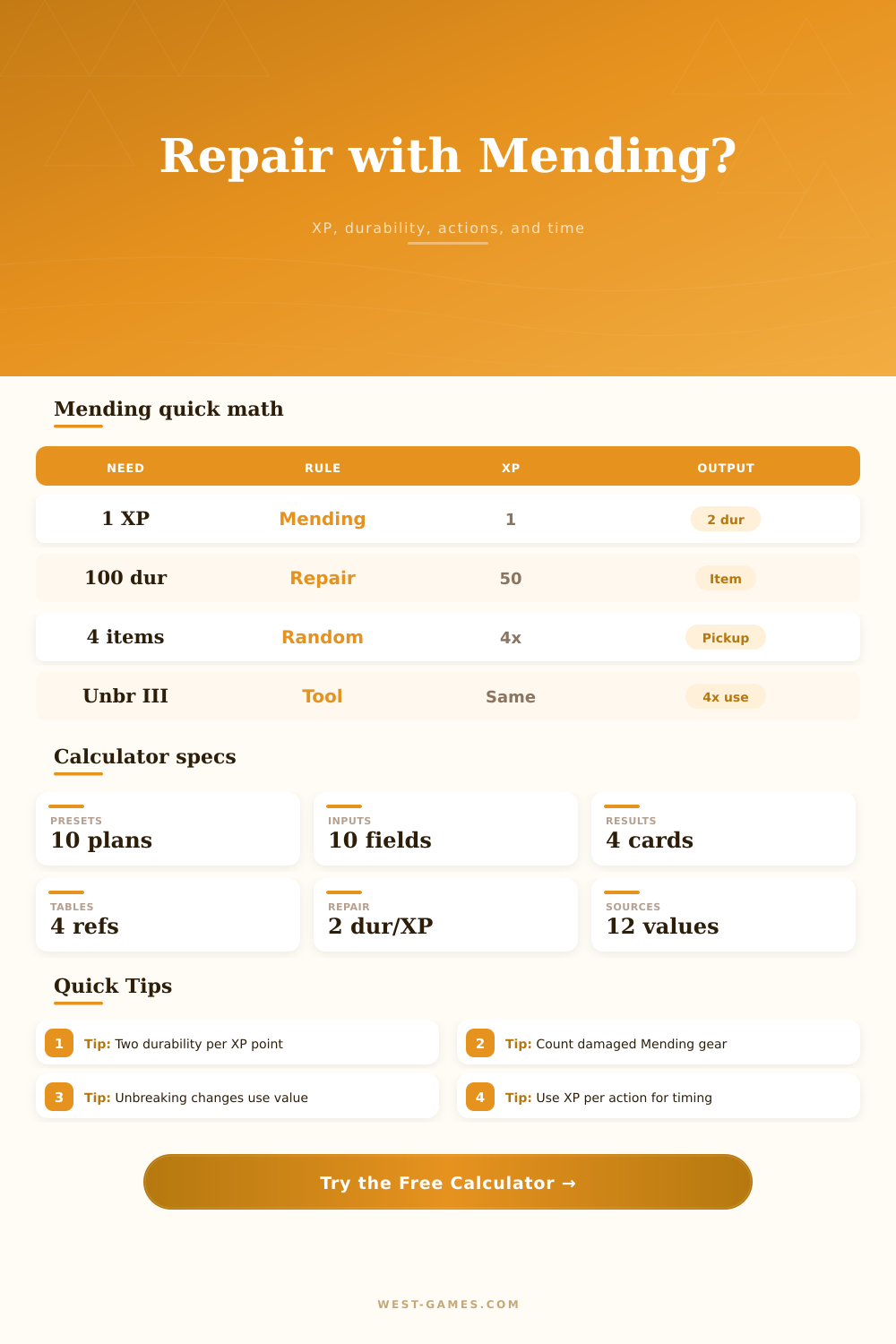
It’s super simple; for every XP you earn, two points of durability are restored to any piece of equipment you’re wearing. The ratio doesn’t change based off item type. It’s always 1:2. Worn out boots and broken swords obeys the exact same math.
But it becomes complicated when we introduce distribution. Since you can apply this buff to more than just one item, the game randomly distributes each XP earned across any item that needs repair. You hit a mob for five XP? That doesn’t guarantee five points of durability for your busted sword. You might get some points split between items. Or your boots could take all five. Or your chest plate takes two and your sword take three. It’s all random, which complicates planning. Hence the need for an average.
This can slow down repairs (most players don’t factor in what their equipment competition will do). For example, trying to repair a nearly-broken pickaxe will result in XP points being stolen by a nearly-full helmet with Mending. The calculator plugs in the number of other damaged items plus their current durability levels, and then applies the math. Other items becomes statistical sinks. It’ll estimate just how many XP points they’ll siphon off before your target item hit its mark.
This matters for efficiency, you might think killing ten blazes will fix your sword. But perhaps your boots is hungry for XP as well? Maybe you’re really looking at fifteen kills.
Another detail that gets missed is the addition of Unbreaking. Unlike Unbreaking, which only changes how fast gear loses durability, there is no mechanic that actualy decreases the amount of XP needed to fix an item. If you had a Unbreaking III pickaxe, it would retain its durability four times longer than usual, while maintaining the exact same cost to repair once broken. This is an important difference to keep in mind if you’re thinking long-term. Unbreaking doesn’t save you XP; it merely spreads out the expense over time. This makes it more of a buffer against unexpected shortfalls then a repair bill discount.
Gear matters, but so does where you get your XP from. Breaking spawners and killing blazes give big spikes of XP, which greatly reduces your grind time. Compare that with mining coal: slow go, lots of tedious work. The reference table on the page show how different activities compare in terms of raw XP per action: To get a feel for how much certain activities are worth, check out this reference table. This can help determine the quickest route to your goal.
For example, do you have a pile of Bottle o’ Enchanting lying around? They’re good for a reliable seven XP apiece, making them a great choice when you need to top off quickly. Mob grinding will take you there the fastest, whereas fishing give you a steady way to repair items. The source doesn’t say you can do both at once, but it does suggest different strategies depending on what you have on hand.
Mending comes down to knowing there’s only so much XP to go around and using it wisely. You’re not trying to collect points; you’re managing those points to put them in places they’re most valuable. When you learn how things compete for XP, when you grasp the exchange rate, you’re no longer fumbling in the dark. Instead, you’re making plans. You’re operating a system called your gear. And it isn’t something you should of suffer through anymore; it’s something you can manipulate.
Next time your durability bar starts blinking red, you’ll know how many more bottles to throw or mobs to run over. Panic gives way to precision.