🎮 Minecraft Nether Portal Coordinate Calculator
Convert Overworld and Nether portal positions, check X/Z scale, compare Euclidean and Manhattan distances, estimate search-radius margins, and spot likely linking conflicts.
Best placement is the converted X, unchanged Y, and converted Z in the destination dimension.
XZ-only distance helps estimate whether the destination portal sits inside the search band.
Euclidean distance includes height and decides which nearby portal is closer.
Axis-by-axis travel distance is useful for tunnels, bridges, and stair-step routes.
Positive values mean your built portal is closer than the competing portal.
| Starting dimension | Destination dimension | X conversion | Y conversion | Z conversion | Example |
|---|---|---|---|---|---|
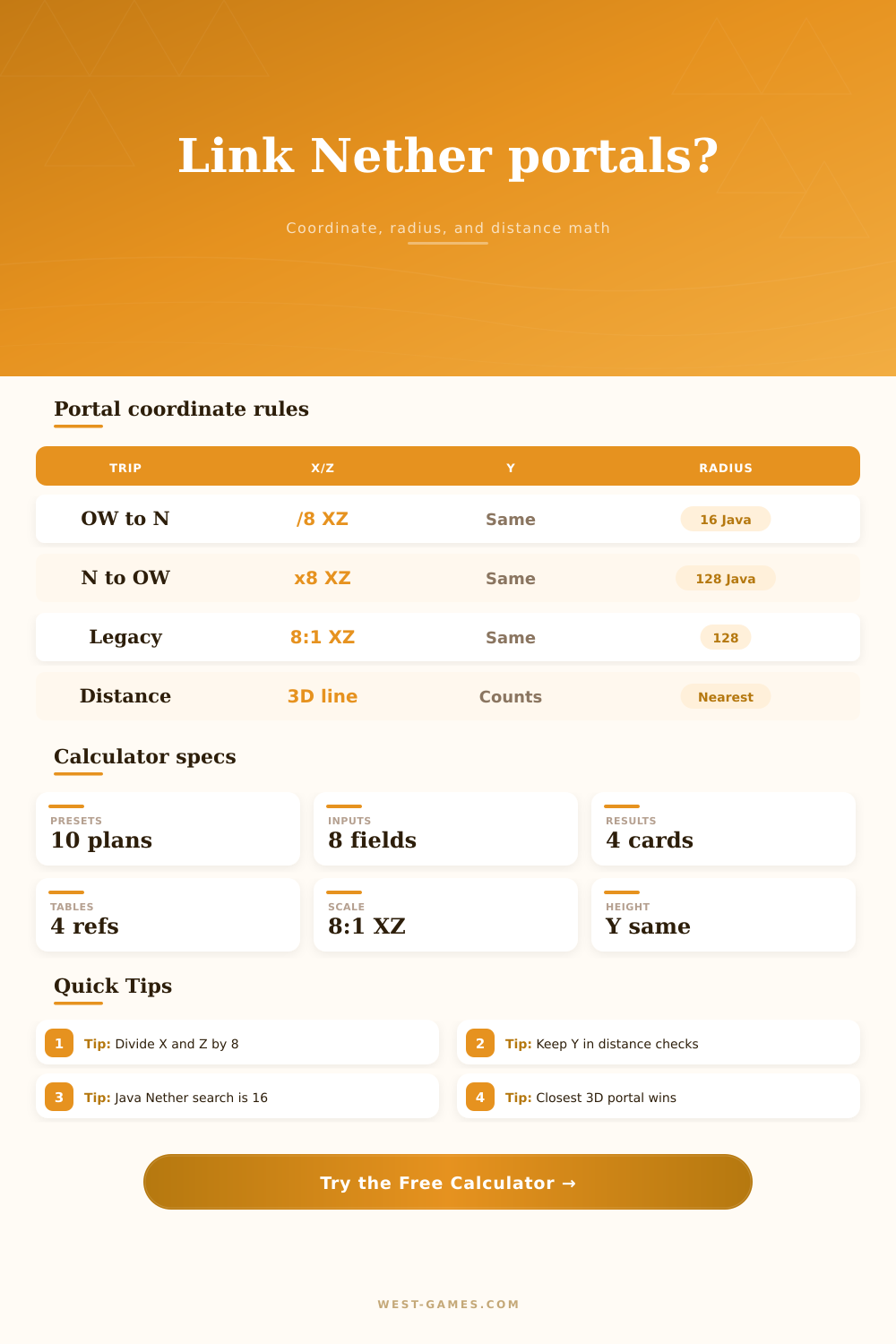
| Overworld | Nether | X divided by 8 | Unchanged | Z divided by 8 | 800, 64, -240 becomes 100, 64, -30 |
| Nether | Overworld | X multiplied by 8 | Unchanged | Z multiplied by 8 | 100, 64, -30 becomes 800, 64, -240 |
| Overworld route | Nether highway | 1 Nether block equals 8 Overworld blocks | Use actual route height | 1 Nether block equals 8 Overworld blocks | 125 Nether blocks equals 1,000 Overworld blocks |
| Portal matching | Both directions | Compare after conversion | Counts in 3D distance | Compare after conversion | Closest active portal is selected |
This calculator keeps decimal math visible so you can decide whether to round, floor, or place the portal at an exact block center.
| Radius profile | Destination Nether | Destination Overworld | Practical meaning | Best calculator use |
|---|---|---|---|---|
| Java current chunk scan | About 16 horizontal blocks, a 3x3 chunk scan | About 128 horizontal blocks, a 17x17 chunk scan | Overworld-to-Nether links need tighter Nether placement | Modern Java survival and servers near vanilla behavior |
| Bedrock or common 128-block model | About 128 horizontal blocks in destination dimension | About 128 horizontal blocks in destination dimension | Broad search can pull players into nearby existing portals | Bedrock planning or simple cross-edition estimates |
| Legacy Java 128-block model | 128 horizontal blocks in destination dimension | 128 horizontal blocks in destination dimension | Older advice often quotes one universal search radius | Older worlds, older guides, and legacy server behavior |
| Custom server radius | User-entered radius | User-entered radius | Plugin or configuration may override default behavior | Paper, Spigot, modded, or hub-managed networks |
The calculator treats the radius as the horizontal search window and separately reports 3D Euclidean distance for nearest-portal comparison.
| Metric | Formula | Uses Y? | Calculator output | Interpretation |
|---|---|---|---|---|
| X/Z horizontal distance | Square root of dx squared plus dz squared | No | Horizontal gap | Checks if the portal is inside the destination search band |
| Euclidean distance | Square root of dx squared plus dy squared plus dz squared | Yes | Built portal offset and conflict comparison | Models nearest active portal selection after conversion |
| Manhattan distance | Absolute dx plus absolute dy plus absolute dz | Optional | Manhattan route | Estimates tunnel or stair-step block movement |
| Conflict gap | Competing portal distance minus built portal distance | Matches distance checkbox | Likely link target | Positive favors the built portal; negative favors competitor |
Manhattan distance is useful for path planning, but portal choice is based on straight-line distance to candidate portals.
| Scenario | Typical source gap | Destination gap after scaling | Linking concern | Recommended check |
|---|---|---|---|---|
| Two Overworld bases 128 blocks apart | 128 Overworld blocks | 16 Nether blocks | May be tight under Java Nether search | Build exact Nether coordinates and compare Y |
| Two Overworld bases 1,024 blocks apart | 1,024 Overworld blocks | 128 Nether blocks | Usually separates broad 128-block matching | Check destination radius and existing hubs |
| Nether portals 16 blocks apart | 16 Nether blocks | 128 Overworld blocks | Can represent separate Overworld portals | Test both directions after exact placement |
| Nether highway to distant structure | 250 Nether blocks | 2,000 Overworld blocks | Large travel saving but possible hub conflicts | Compare every nearby destination portal |
| Stacked portals at different heights | Same X/Z, different Y | Same X/Z, unchanged Y | Height can determine nearest 3D portal | Use Euclidean distance with Y enabled |
For dense hubs, exact X/Z pairing plus a clear Y plan is usually more reliable than relying on search radius alone.
The way people use the Nether portal is an exercise in frustration. “I’ll set up this portal here,” you say to yourself. “Now I’m going to teleport through to my hub.” This is what actualy happens: you fall down into some random cave network.
Why? Because everyone ignores portal linking. It’s a suggestion. To the game, however, it’s a strict geometric rule. Your intention doesn’t matter, Euclidean distance matters. If you want consistent travel, you must honor the math.
How to Use Nether Portals Correctly
It’s a pretty simple mechanic at heart, but it’s something that is easy to miss. By default, the Nether and Overworld share their vertical coordinate systems, but their horizontal ones are different (by a factor of eight). When you enter the Nether, the game take your X and Z coordinates and divides them both by eight to find the corresponding point in the Nether. When you exit back into the Overworld, it multiplies them again by eight. Your Y level doesn’t change one bit.
Any difference of ten blocks in the Overworld equates to a difference of only 1.25 blocks in the Nether. That sounds reasonable enough until you realize that the game don’t choose the portal you created; instead, it picks the closest active portal found within its search range. But I don’t want you dividing really big numbers by hand, so here’s a little calculator that will do all the math for you:
This will convert your coords and let you see how close (or far) your destination is compared to any existing portals on the same portal network. Most builders of networks misses this point entirely. Building a portal on the new coordinates doesn’t guarantee you’ll get sent there… Unless there’s an old portal twelve blocks away in the Nether that’s actualy closer. You still go to the old one because it’s closer.
If you have an old portal sitting twelve blocks away in the Nether, and your new portal is thirteen blocks away from the spawn point, the game will send you to the old one. And it’s a straight line distance, so height counts too, not just horizontal location.
Radius In current versions of Java Edition, the game look at a narrow search radius of approximately a thirty-two by thirty-two block square area in the Nether. If you place it accurately, it is easy to connect because that range is so small. But it also means that you can’t just throw a portal down anywhere near the target. On older servers (and Bedrock) the search radius can be as large as one hundred twenty-eight blocks. When the radius is big, it gives you more opportunity to accidentally link to some random portal you forgot about building somewhere. You can switch between these profiles and see what amount of buffer space you really need on this page.
Always consider the vertical distance as well. That’s why it’s easy to forget about Y coordinates: They don’t scale. So you can assume that two portals is lined up exactly on the X and Z axes, which would make them connect. Except one of them is at Y level zero while the other is at Y level sixty-four. Even though they’re close in a straight line, there may be too much vertical distance for the game to recognize them as same pair. There’s an option in the calculator that factors this vertical distance into the measurement. What it shows you is how much your vertical positioning is contributing to (or detracting from) the reliability of your links.
To plan out a Nether highway, remember that everything is a multiple of eight. One thousand blocks in the Overworld? You’re going to have to run one hundred twenty-five blocks in the Nether. Give it your starting point and end point, and it’ll spit out the exact set of coordinates where you should of go. It will also display the Manhattan distance, which comes into play when you plan bridges and tunnels. Nothing inside solid stone is made of completly straight lines. These conversion rules are laid out nicely in the reference tables on the page. They tell you precisely where the coordinates move and provide examples of what the search windows will be for each edition. That’s helpful so that you know how close you can place your portals without conflict.
If you’re creating a dense network, exact placement isn’t negotiable. If you’re only establishing a home base, then a little bit of leeway will do. It’s about precision in reliable portal connection.
The game doesn’t know where you want to go so you shouldn’t expect it to just guess right. Tell it. Accurately convert your coordinates. Check other portals that is nearby. Take the randomness out of it. Know where you’re going instead of guessing. That is what makes for a seamless journey rather than a frustrating one.