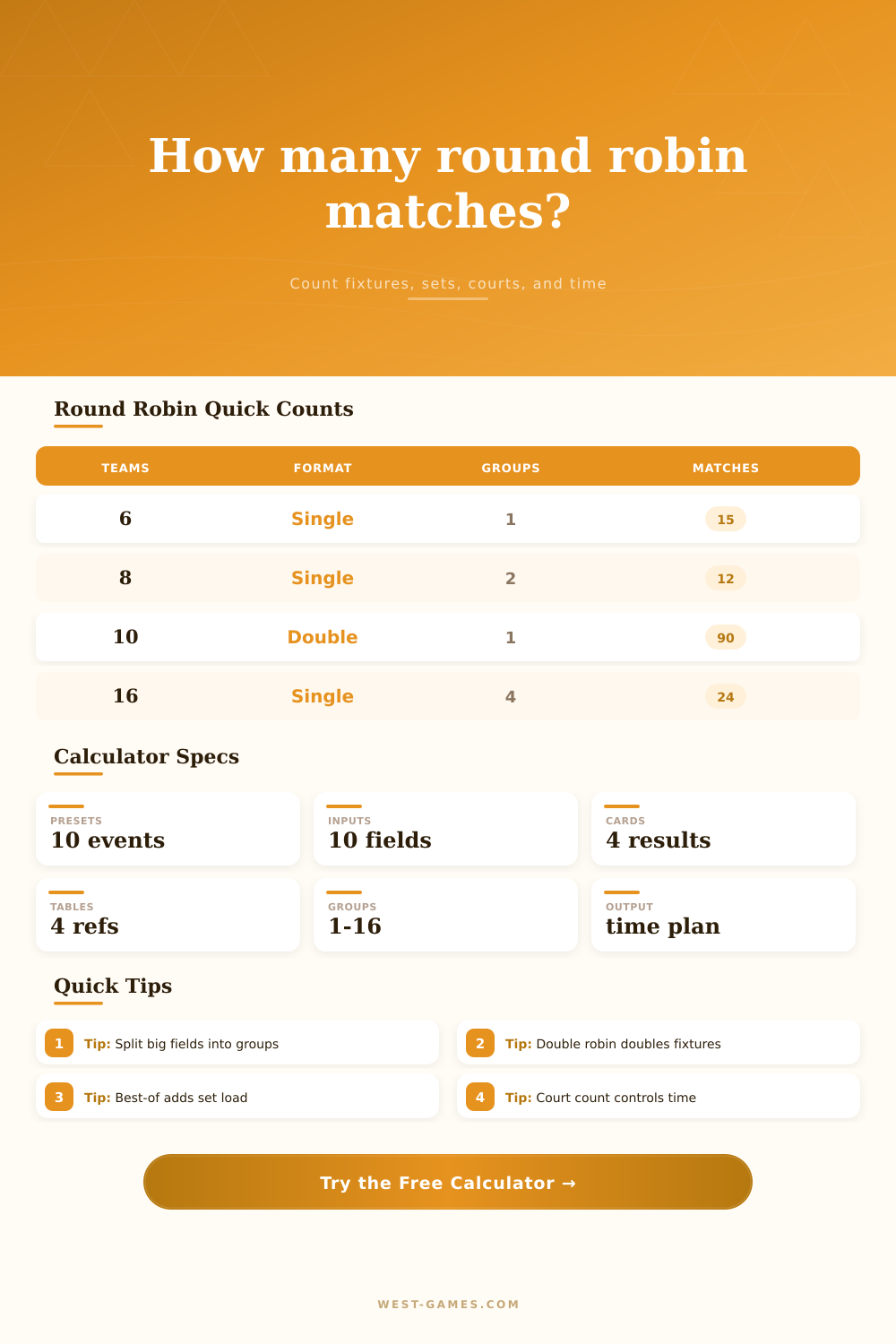
Round Robin Match Count Calculator
Plan tournament fixture load from team count, group split, single or double robin format, best-of length, courts or stations, match duration, breaks, and buffer time.
Calculator note: Uneven groups are distributed as evenly as possible, then matches are counted inside each group only. Add playoff brackets separately if your event advances teams after pools.
| Group size | Single robin matches | Double robin matches | Typical use | Schedule feel |
|---|---|---|---|---|
| 4 teams | 6 | 12 | Small pod, tabletop pod, mini league | Compact and easy to finish in one sitting. |
| 5 teams | 10 | 20 | Club night, casual ladder, qualifier pool | Manageable, but byes appear each natural round. |
| 6 teams | 15 | 30 | Local bracket seed pool, weekly league | Good balance between fairness and time. |
| 8 teams | 28 | 56 | Division play, online group stage | Needs enough stations or multiple sessions. |
| 10 teams | 45 | 90 | Full league table, long ladder | Usually too long for a single short event. |
| Match type | Common duration | Best-of setting | Break planning | Calculator note |
|---|---|---|---|---|
| Fast board game | 15-25 min | Best of 1 | Short score-entry gaps | Duration can be the full table cycle. |
| Fighting game set | 10-20 min | Best of 3 or 5 | Breaks after blocks | Use match duration after expected set count. |
| Esports map | 25-45 min | Best of 1 or 3 | Tech buffer matters | Add buffer if server setup is manual. |
| Chess rapid round | 20-40 min | Best of 1 | Fixed round starts | Courts act like boards or tables here. |
| Sports court match | 30-60 min | Best of 3 | Changeover matters | Longer best-of formats need realistic court slots. |
| Preset | Teams | Groups | Format | Planning reason |
|---|---|---|---|---|
| Preset rows load with the calculator. | ||||
| Step | Formula | Uses | Watchpoint | Why it matters |
|---|---|---|---|---|
| Single robin | n x (n - 1) / 2 | Pairings inside one group | Do this per group | Uneven groups must not be averaged too loosely. |
| Double robin | single x 2 | Home-away or rematch formats | Doubles time | Fairer side selection costs the full fixture load. |
| Court slots | ceil(matches / courts) | Parallel round estimate | Idle slots at end | More stations reduce time until group flow bottlenecks. |
| Schedule length | slots x pace + breaks + buffer | Event clock estimate | Use real duration | Overruns usually come from changeover and setup gaps. |
| Expected sets | matches x set factor | Game load estimate | Best-of model | Helpful for score sheets, streams, and referee coverage. |
For their inaugural game tournament, they had six teams playing each other in the first round. It was supposed to be an hour. It ended up taking them three and a half hours. Because one, the organizers forgot that changeovers add up; two, players need to go to the bathroom; and three, people forget where they put the controller from one match to another.
Fixtures is seldom simply math. The way time behaves when you’re not playing has logistics hidden behind numbers. How time operates when people aren’t gaming can make or break an event, turning it into either a logistical nightmare or a fun experience.
Simple Tips for Running a Tournament
Round robin is fair, Everyone competes against all others. Each match are pre-determined and can’t be negotiated out. You know exactly how many matches you will get regardless of results. The formula for determining matches is fixed by group size and number of teams per group. For example, if you have eight teams in one group, then there will be 28 pairings. However, if you break them into two groups with four teams each, you only have twelve matches total. This creates an imbalanced situation between the pools. In the end, you’re left with a choice between making it manageable (in terms of numbers) versus making it completely fair.
The beauty of this calculator is it does all the math for you after plugging in your desired group structure and number of teams. No more guessing at conversions or coefficients.
There are some time sinks no one sees. It doesn’t occur to most organizers. They focus on length of matches and not the changeover times. Board games only take thirty seconds to set up. Sports leagues has five minute player transitions from station to station. If you add those five minutes between each slot of a twenty match tournament, you just added hours to the day.
Real life events are always behind schedule. That’s why there should of a buffer. Entering scores takes more time than expected. Someone’s phone rings during a critical set. Ten percent isn’t being negative, it’s being realistic.
The usual workaround for time pressures is just to split the big field across several groups. This alters the competitive feel of the event, though. If all players compete as one group, the final standings are obvious. If we divide that same group into two groups, then you might need to use some sort of playoff bracket (or even more tie-breakers) to see who moves on. You can see from the match count scaling in the table on the page how much this matters.
Ten teams results in 45 matches, which is rarely doable in a single day unless your venue has enough courts running at the same time. With four teams, there are only six matches! That’s fast and cozy. There’s a balance between what the venue supports versus how happy players will be.
That said, best-of also influences load, and not always in obvious ways. A best-of-one is easy to predict. Best-of-five can easily double or triple the amount of time actualy spent playing each fixture. Even if you’re assuming it will be a speedy victory, half of your games end up going to five sets, which will slide the whole day over from afternoon into evening. Choose an average set count that takes into account how competitive your community tends to be. Casual communities tend to settle on shorter matches. Competitive leagues tend to lose minutes during each tiebreaker.
The entire system is throttled by court availability. It doesn’t matter that you’ve got 10 teams, if you can only have a single table to play on. As you increase parallel play, overall time go down at a steady rate, but eventually you hit the point where coordination overhead becomes the main factor (diminishing returns). If you have too many stations, you get confusion amongst the refs and players wandering aimlessly trying to find their games. Usually two-three station represent a sweet spot for small-to-mid events. They keep things moving without causing chaos.
Remember that it’s not how many minutes your event has but rather how its rhythm impacts players and organizers alike. A 15 minute pause after four rounds prevents burnout and resets your energy level so that the last matches aren’t suffering from fatigue or sloppy set-up due to a lack of proper attention span.
At the end of the day though, tournaments aren’t mathematics. They’re not about crunching numbers. They’re about setting proper expectations. Yes the math can be simple, but people are anything but clean-cut. Add realistic set times, buffer time between changes, and changeover times. This adds a little extra room to help ensure everything stays on schedule. It won’t be the dissapears disastrous three-and-a-half hour ordeal like it was that first time. It’ll be a well-oiled machine. Everyone will have fun competing, and the folks running things can go home without losing their minds.
How much is played? That’s easy. How long does each game last? That’s up to experience.