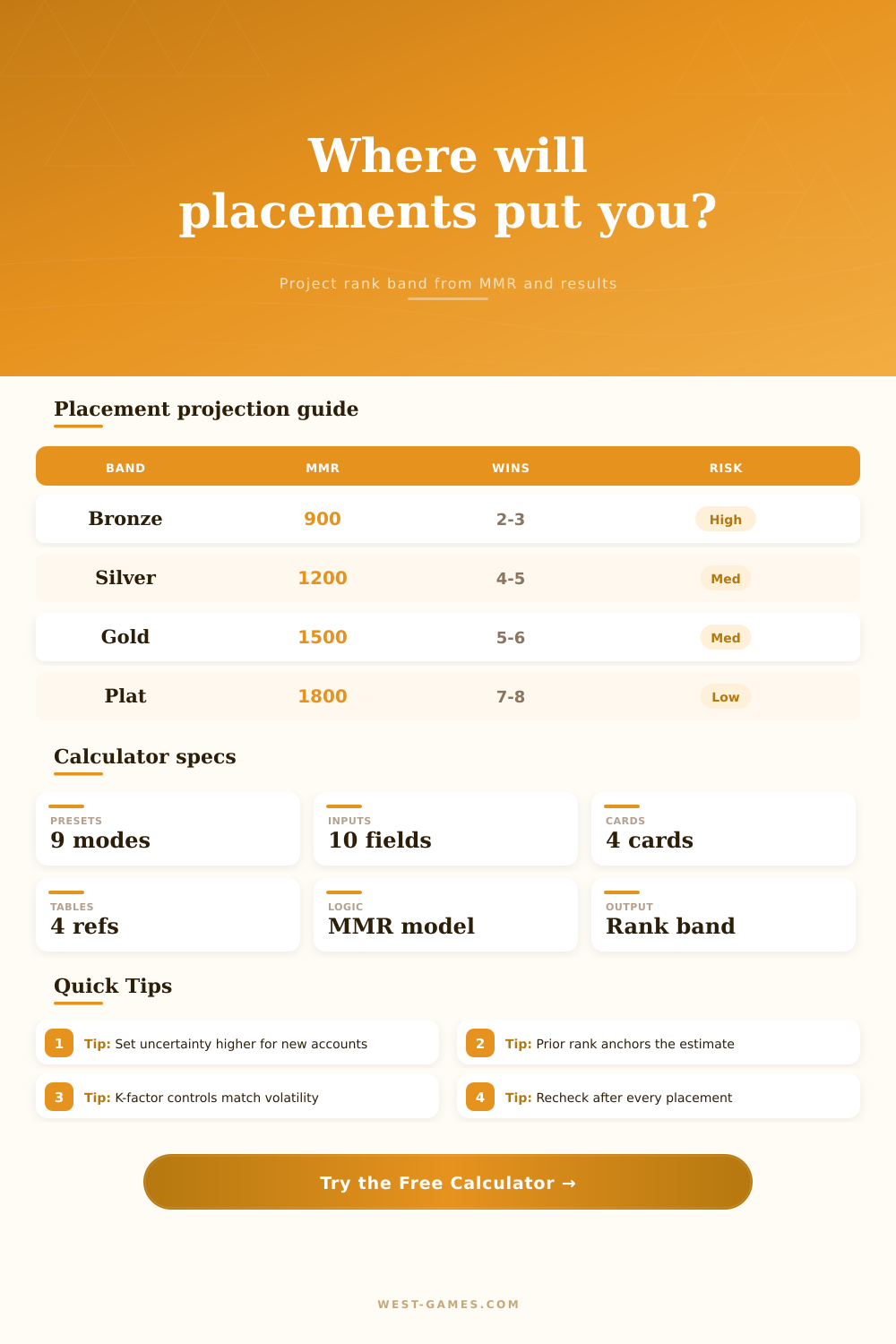
Placement Match Projection Calculator
Estimate your placement outcome from hidden rating, prior rank anchor, projected wins and losses, K-factor, uncertainty, and rank-band mapping.
🎯Placement Presets
⚙Projection Inputs
📊Live Projection Specs
🧮Comparison Grid
Expected Record
--Same inputs with wins set to expected chance.
Plus One Win
--Shows the value of flipping one loss.
Minus One Win
--Shows downside if one projected win drops.
Low Uncertainty
--Uses half uncertainty for stable accounts.
🏆Rank Band Reference
| Rank Band | Typical Rating | Placement Record | Projection Note |
|---|---|---|---|
| Iron | 0–599 | 0–2 wins | Large uncertainty can still move this upward quickly. |
| Bronze | 600–899 | 2–4 wins | Prior season anchor often matters more than one upset. |
| Silver | 900–1199 | 4–5 wins | Near-even records usually hold around the anchor. |
| Gold | 1200–1499 | 5–6 wins | Positive records begin pushing above prior rank. |
| Platinum | 1500–1799 | 6–7 wins | Opponent rating and K-factor decide the band edge. |
| Diamond+ | 1800+ | 7+ wins | High prior anchor reduces the penalty from one bad game. |
⚔K-Factor Impact Table
| K-Factor | Best For | 5-5 Swing | 7-3 Swing |
|---|---|---|---|
| 16 | Settled veteran rating | Small | About +32 points |
| 24 | Normal returning account | Low | About +48 points |
| 36 | Standard placement run | Medium | About +72 points |
| 48 | Fresh season reset | High | About +96 points |
| 64 | New account calibration | Very high | About +128 points |
🔮Uncertainty Range Table
| Uncertainty | Account Type | Range Width | Use In Projection |
|---|---|---|---|
| 0–15% | Recently active | Narrow | Final band should stay close to calculated rating. |
| 16–35% | Normal returning player | Moderate | Use the center rating and one-band caution. |
| 36–60% | Long break or role swap | Wide | Projected band can cross several division edges. |
| 61–100% | Fresh or hidden account | Very wide | Treat early wins as strong calibration signals. |
🗂Placement Scenario Table
| Scenario | Input Shape | Likely Movement | What To Watch |
|---|---|---|---|
| Clean 5-5 | Wins match expected rate | Holds near prior rank | Opponent rating decides small gains or losses. |
| Hot opening | 7+ wins with high K | Moves one or more bands | Uncertainty can amplify the visible jump. |
| Rough opening | 3 or fewer wins | Drops below anchor | Prior rank may soften the landing point. |
| Hard lobbies | Opponents exceed your MMR | Losses hurt less | A close negative record can still place well. |
| Soft lobbies | Opponents below your MMR | Wins add less | Great records may not jump as far. |
💡Placement Projection Tips
When you sit down for those initial placement matches, you have a singular goal in mind: to hit your true skill level without wasting three weeks climbing back up from Bronze. So, yes, you’re anxious, it’s the nature of the beast.
In the calibration stage, the matchmaking system gets to find the relative value of your old ranking compared to your new one. The battle between what has been vs. The idea of what might be fuels the projections. After you input your estimated expected win rate and hidden rating, the calculator do the math for you. It spares you from having to guess what your placement is based off volatility.
How Placement Matches Work
Players tend to be focused on winning their matches, which ignores structure behind placements. The system doesn’t care as much about winning or not winning; it cares about who you do win/lose against. If you go seven wins to three losses against opponents rated well above you, you will land higher than someone with a ten-to-zero record against easy lobbies. How fast you climb depend on the quality of those games you play.
Casual players is confused about the K-factor. Every time you play a match it’s multiplied by a K-factor. The higher the K-factor, the faster your new account moves as the system doesn’t know where to place you. The lower the K-factor, the harder each win or loss count as veterans’ ratings settle.
Are you returning from a long absence? The system sees you as new once more. Adjust your expectations accordingly. You are expecting moderate swings. One bad game at the start isn’t going to tank you. Assume you’re steady when you aren’t, however, and you might be surprised how much one bad game will sting.
There’s also a lot of uncertainty. This refers to the certainty the system has about its starting point. The wider and more flexible the rank bands, the higher the uncertainty. In other words, based solely on streaks you could be anywhere from Platinum to Silver. If there’s low uncertainty, it stay very close to your estimated skill tier.
And this affects the way you should approach those opening games. Uncertainty is like both your friend and your enemy when it’s high. It will put you in lobbies that feel impossible to get out of. Either they are far too easy, or far too difficult. That’s because the system is testing the boundary to see where you’ll fall over. But it’s not a cage… It’s an anchor.
Sure, the system is going to give you some indication of where you begin, but it won’t stop you from moving up if what you’re doing say something different. For instance, someone in Diamond who falls to Gold may remain down there if they’ve gone rusty, despite getting off to a good start. Recent results count more than past glory.
The best way to think about your old rank: It’s a starting assumption which your new games either validate or invalidate. It can offer helpful clues into what might be causing you to feel out of place at first. You can see a visual representation of that in the ratings table at the top of the page. Each row of bands has its own range of typical ratings. The lower part (Iron to Bronze) spans the bottom quartile. Then there’s the competitive ceiling (Diamond and up).
You’ll have some idea what it takes to get to Platinum if you think your rating might be around 1500 MMR. Winning isn’t enough; you need to defeat players who are better then you. Grinding is not climbing. Placement is a pretty anxious time because it’s so important for establishing your rank. Just try to be consistent.
If you can get a 6-4 against decent competition, that’s usually going to work out better. It is better than exploding and going 7-3 with widely differing lobby quality throughout. The system is designed so that steadiness trumps an explosion/tilt start. Play how you normally play and let the math lead you where it wants.
It’ll find its way sooner if you trust it and don’t tilt for wins, rather than if you do. Until you see the signal, those initial couple matches are nothing but noise. Beating it isn’t what we’re about. We want the system to find you.
And when you stop calibrating, all of those points shows how good you are, rather than being a shot in the dark based off stats. That’s what you want that first line to show, an honest look at your ability. Play like yourself. Accept the variances in the beginning and by the time you hit the end, I think that last band will represent who you realy are as a player.
Respect the inputs and the transition between where you start and where you end up is pretty quick. You should of seen it coming.