Promotion Series Odds Calculator
Calculate exact best-of promotion odds from your current score, match win probability, streak bonus, tilt penalty, dodges, and loss forgiveness.
Exact odds model: the calculator walks every remaining win/loss branch until the series is won or lost. Streak and tilt adjustments update after each simulated result, so the final probability reflects the whole path.
| Series Format | 50% Match WR | 55% Match WR | 60% Match WR | 65% Match WR |
|---|---|---|---|---|
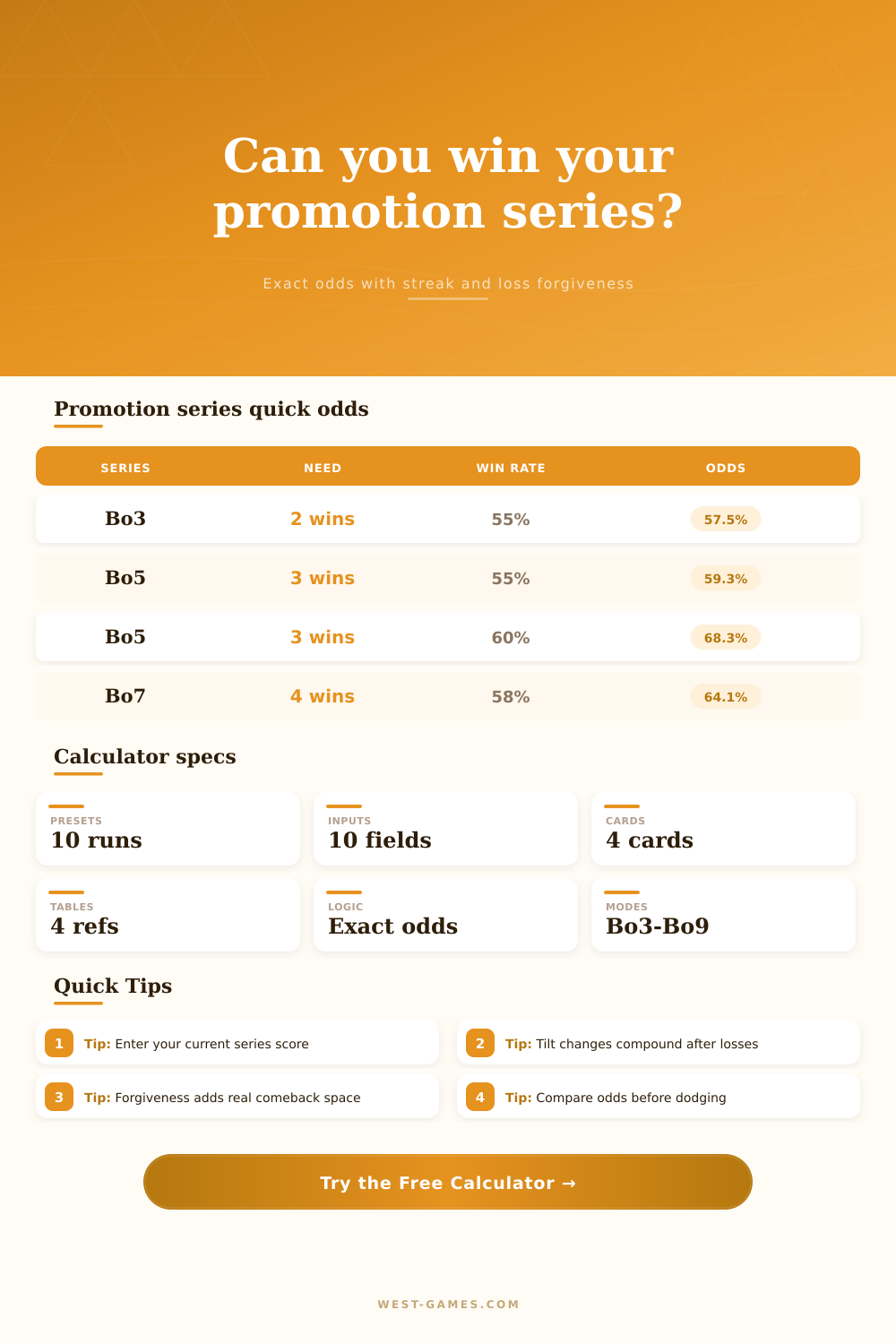
| Best of 3, need 2 wins | 50.0% | 57.5% | 64.8% | 71.8% |
| Best of 5, need 3 wins | 50.0% | 59.3% | 68.3% | 76.5% |
| Best of 7, need 4 wins | 50.0% | 60.8% | 71.0% | 80.0% |
| Best of 9, need 5 wins | 50.0% | 62.1% | 73.3% | 82.8% |
| Form Setting | Typical Range | Model Effect | Use When |
|---|---|---|---|
| Win streak boost | 0% to 3% | Adds chance per consecutive win | You play better with momentum |
| Tilt penalty | 0% to 5% | Subtracts chance after loss streak threshold | You queue worse after losses |
| Tilt start | 1 to 3 losses | Delays penalty until streak is reached | One loss does not affect you |
| Probability clamp | 5% to 95% | Prevents impossible certainty | Any competitive matchmaking ladder |
| Forgiveness Type | What It Changes | Best Use | Risk Note |
|---|---|---|---|
| Dodge / remake forgiveness | Offsets current or future losses | Bad lobby, autofill, disconnect remake | Does not improve game skill |
| Promotion loss forgiveness | Adds protected loss slots | Rank shield, provisional buffer | Can hide tilt damage |
| Current score wins | Reduces wins still required | Mid-series recalculation | Pressure rises near final game |
| Current score losses | Consumes loss room first | Tracking comeback odds | Must be entered accurately |
| Scenario | Series State | Input Profile | Read The Result As |
|---|---|---|---|
| Fresh promotion attempt | 0 wins, 0 losses | Base WR only | Your clean ladder expectation |
| One win banked | 1 win, 0 losses | Momentum enabled | How much early lead matters |
| Elimination game | Near loss cap | Tilt settings visible | Chance to survive the next branch |
| Protected comeback | Loss forgiveness active | Extra loss room | How much shield value remains |
Skill plus psychology lead to series of promotions. By this time, you’ve prepped, practiced and are ready to go, but now it’s come down to something that seems so arbitrary, a matter of nerves. A lot of times it isn’t about being the most talented. For player, it’s more about handling pressure during each match and having your score on the line.
The typical player views his or her win rate as something constant: “If I’m winning 55% of the matches in regular lobbies, then I’ll be getting into Promos at around 55%.” Most players is forgetting about impact of tilt and streaks on their win rate during a series. Your momentum (i.e., feeling) isn’t simply subjective; it represent a measurable shift in probability that affects your odds with each outcome.
How Nerves and Mood Change Your Chances
Winning multiple matches in a row boost your confidence and sharpens your decision-making, resulting in higher-than-average win rate. Conversely, losing two games can lead to frustration which negatively impacts your play. Because this tool takes this into consideration rather than calculating an even average, you get a better understanding of where you currently stand.
To build confidence in the output, it’s important to know what goes into it. Your initial “base” match win probability represent your neutral skill level, while streak boost and tilt penalty fields represent how that form change throughout the series. You should of positively adjust up if you tend to get in a flow state after winning three games, or add a negative tilt penalty if you start playing recklessly aggressive after losing two games.
The reason these tweaks make a difference is because they change possibilities for the series outcome. Someone who resists tilt but has high streak potential could be a wild card, alternating between super high promotion chances and almost certain elimination depending on first few matches.
Strategy comes from the forgiving nature of matches: Dodge forgiveness and loss shields extend length of the series without increasing number of wins required. This means less pressure per match. With fewer losses permitted, every match is now a must-win match. That puts pressure on people to make mistakes. Buying back with legit remakes/rematches/rank protection slots create extra room to come back from an unlucky beginning.
Standard models don’t consider things that happen mid-series such as protected losses/tilts. How win rate & series length interact can be seen in the reference tables. If your base win rate is less than half (i.e. 50%), mathematically speaking, it’s a bad idea to go chasing promotion. The bracket system are designed for you to fight against the numbers.
The longer the series, the harder it is to close the skill gap using only luck. Sure, maybe you think you’ll out-play everyone in the lobby, but the odds aren’t stacked in your favor. Before you queue up, take time to check the numbers and see what your realistic odds are. If they’re not great? Avoid wasting your time and instead play some regular matches, increase your true win-rate buffer, and avoid relying on variance.
But in the end it’s all about managing tilt, not perfecting it. It’s knowing your own tilt triggers and knowing when forgiveness slots apply. That lets you go into the ladder with a clear head. You can view matches less like singular event and more as a dynamic system. This system is shaped by past outcomes, which changes the probability of future ones.
And understanding that makes you less anxious, because you’re not shocked by swings anymore. You expect them. You factor them in. You plan around them. It’s not just climbing over hurdles. It becomes walking a path.