Lead Time Calculator
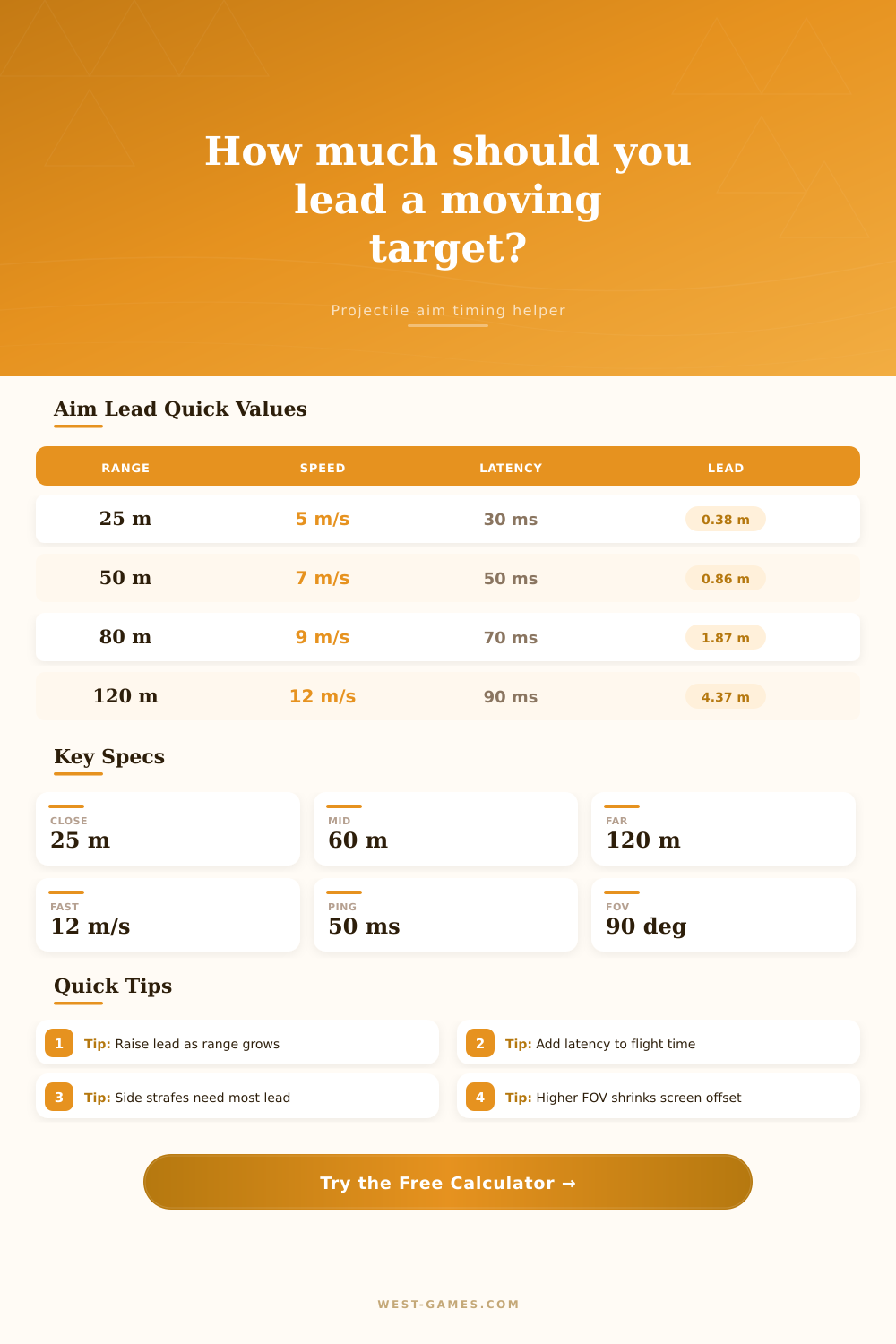
Estimate projectile travel time, moving-target lead distance, and reticle offset from target speed, angle, range, latency, FOV, and strafe direction.
⚙ Scenario Presets
🎮 Aim Inputs
📊 Current Spec Snapshot
🔬 Projectile Comparison Grid
| Profile | Typical Speed | Useful Range | Lead Feel |
|---|---|---|---|
| Near Hitscan Rifle | 300 m/s | 0–150 m | Tiny hold unless latency is high |
| Fast Energy Bolt | 160 m/s | 20–120 m | Small but visible side lead |
| Vehicle Cannon | 120 m/s | 50–250 m | Moderate lead on fast targets |
| Rocket Projectile | 80 m/s | 15–90 m | Needs readable target pathing |
| Bow or Crossbow | 70 m/s | 10–80 m | Strong lead at long range |
| Grenade Launcher | 45 m/s | 10–60 m | Large lead, arc not modeled |
| Slow Plasma Orb | 28 m/s | 5–40 m | Very large predictive lead |
💡 Movement Angle Reference
| Angle | Motion Type | Side Component | Calculator Effect |
|---|---|---|---|
| 0° | Directly toward or away | 0% | No horizontal lead from movement |
| 30° | Shallow diagonal | 50% | Half the target speed counts |
| 45° | Diagonal strafe | 71% | Noticeable offset at mid range |
| 60° | Wide diagonal | 87% | Almost full strafe lead |
| 90° | Full side strafe | 100% | Maximum horizontal lead |
⏱ Latency and Timing Reference
| Network Feel | Latency Input | Added Lead at 7 m/s | Practical Read |
|---|---|---|---|
| LAN or excellent | 10–25 ms | 0.07–0.18 m | Mostly projectile timing |
| Solid online | 30–55 ms | 0.21–0.39 m | Small extra hold |
| Average server | 60–90 ms | 0.42–0.63 m | Latency becomes visible |
| High ping | 100–150 ms | 0.70–1.05 m | Favor earlier shots |
| Unstable match | 160 ms+ | 1.12 m+ | Expect inconsistent confirms |
🖥 Reticle Offset Reference
| Offset Result | Visual Meaning | Best Use | Risk |
|---|---|---|---|
| 0–20 px | Inside target silhouette | Fast rifles, close fights | Over-leading is common |
| 21–70 px | Just ahead of edge | Mid-range strafes | Target jukes can punish |
| 71–150 px | Clear space ahead | Rockets, bows, cannons | Needs smooth tracking |
| 151–300 px | Large screen hold | Slow projectiles | Prediction dominates aim |
| 300 px+ | Extreme offset | Long range slow shots | Wait for a better path |
📝 Aim Notes
You pull the trigger and watch as your shot falls just a bit to the left. They shifted right and you led, but you still missed as your bullet hit nothing but air where they once were. Anyone that go from hitting a target with hitscan weapons to one requiring a projectile with travel time makes this mistake. It’s not a matter of raw aim. It’s a matter of time. You’re thinking about position as if it happens instantly, but to make an accurate shot, you must also factor in how long it takes your projectile to get there. That’s the lead time, and learning to master it turns frustrating misses into consistent kills.
That’s why I built this tool, which turns latency, speed and range into actual pixel offset. You won’t have to do head-scratching trigonometry in combat anymore. Just put in what you care about. Start with target speed. Angle counts too. If they’re headed straight for you, there’s no horizontal component to compensate for. A perpendicular strafe? It is maxed out. Everything else falls somewhere in between, typically around a 45-degree angle. This gives them approximately seventy percent of their total speed along the axis you’re trying to hit them on. That kind of geometry make the difference between a good shot and a great one.
How to Lead Your Shots Better
It gets complicated with latency, which doesn’t exist in local play. When I shoot, my shot command goes out to a server, gets processed, and returns projectile data back to their client. Since your ping will be higher sometimes, they’re going to see you shoot after the fact. This means that by the time the bullet reaches them, they has moved away from where you aimed. So we add the latency time into flight time of the calculator. This way you account for both the travel of the projectile and the delay in the network. Because even though it doesn’t feel as immediate as gravity, it have just as much effect if you ignore it.
Lead also depends on field of view. Wider fields of view distribute more of your visual world across screen, which makes any given angular adjustment look smaller on-screen. Depending on your settings, you may have to lead something by ten degrees no matter what, but those ten degrees will occupy roughly eighty pixels if you’re at one-hundred-twenty FOV and fifty pixels at ninety. That’s why casual players who pick up a mouse after spending time in competitive play are so likely to over-shoot targets: what they saw happen with their crosshairs didn’t match what actualy happened. It’s part of the reason why many people goes through some kind of training room, where they adjust for this sort of difference in perception.
Each type of projectile has its own mental model. Unless there’s a big spike in latency, you have very little lead when firing a near-hitscan rifle, it’s instant. Rockets and arrows moves slowly enough that you see where the target is going to be before they are on top of you. The tool breaks those profiles out into comparison grid so that you can see impact of velocity on timing. If you fire a slow moving plasma orb, the window for error gets stretched out and you need to make some crazy predictive aim to hit them. It becomes almost like playing a game of reaction versus prediction.
Prediction.
The only way to learn these things is by practicing. Reflexes are one thing, but precision comes from calculators. Take some time getting used to it in practice modes where you know the distance and speed. Learn what three meters of lead looks like at fifty meters versus two hundred. What does a twenty millisecond delay cost you on the screen? When you get that feel for space, that’s when the math turn into muscle memory. Instead of doing calculations in your head, you’re learning to see where they will be. It’s not so much that you calculated exactly right as it is that your instincts caught up with the physics engine and boom, the ball goes through.