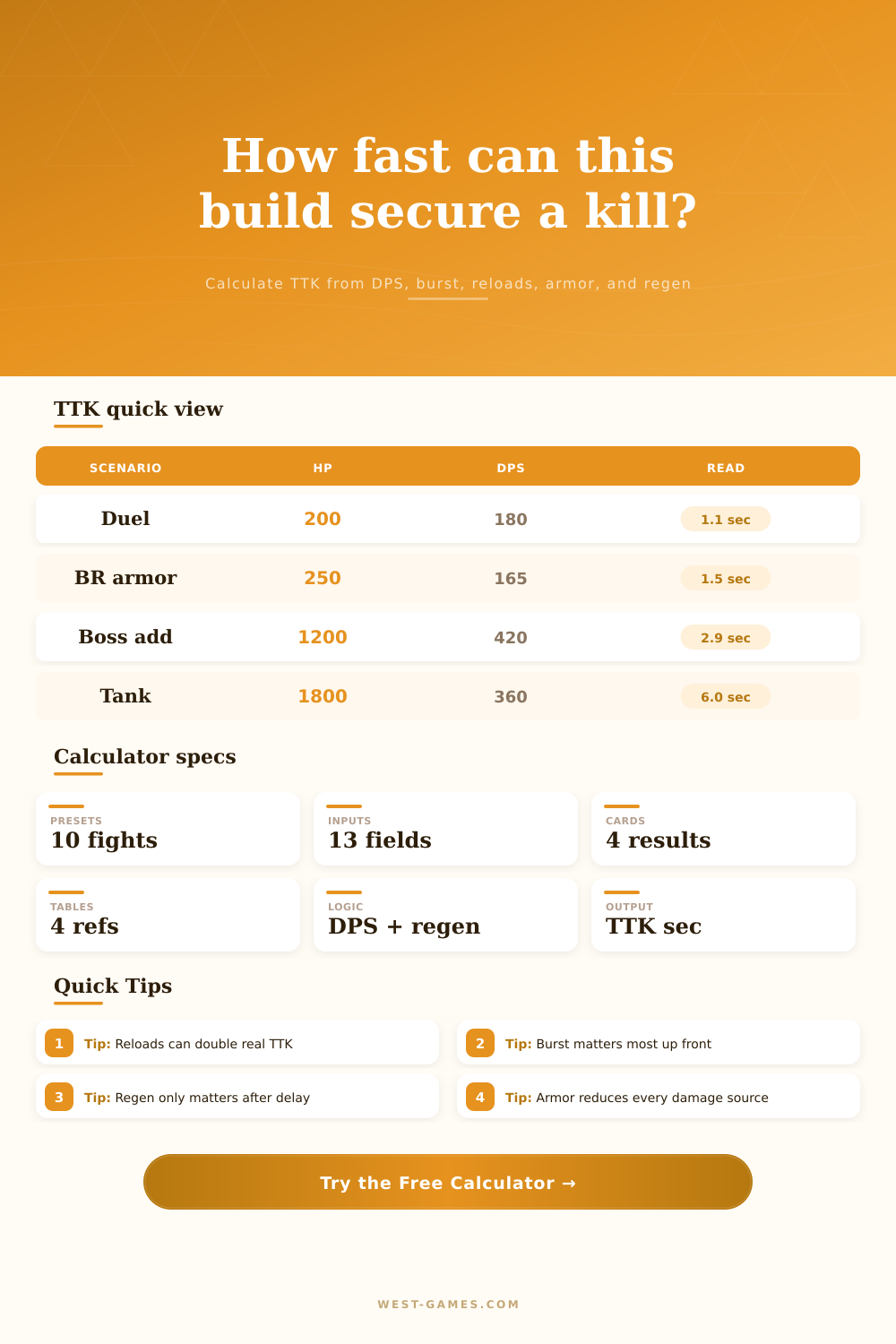
Time To Kill Calculator
Estimate combat TTK from target health, shield pool, armor or resistance, weapon DPS, burst windows, reload downtime, accuracy, weakpoint damage, healing, and delayed shield regeneration.
TTK model: sustained weapon DPS is reduced by reload cycle, accuracy, weakpoint factor, and mitigation. Burst damage is averaged by cooldown, healing subtracts from pressure, and shield regen applies only after its delay.
TTK Breakdown
Kill Pressure Read
Current Setup
Uses all active inputs including mitigation, accuracy, reload downtime, burst cooldown, healing, and delayed shield regen.
No Reload Loss
Shows the TTK if the listed weapon DPS could continue without magazine downtime or reload exposure.
Plus 10% Accuracy
Raises practical hit rate by ten percentage points, capped at 100%, to test aim improvement value.
No Enemy Sustain
Removes healing and shield regeneration so you can isolate raw defensive sustain from the TTK result.
| Archetype | Typical pool | Mitigation | TTK impact |
|---|---|---|---|
| Glass duelist | 150 to 250 HP | 0% to 8% | Accuracy changes matter more than reloads. |
| BR armored | 225 to 300 HP | 5% to 15% | One missed reload can decide the trade. |
| Hero tank | 650 to 1000 HP | 15% to 30% | Sustain can turn fast kills into long burns. |
| Boss add | 1000+ HP | 10% to 35% | Burst cooldown and uptime dominate the read. |
Pools vary by game, but the relationship between pool, mitigation, reload, and sustain stays useful for planning.
| Profile | Strength | Weakness | TTK note |
|---|---|---|---|
| Rifle / AR | Stable DPS | Mid reloads | Good baseline for mixed ranges. |
| SMG | High close DPS | Accuracy falloff | Practical accuracy drives real TTK. |
| Sniper | Opening burst | Low sustain | Weakpoint multiplier can outweigh DPS. |
| Launcher | Big burst | Long reloads | Cooldown and reload downtime must be counted. |
Use the weapon profile to frame the result; the numeric fields still control the calculation.
| Defensive layer | Input field | Model behavior | When it matters |
|---|---|---|---|
| Armor or resistance | Mitigation % | Reduces all applied damage. | Always active from first hit. |
| Healing | HP/sec | Subtracts from kill pressure. | Matters most in long TTK fights. |
| Shield regen | HP/sec + delay | Starts after the delay timer. | Only affects kills that exceed delay. |
| Extra shield pool | Shield HP | Adds to total damage required. | Raises both burst and sustain needs. |
Delayed regen is handled in two phases: before regen starts, then after regen begins countering damage.
| TTK band | Combat feel | Common cause | Adjustment to test |
|---|---|---|---|
| Under 0.8 sec | Instant pick | High burst or low pool | Lower burst or raise health. |
| 0.8 to 2.0 sec | Fast duel | Strong DPS, moderate armor | Test accuracy and reload exposure. |
| 2.0 to 5.0 sec | Sustain fight | Armor, shields, or healing | Compare no sustain and no reload loss. |
| Over 5.0 sec | Burn phase | Large pool or heavy mitigation | Add burst or reduce regen window. |
These bands describe pacing rather than balance rules; use your game mode and engagement range as context.
| Change | Weapon DPS | Net pressure | Estimated TTK |
|---|---|---|---|
| Waiting | 0 | 0 | Ready |
Rows recalculate from your current fight profile so small DPS, accuracy, and sustain changes can be compared quickly.
Time to kill bridges gap between theorycraft and the realities of combat. A stat page might show high number in terms of damage per second, but when you’re actually firing it’s likely lower due to missing shots or having to reload. That’s where disconnect arises: raw damage per second is an optimistic statistic that assumes you’ll never run out of ammunition or miss any shot. Those two assumptions fall apart right away in practice. There’s armor reducing its impact, there are missed shots and there’s reload downtime.
Instead of simply taking the listed values from your gun and copying them into calculator, you can put in real-world reload cycles and accuracy so it will do math for you. Why does this matter? Because a weapon with higher raw damage per second may lose duels to a slower-firing rifle with quicker reloads.
Real Combat vs Paper Stats
Regeneration and shields is another factor. Breaking a shield doesn’t mean you killed the target. And in some cases there’s a delay before the shield starts regenerating after being damaged. If you gradually whittle down character’s shields, it may be too long before you’re able to take advantage of it during which time the shield will fully recharge again. That leads to sort of a soft ceiling on how much damage you actualy do.
You can only sustain X amount of damage per Y time frame rather than just having raw firepower. That’s especially true with burst damage, which isn’t a steady stream, it comes and goes. You could use a heavy attack or throw a grenade and deal ridiculous amounts of damage … but then that attack has to cool down. It won’t be available for every moment of combat.
That’s why the tool accounts for how much damage that burst will average across its cooldown time. That way, when you have an ability that does a lot of damage but triggers only every 10 seconds, it doesn’t inflate your perception of how valuable that ability is. It brings you back down to earth about what you’re actualy capable of doing in a 30-second battle.
Another issue lowering efficiency are armor reduction. A 20% damage resistance seems reasonable enough. However, it is applied to every single blow. This makes combat last longer and allows enemies more time to recover or counter. The enemy is healed? Now your total damage output suffers further. You’re still doing three-hundred damage per second…but they’re recovering fifty health. That means you’re only narrowing the gap by two-hundred and fifty. It transforms a rapid kill into an extended war of wearing them down, with positioning trumps firepower.
We spend way too much time worrying about weapon and not enough about the fight. Do I have a glass cannon that wrecks things in less than a second but melts under heavy armor? Are we fighting an armored tank? Do I want a sniper to punch holes through their defenses or do I want something more sustained like an assault rifle? The reference tables allows you to look at different types of target archetypes, compare the results and see what the difference is between shooting at a sniper pick versus a prolonged assault rifle battle.
That context allows you to select your gear based off who you’ll be facing and not just which weapon looks the coolest or has the best base numbers. Knowing those things lets you be more intelligent with loadouts. If most of your battles are against shield regenerating armored foes, maybe you trade up from a high-damage gun in favor of something faster to shoot and more accurate since their shields create a soft ceiling that requires bypassing their regeneration.
Match damage type to armor strength. Don’t go hunting to do damage, hunt to do damage efficienty enough that the other guy can’t respond in kind. Your overall win rate has a tendency to climb when you stop trying to chase numbers and start actually playing the game as it unfolds. It’s less of a roll of the dice and more of a calculated response in that first split second.
You should of used this tool sooner.