📈 Exponential XP Curve Calculator
Design RPG level curves with base XP, growth multipliers, cumulative totals, cap levels, rounding, and balancing previews.
| Level | XP for next level | Cumulative XP | Hours from start |
|---|
Rows are sampled across the selected level range so you can inspect early, mid, and cap pacing at a glance.
| Multiplier | Steepness | Common use | Watch for |
|---|---|---|---|
| 1.05x-1.15x | Very gentle | Story games | Low long-term pressure |
| 1.16x-1.25x | Moderate | JRPG campaigns | Midgame reward pacing |
| 1.26x-1.40x | Steep | ARPG and MMO | Late level gaps |
| 1.41x-1.70x | Very steep | Idle and prestige | Reward inflation |
| 1.71x+ | Extreme | Short loops only | Cap frustration |
The calculator rates steepness from your actual multiplier and cap distance.
| Metric | Formula | Meaning |
|---|---|---|
| Level XP | base x multiplier^offset | XP needed for that level-up |
| Rounded XP | round(level XP / step) x step | Readable player-facing value |
| Cumulative XP | sum of rounded level XP | Total XP needed to reach level |
| Hours to target | remaining XP / XP per hour | Balancing preview for grind time |
Rounding is applied per level before cumulative totals, matching how most shipped RPG tables are authored.
| Hours to target | Player feel | Design note |
|---|---|---|
| 0-3 hours | Fast unlock | Good for tutorials and early builds |
| 4-10 hours | Meaningful goal | Good for campaign chapters |
| 11-25 hours | Long grind | Needs varied rewards and activities |
| 26+ hours | Endgame wall | Use soft caps, rested XP, or bonus events |
Compare the grind preview against how often players receive new skills, gear tiers, and content unlocks.
| Preset | Base | Multiplier | Cap |
|---|---|---|---|
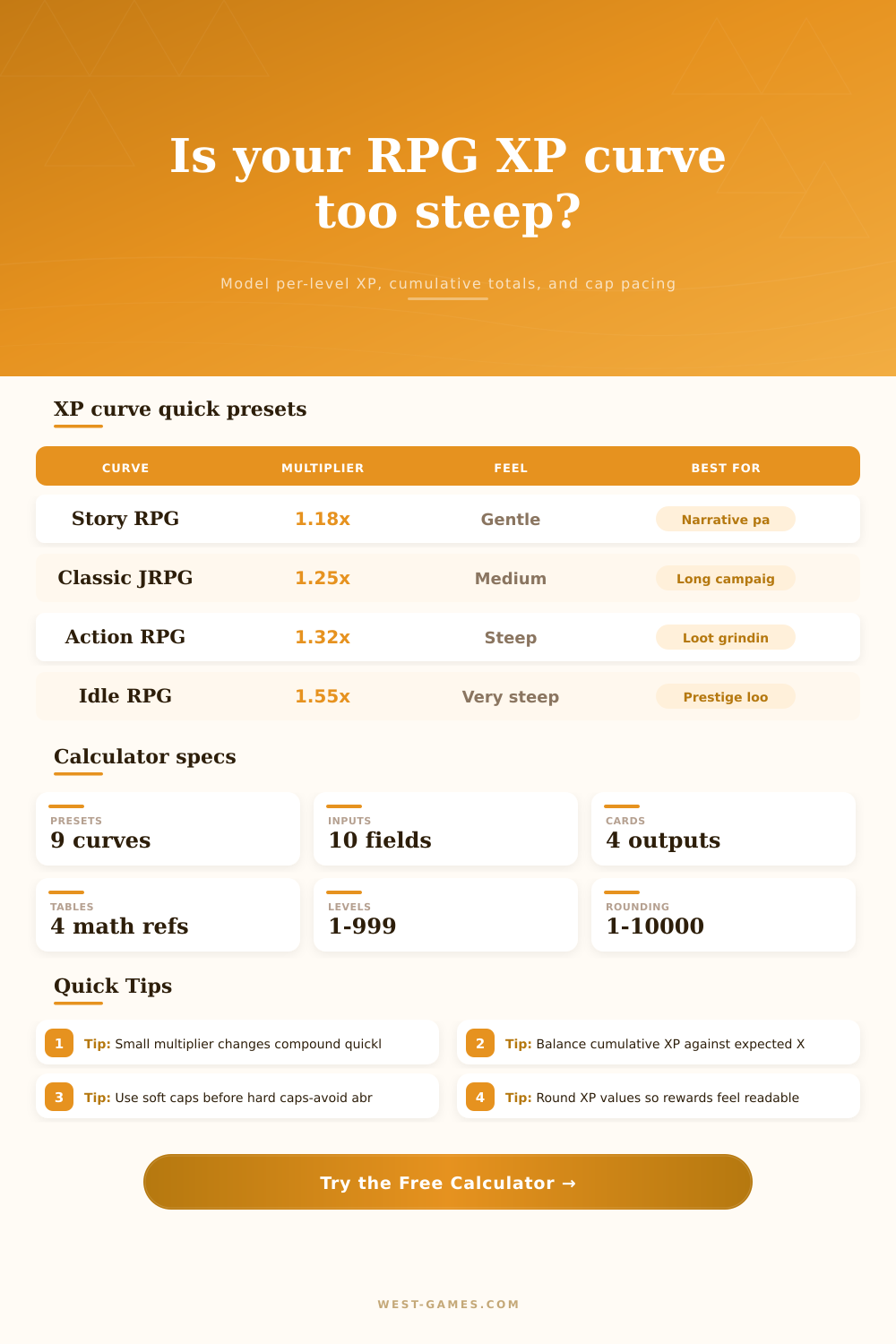
| Story RPG | 80 | 1.18x | 30 |
| Classic JRPG | 100 | 1.25x | 50 |
| Action RPG | 120 | 1.32x | 70 |
| MMO Questing | 250 | 1.28x | 80 |
| Idle RPG | 25 | 1.55x | 150 |
Presets are starting points, not rules. Tune them against your actual encounter reward economy.
But it all depends on numbers that power level forty.
How hard a game’s experience points system are to reach is less mathematical than psychological. This calculator takes care of those exponential curves for you. You can see how a tiny change in growth multipliers compounds over time to make big differences as you get further along. At its heart, it’s about how far and how fast the player should progress. Make it too quick and they’re done playing by the time they reach the plot, too slow and they’ll give up because they aren’t getting anywhere.
How Game Levels Work
Typically, developers begin with a baseline amount of XP needed to level from 1 -> 2 which will establish the cadence. This isn’t particularly tangible until you understand it governs a new player’s first sensation of achievement. On one hand, you want the experience to feel rewarding right away, but if it’s too easy, they won’t appreciate the effort put into early portions of gameplay.
If you want a slower climb, perhaps for a story-driven game where the feeling of leveling up matters more than stats, a smoother slope might use a multiplier of about 1.18. And once that curve starts growing beyond a certain point? The math will take over exponentialy. Every next level demand more experience then the one before it, scaling to match whatever multiplier you’re using. This is where a lot of project fail.
Moving from one point two five to one point three doesn’t sound like much on a piece of paper but it’ll significantly lengthen the time spent before reaching end-game content. That’s laid out in reference table on the page, which shows how steepness maps to different expectations for each genre. Steeper curves tend to be used by action RPGs to fuel their loot grinding loop. Idle games could push them even higher to show difference between multiple prestige tiers.
It’s also necessary to understand cumulative costs at each level, rather than simply per-level costs. Gamers don’t conceptualize the game in terms of “this level gap,” instead thinking about total number of hours played to hit some goal. This determines the grind preview, how many hours might be spent hitting a given target level. It also provides a realistic time estimate when you’ll hit those target levels.
Suppose it would of take forty hours to get to level fifty, while your main campaign only lasts ten hours? You’ve got a pacing issue. Tweaking the cap level or adjusting the hourly XP reward rate can solve that mis-match without upsetting the underlying economy.
The other thing that unexpectedly influences way people play is rounding. A nice round number such as 500 or 1000 sticks in a person’s head better than an odd number like 842. You can use this calculator to round those numbers, making your progression milestones seem more intentional and less random. It may not be important to some but when trying to build trust with your audience, it does matter.
Another type of control is soft caps that don’t have any hard limits at all. They still dramatically raise the XP needed so there’s no hard stop to advancement, but it also slows things down naturaly. It means there are always end-game player active and they don’t need to constantly add content. The soft cap falls somewhere in between the strict exponential or linear models, as shown on the comparison grid. That’s where long-term retention come into play.
Ultimately it’s about gradual progress. Regardless of whether you’re building a big multi-player universe or a simple mobile game to play on the subway, the math apply the same way. Play-test your curves as soon as possible and frequently, and observe how players respond to points where the pace slows (bottlenecks) or accelerates (progression surges).
Player experience is what makes it work… Not the math. If you get it right, those “level-up” experiences feel organic instead of forced; players become hooked from the beginning to end.