⏱ Grind Time Calculator
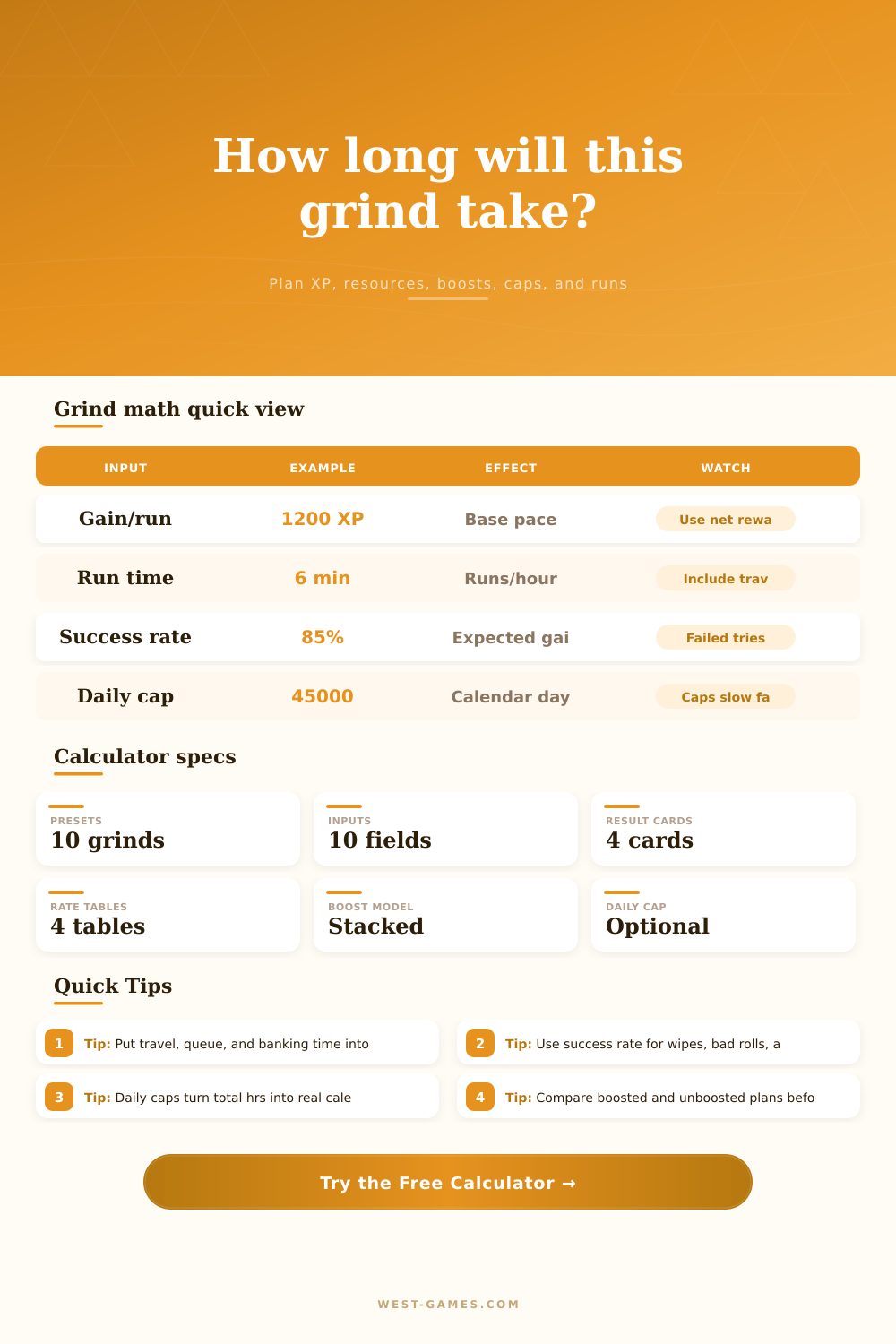
Estimate how many runs, hours, and calendar days a game grind will take after success rate, downtime, boosts, daily caps, and daily play time.
Same run time and success rate, but boost multiplier and bonus removed.
baselineShows the best case if every attempt gives full reward.
clean clearsUseful for seeing how much queues, travel, and resets cost.
speed routeCalendar estimate if you can only play half the entered daily hours.
schedule risk| Activity pace | Gain/run | Minutes/run | Raw rate/hour |
|---|---|---|---|
| Slow quest loop | 1,000 | 10 | 6,000 |
| Average dungeon route | 12,000 | 8 | 90,000 |
| High efficiency XP farm | 45,000 | 6 | 450,000 |
| Daily-capped reputation loop | 1,500 | 5 | 18,000 before cap |
Raw rate does not include success rate, downtime, cap, or fatigue. The calculator applies those above.
| Boost source | Typical multiplier | Best use | Planning note |
|---|---|---|---|
| Rested XP or rested bonus | 1.25x to 2.00x | Leveling grinds | Spend on dense reward loops. |
| Weekend or event bonus | 1.50x to 2.00x | XP, rank, currency | Save long grinds for event windows. |
| Premium or consumable boost | 1.10x to 2.50x | Timed sessions | Include downtime so paid time is not overstated. |
| Guild, group, or food bonus | 1.03x to 1.20x | Repeatable farming | Small boosts matter over hundreds of runs. |
| Modifier | What it represents | When to raise it | When to lower it |
|---|---|---|---|
| Downtime | Non-reward minutes between attempts | Queue, travel, banking, wipe recovery | Premade group, saved route, nearby vendor |
| Success rate | Chance that an attempt pays full gain | Stable clears, guaranteed rewards | Wipes, PvP losses, missed objectives |
| Fatigue penalty | Long-session slowdown | Late-night, hard mechanics, repetitive routes | Short sessions, relaxed farm, rested player |
| Daily cap | Reset-limited counted progress | Reputation, focus, resin, token limits | Unlimited XP or open-world material routes |
| Preset | Goal type | Cap style | Why it matters |
|---|---|---|---|
| OSRS Rooftop Agility | XP | None | Small downtime changes the hour count quickly. |
| WoW Reputation Farm | Reputation | Daily reset | Calendar days can exceed actual play hours. |
| FFXIV Tomestones | Currency | Weekly style cap | Useful for translating roulettes into unlock dates. |
| Warframe Focus Cap | Focus XP | Daily cap | Fast farms still wait on reset limits. |
The progress bar stares back at you. Ninety percent! That’s success right there, right? Nope. It’s a mathematical trap that snares nearly all player sooner or later: The last portion of any video game grind take exponentially longer than the early stages because the figures become to concrete to ignore; they demand hours out of your life rather than abstract goals. How many hours do I have left until I’m done? Is this going to take me weeks of monotonous clicks? Will I be able to finish before expansion drops?
Enter the calculator above. It breaks down those random goals into real-world calendar days while taking into account the kind of friction that raw mathematics fails to appreciate. Players typically guess at how long something will take based off dividing their goal by their per-run reward. That’s a critical mistake as it makes assumption that runs are not only uninterrupted but perfect. Real life gaming includes dead time: resetting from a wipe, queuing up for matches, traveling around maps, banking item. Dead time accumulates more quickly then you realize.
Why Grinds Take So Long and How to Plan Them
For instance, if you assume an 8 minute dungeon clear with a couple of minutes spent travelling between runs, you’ve now made each session longer by 25%. The tool considers this dead time, and what shows on the clock on the wall is reflected in your estimate, not just in-game combat timer.
But it’s worse: Success rates aren’t just important, they’re doubly so. If a boss fight has a ten percent failure rate, it doesn’t mean that you lose ten percent of what you’ve been doing. You lose 10% of the times you try, meaning that all of those losses still took up time while delivering no results. That’s crucial when dealing with random drop farming or other high-difficulty content. And because your actual gain change based on success rates, a six-hour gig can end up taking eight hours. It compels you to admit that there is such thing as lucky hours.
And then there’s what screws it all up: the modifiers. The boosts make you go “oh wow” in the moment, but they also greatly change denominator side of your time equation. Rested bonuses, or weekend double-experience events don’t just tack numbers onto the numerator. They squash your timeline. But this squashing have a limit: a hard cap set by daily caps. You can spend two hours farming every hour in a day, but if the game only gives you ten thousand reputation points per day, you’ve just spent an additional twelve hours doing nothing but wasting motion.
That’s where your calendar days output comes in. It distinguishes between playtime and progress slots available. Finally, take into account how tired you’ll be. Nobody operates at best efficiency when grinding away for 40 hours in a row, which is why there’s a fatigue penalty input. Attention drifts. Mistakes increase. Reaction time slow down. Accounting for a small loss in efficiency during longer sessions makes the plan honest. It eliminates optimism bias (which causes burnout). “Oh I can grind through the night.” No, says the math: Smarter to break it up into manageable chunks.
This is where this tool shines, it shows you exactly how much each of these variables cost through the comparison grid. You can see the contrast between a baseline run to a boosted run, which allows you to know if it’s worthwhile to buy a boost now or hold out until an event. This turns personal feelings into measurable value. Maybe you’ll find that your best use of your premium boosts is on the days with a daily cap. This will give you the most bang for your buck, rather than pulling one out at random whenever you’re too lazy to do otherwise.
In the end, that’s what planning a grind real is. It’s setting your expectations. The numbers don’t lie, but they also don’t tell you how frustrating it is to repeat something over and over. However, they do take away the anxiety of the unknown. They quantify the time investment up front so you know whether or not you’re willing to put in the work for the reward before you ever make the first run. That allows what might otherwise feel like a tedious chore to become a chosen commitment. It becomes a drive rather than being driven by progress bar. Knowing exactly what you’re getting yourself into is sometimes all that separates dread from completion.