RS3 Combat Level Calculator
Calculate RuneScape 3 combat level with the 138-style EOC formula, active combat style weighting, next-level thresholds, and a practical training path.
Combat style weighting
Next combat level thresholds
Focused training plan
XP from level floors
| Formula part | Included levels | Calculation | What it means |
|---|---|---|---|
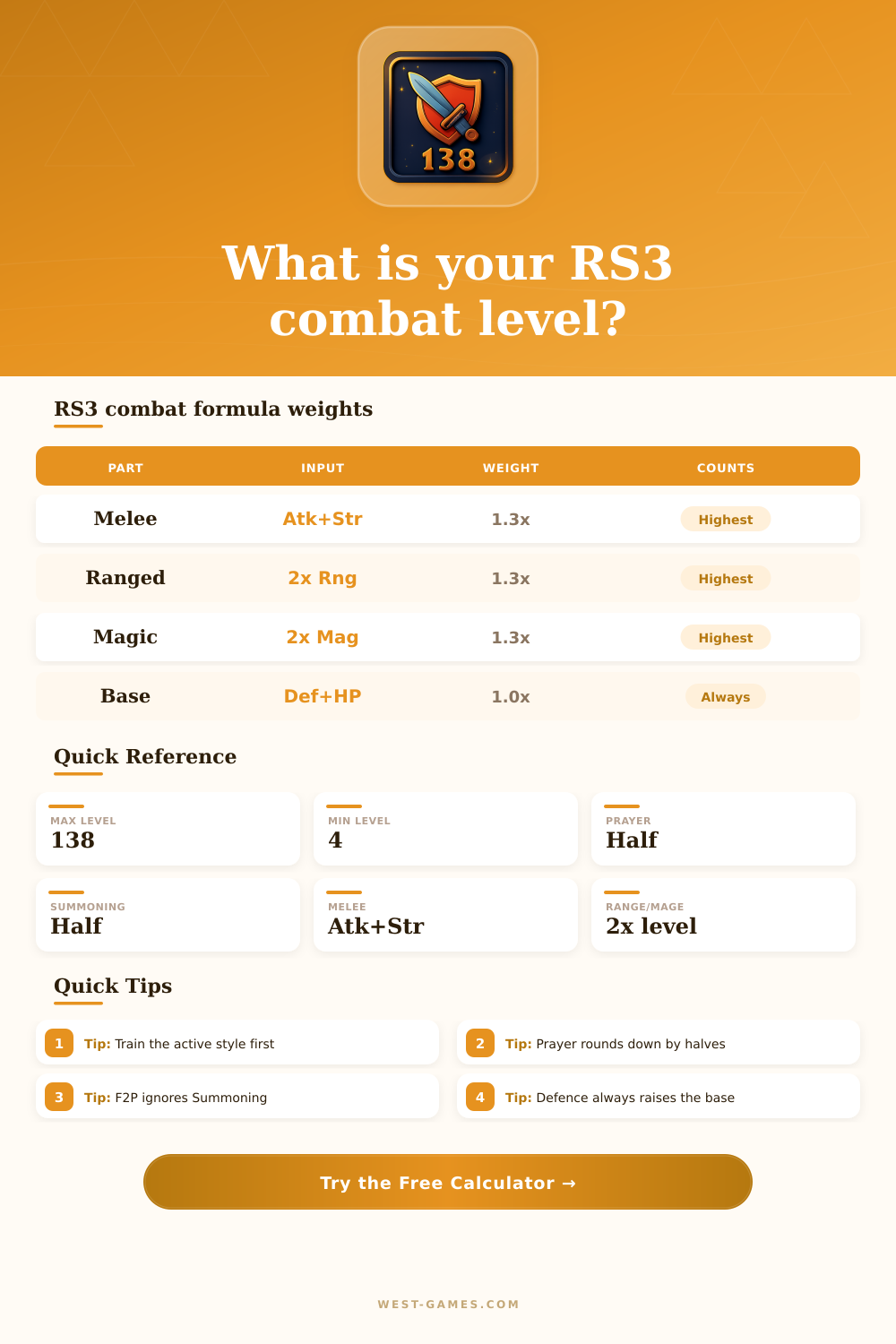
| Melee offence | Attack and Strength | 1.3 × (Attack + Strength) | Only counts if it is the highest offensive branch. |
| Ranged offence | Ranged | 1.3 × (2 × Ranged) | Single-skill branch balanced against two melee skills. |
| Magic offence | Magic | 1.3 × (2 × Magic) | Single-skill branch balanced against two melee skills. |
| Defensive base | Defence and Constitution | Defence + Constitution | Always contributes, regardless of active combat style. |
| Support base | Prayer and Summoning | floor(Prayer / 2) + floor(Summoning / 2) | Half-level contribution, rounded down before the final division. |
| Displayed level | All counted parts | floor(total / 4) | Decimals are not rounded up for the shown combat level. |
| Level | Total XP floor | Typical combat meaning | Planning note |
|---|---|---|---|
| 10 | 1,154 | Constitution starting band | Early accounts move combat levels quickly. |
| 40 | 37,224 | Rune weapon and armour tier area | Balanced melee starts to overtake low ranged or magic. |
| 60 | 273,742 | Mid-game combat tier | Defence and Constitution begin adding steady base levels. |
| 70 | 737,627 | Common boss entry preparation | Prayer breakpoints may be more useful than raw combat level. |
| 80 | 1,986,068 | High-tier training target | Use the active branch to avoid wasted off-style levels. |
| 90 | 5,346,332 | Late-game combat foundation | Support skills can push final combat thresholds efficiently. |
| 99 | 13,034,431 | Classic skill cap | Max 138 requires high offence, base, and support contribution. |
| Build focus | Offensive driver | Base pressure | Combat-level behavior |
|---|---|---|---|
| Melee specialist | Attack + Strength | Defence and Constitution still count | Needs both melee skills high to compete with one high style. |
| Ranged main | 2 × Ranged | Prayer and Summoning add slow support levels | One strong ranged level can outscore uneven melee levels. |
| Magic tank | 2 × Magic | Defence increases every formula result | Combat rises from both spell power and tank base. |
| Summoning-aware wilderness account | Highest combat branch | Summoning may display as a plus bonus | Check split display before judging Wilderness range. |
| Free-world account | Melee, Ranged, or Magic | Summoning treated as level 1 | Members and free-world displayed levels may differ. |
| Training choice | Formula impact | Best when | Threshold warning |
|---|---|---|---|
| Attack | Adds 1.3 to melee branch | Melee is active or nearly tied | No combat gain if Ranged or Magic stays higher. |
| Strength | Adds 1.3 to melee branch | Melee is active or nearly tied | Works like Attack for combat level math. |
| Ranged | Adds 2.6 to ranged branch | Ranged is your main combat style | May jump thresholds faster than one melee skill. |
| Magic | Adds 2.6 to magic branch | Magic is active or close to active | Off-style levels wait until Magic becomes highest. |
| Defence | Adds 1 to every formula total | You want reliable base combat growth | Four Defence levels roughly equal one combat level. |
| Constitution | Adds 1 to every formula total | Combat training is also raising life points | Starts at level 10 on normal RS3 accounts. |
| Prayer | Adds 1 every two levels before division | You are one support half-level from a threshold | Odd levels can be a rounding pause. |
| Summoning | Adds 1 every two levels before division | Members world or familiar planning matters | Free worlds treat Summoning as level 1. |
You’ve spent hundreds upon hundreds of hours grinding out monster after monster in RuneScape 3. The ticks on your skill levels fill you with quiet satisfaction. But there’s always been something weirdly disconnected about a single number floating over your head and how strong you feel. Your combat level isnt just a representation of power. It’s a carefully crafted mix of your greatest strengths, skewed towards whatever it thinks you’re best at performing in any given moment.
This knowledge shifts the way you train. When you look at your combat level as a sign of strength overall… Instead of strength in a particular method, you’ll probably end up wasting your time training things that dont really impact your playstyle anyway. That is how the math works, and the system are set up this way to reward specialization.
How Your Combat Level Works
There are three branches of offensive stats: magic, ranged, and melee. For every one of these branches, the game assign it a score and only uses the best one when calculating your overall stat. So, for example, let’s say you put all your effort into being good at ranged; you’ve got level ninety-nine Ranged, but your Attack and Strength is merely levels forty. Those melee stats dont count towards your displayed combat level; they’re ignored by the combat calculator. They’ll neither increase nor decrease your displayed level, because the game consider you a specialist in ranged. If you want to farm Attack until your arms drop off, go right ahead, as long as Ranged stays higher, your combat level will remain unchanged. Most people dont understand that.
While Defence and Constitution act as your survival mechanics against all types of damage, they function independent from the active branch you’re attacking with. In other words, whatever offensive skill you choose to use will always contribute to your overall combat level. You have that solid, reliable base of damage reduction to fall back on.
Now things get slightly more complicated with Summoning and Prayer since those skills is partially weighted. Each point of contribution from those skills is cut in half then factored into the total. It requires double the support skills power to recieve an equivalent amount of influence as your primary attack type. This implies the player should specialize in one dominant combat style and supplement it with support abilities instead of letting them be driving force.
If you look at reference information given with this tool, it will clearly explain how those numbers work together. After plugging in your existing skill levels into the calculator above, it spares you the conversion and coefficient guesses. It finds out what kind of combat style you’re actively pursuing based off the weighted values of each magic/ranged/melee branch.
So if you decide to pick up a greatsword instead of a bow, dont expect your displayed level to bump up right away. That’s OK. What happened is you’ve just shifted which branch controls the equation. The highest value is still going to be the deciding factor until its weighted score tops the previous one. This mechanic can save you a lot of frustration if you plan accordingly with how you train.
Say you want to hit a certain combat stat in order to meet an entry requirement for some bosses? Consider what will give you the biggest bang-for-your-buck in terms of skill gains. Because Ranging (or magic) is doubled before being compared to any other skill, adding one point to either of those skills have a larger mathematical effect then adding one point to strength or attack. This doubling is there to offset the fact that melee requires two skills in order to be even.
While you’ll put in more effort up front by training two melee skills rather than just one, it also provides a wider base upon which to build your melee damage output, far past what your combat level says. This can also be illustrated with various build presets present in the interface: the progression curve for a pure mage differs quite significantly from that of an all-rounder who distributes experience equally between all combat skills. In the latter case, you’ll frequently see lower combat levels displayed for much longer since no individual branch will dominate the calculation during early stages. This isnt a bug; it’s a reflection of the idea that specialized builds achieve higher peak performance within certain contexts.
For free-to-play players, please note that Summoning doesnt factor into combat level in standard worlds, your progress will only be measured through your melee/ranged/magic/defensive stats.
In conclusion, your combat level is a snapshot of the strongest way you fight right now. It’s not necessarily an indicator of how well you can fight if you switch things up in-game, it’s an indicator of what the game believes you’re good at. Use this understanding to guide your training decisions. If you want to be more strong, start there. Then shore up your defense until your total resilience stays steady. And then boom: your number follows accordingly.
Because when you do the math, the number will reflect your work. You should of tried to go after everything. Just know which ones matter.