⚒ WoW Crafting Quality Calculator
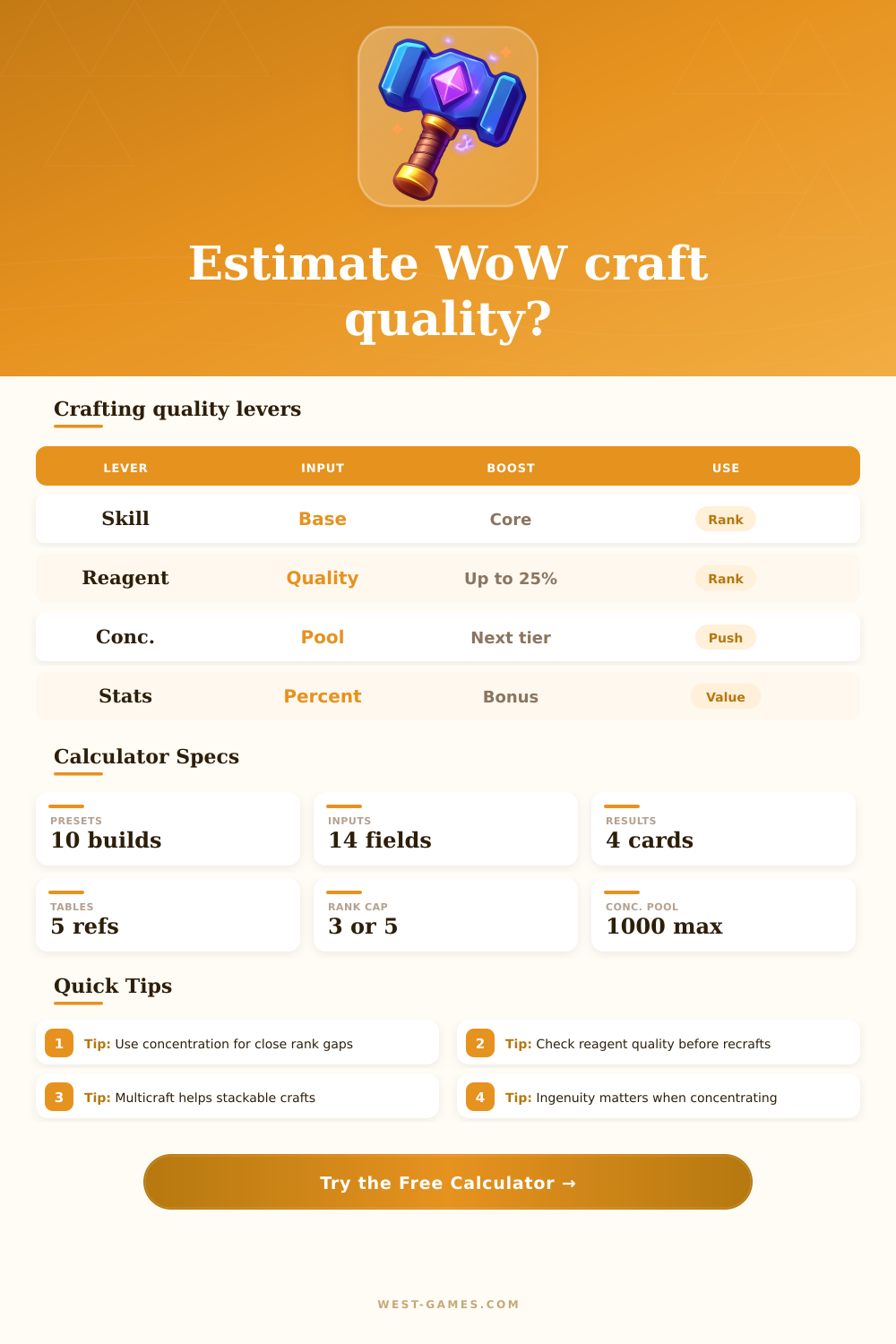
Estimate profession skill, recipe difficulty, reagent quality, concentration spend, secondary crafting stats, expected rank, bonus output, and recraft chance.
| Rank cap | Rank 1 | Middle ranks | Max rank |
|---|---|---|---|
| 3-rank craft | Below 70% | 70% to 99.9% | 100% skill |
| 5-rank craft | Below 40% | 40%, 60%, 80% | 100% skill |
| Concentration | Not needed | Can push next tier | Cannot exceed cap |
| Recraft | Use bonus field | Retest threshold | Compare attempts |
The model treats recipe difficulty as the max-rank threshold and divides lower ranks into practical bands.
| Stat | Best for | Calculator effect |
|---|---|---|
| Multicraft | Stackable crafts | Expected extra output |
| Resourcefulness | Material-heavy crafts | Expected reagent returns |
| Ingenuity | Concentration crafts | Expected concentration refund |
| Inspiration style | Older lucky-rank planning | Modeled as recraft success lift |
Retail concentration planning favors controlled quality pushes; older inspiration-style logic is represented as chance-based planning.
| Average quality | Skill share | When to use |
|---|---|---|
| Rank 1 | 0% of difficulty | Cheap tests and leveling |
| Rank 1.5 | 6.25% of difficulty | Mixed leftovers |
| Rank 2 | 12.5% of difficulty | Routine orders |
| Rank 2.5 | 18.75% of difficulty | Near-rank pushes |
| Rank 3 | 25% of difficulty | Max-quality attempts |
The reagent skill share is an approximation for planning and comparison, not a replacement for the in-game profession window.
| Option | Skill effect | Typical reason |
|---|---|---|
| No finishing reagent | +0 | Baseline craft quality |
| Minor finishing boost | +10 | Small rank gap |
| Major finishing boost | +20 | Medium rank gap |
| Insight-style boost | +30 | Max-order safety |
| Missive or option | -15 | Chosen secondary stats |
| Embellishment | -35 | Power option with difficulty |
Some optional choices add value but make the craft harder. Use the penalty rows to model that tradeoff.
| Preset | Profession | Rank cap | Main stat | Planning angle |
|---|---|---|---|---|
| Alchemy Rank 3 Flask | Alchemy | 3 | Multicraft | Consumable output and rank 3 certainty |
| Potion Multicraft Batch | Alchemy | 3 | Multicraft | Large stackable craft batch |
| Jewelcrafting Gem Cut | Jewelcrafting | 3 | Resourcefulness | Gem quality with material returns |
| Blacksmith Weapon Order | Blacksmithing | 5 | Resourcefulness | High-difficulty gear order |
| Embellished Armor Craft | Leatherworking | 5 | Ingenuity | Penalty offset with concentration |
| Enchant With Concentration | Enchanting | 3 | Ingenuity | Controlled max-rank enchant push |
| Weapon Recraft Push | Blacksmithing | 5 | Ingenuity | Recraft odds and concentration spend |
| Inscription Contract Stack | Inscription | 3 | Multicraft | Stackable order efficiency |
| Tailoring Bolt Batch | Tailoring | 3 | Multicraft | Reagent production batch |
| Low Reagent Test | Engineering | 5 | Resourcefulness | Shows how weak reagents widen gaps |
Preset numbers are editable scenario starters for comparing WoW crafting quality, not fixed profession rankings.
If there’s one type of anxiety unique to World of Warcraft, it is opening up a high level craft order. You’ve been out there grinding for hours to farm your reagents. Your concentration pool is fully topped off. Now what? Do you risk going for the highest possible rank or play it safe with a middling option?
It seems like an instinctive choice, right up until you remember that instinct has little bearing on underlying mathematics of secondary stats. Data replaces luck. Planning shifts from hoping to probability. The amount of skill needed compared to what your character actualy has at the end of the day is at the heart of crafting. So even if your character are very skilled at a craft out of the gate, that doesn’t mean it won’t be difficult.
How to Plan Your Crafting in WoW
The quality of reagents (rank three can increase your effective skill by 25% of the cost) can actualy make or break lot of things. You’ll want to keep your reagents at same quality so you don’t have to use as many extra reagents or as much concentration to reach desired quality. Many people ignore this because they’re only concerned with their profession level. They aren’t factoring in effective skill = (profession + other skills).
The key variable is concentration. This is the main way that control outcome, but there’s no such thing as free opportunity cost: by spending points to raise a craft from rank 2 to rank 3, I’m draining my pool for use on other tries. By entering your spending limits and available concentration into calculator above, it spares you having to do the mental arithmetic of “is this little bump really worth these resources?” You have to consider how much more certain you are of getting a max-rank vs. You also have to consider how flexible you will be if you save some points for another hard-to-get recipe farther down the queue. It is a budgeting problem wrapped inside a crafting interface.
For those just starting out, crafting can get more complicated with secondary stats. Resourcefulness returns some materials that help offset cost of using them up. Multicraft boosts expected output of stackables. Neither affects quality rank of whatever you’re crafting, though it dramatically alters how cost-effective your crafting is. Ingenuity works directly with concentration to refund and expand your crafting range into other tricky recipes. What’s the right stat to focus on? That depends solely based off what you’re trying to make. An alchemist brewing flasks wants bonus output; a gemcutter cares about material return.
Recraft reintroduces variance. To be clear, recrafting adds variance back into a system that was designed to be deterministic. Your probability of hitting your target rank depends on what rank you are currently at (your skill gap) and how many times you’re willing to risk it. This is explained in the reference table on that page; each adjustment to reagent quality or skill moves the probability distribution up and down. So you could be looking at 50-50 according to the raw values…but take into account your recraft bonus and the ingenuity refund and suddenly expected value looks very different.
Preparing for variance will save you the frustration of running out of stuff mid-order. Don’t over-concentrate for recipes that don’t make a big enough quality difference, and don’t ignore ingredient quality if the skill gap is already low (since a finishing ingredient may get you there anyway). Overlooking ingredient quality for a difficult recipe will cause you to fail a max-rank attempt which would of succeeded had you just used better materials. Ignoring reagent quality when facing a steep difficulty curve lead to failed max-rank attempts that could have been prevented with better materials.
Seeing exactly how much every variable impact your outcome lets you see and visualize those tradeoffs. You know what you can control and it takes out the randomness. In the end, moddern WoW crafting isn’t about rolling well, it’s about making smart decisions and understanding your risks. You will rarely achieve perfect results every time, but consistent planning leads to better long-term gains then sporadic lucky breaks. It doesn’t matter whether you’re lucky or unlucky, however: good planning yields more reliable results over time than random good fortune.
When you realize the role each component play (skill, materials, concentration), what was once an anxious mess becomes a system you can count on. Next time you have to tackle a tricky recipe, know this: the most successful craft is the least-surprising one.