⚔ War Within Talent Calculator
Plan WoW class tree, specialization tree, and Hero Talent points for Mythic+, raid, PvP, and delve-ready builds.
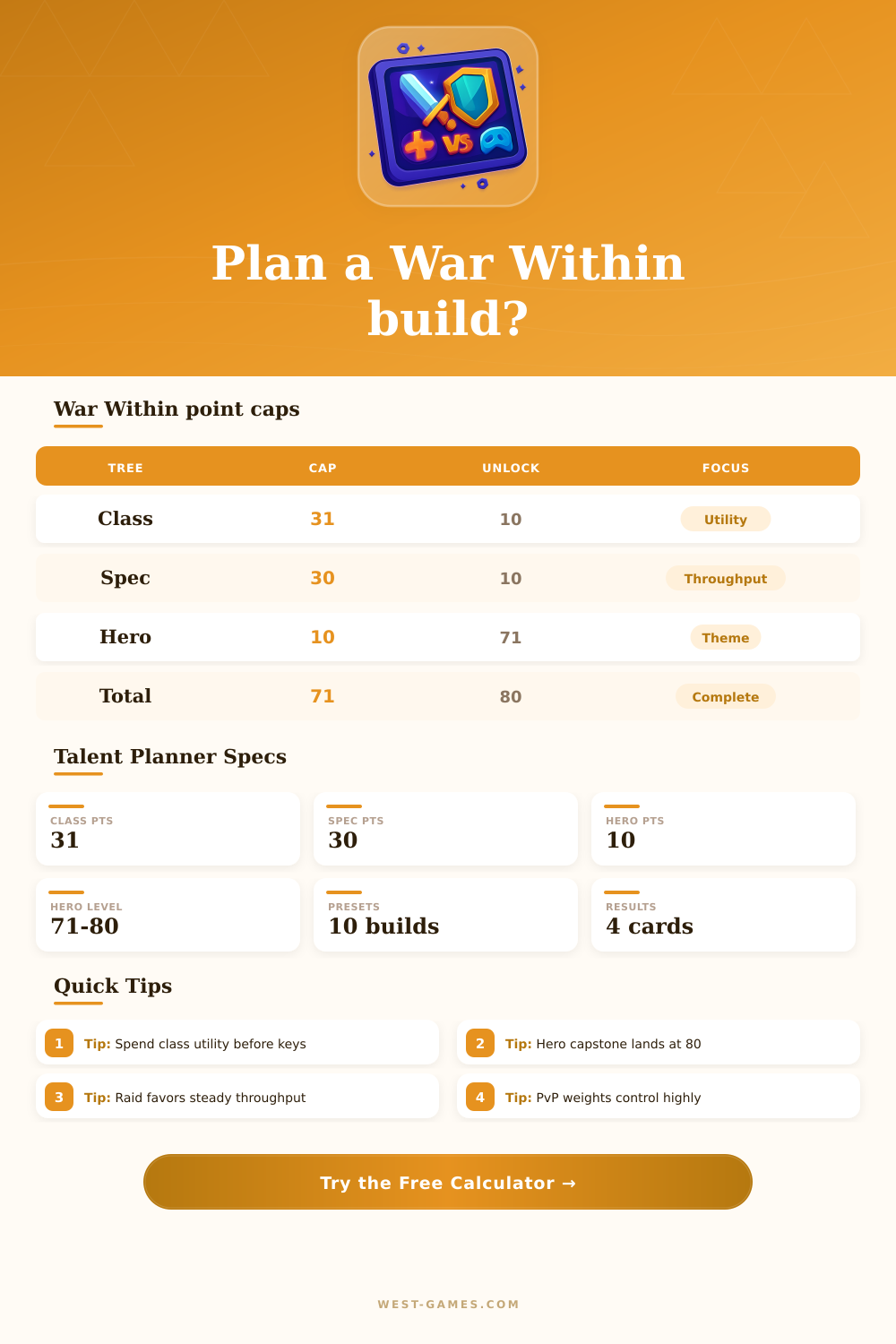
| Tree | Planner cap | Primary job | Check |
|---|---|---|---|
| Class tree | 31 points | Utility, defensives, shared power | Exact spend |
| Spec tree | 30 points | Rotation, throughput, spec identity | Exact spend |
| Hero tree | 10 points | Hero fantasy, keystone, capstone | Level 71 to 80 |
| Total at 80 | 71 points | Complete endgame build | No overflow |
The model assumes a current level-80 War Within planner, where normal class and spec trees are complete before Hero Talent progression finishes.
| Layer | Meaning | Calculator effect |
|---|---|---|
| Keystone | First Hero node at 71 | Starts Hero identity score |
| Choice nodes | Utility or throughput options | Changes node balance |
| Capstone | Final Hero node at 80 | Adds one capstone count |
| Full tree | All Hero nodes active | Completes Hero score |
Hero tree names are used as planning labels. Always confirm final in-game node text after a patch or hotfix.
| Focus | Raise when | Build signal |
|---|---|---|
| Mythic+ | Keys, affixes, interrupts, skips | Utility plus burst windows |
| Raid | Boss progression, logs, assignments | Throughput and capstones |
| PvP | Arena, battlegrounds, world PvP | Control, mobility, defensive value |
| Delves | Solo or duo progression | Self-sustain and consistency |
Weights do not need to add to 100. The calculator normalizes them for the final content-fit score.
| Band | Utility share | Typical use |
|---|---|---|
| Low utility | Under 25% | Raid parse or pure damage plan |
| Balanced | 25% to 45% | Most endgame loadouts |
| Utility heavy | 45% to 65% | Keys, PvP, solo safety |
| Overloaded | Above 65% | Check lost throughput |
Utility nodes are valuable, but the score warns when they crowd out too much specialization throughput.
| Preset | Level | Point split | Best use | Node idea |
|---|---|---|---|---|
| Mythic+ DPS | 80 | 31/30/10 | Dungeon keys | Interrupts plus burst |
| Raid Single Target | 80 | 31/30/10 | Boss damage | Throughput and capstones |
| PvP Control | 80 | 31/30/10 | Arena and battlegrounds | Defensive utility |
| Tank Key Utility | 80 | 31/30/10 | Route control | Survival and stops |
| Raid Healer | 80 | 31/30/10 | Healing assignments | Cooldown throughput |
| Solo Delve | 80 | 31/30/10 | Self-sufficient play | Defensives and sustain |
| Fresh Hero | 71 | 31/30/1 | New Hero tree | Keystone only |
| Level 75 Test | 75 | 31/30/5 | Leveling comparison | Half Hero progress |
Presets are editable planning starters for point structure and content weights, not rankings or class-specific rotations.
And none of this matters more then it does in War Within, where, from the second you click “queue” on an arena match or walk through the door of a Mythic+ dungeon, your talent build is your only security blanket. When raid bosses does something you didn’t expect, or affixes go hostile, there’s no time for maybes. It all comes down to decisions that determine not only your output, but if you’ll be alive to matter at all.
To plan out those builds means going beyond the eye candy, knowing what the system can (and can’t) do, structurally. There are three kinds of trees, each with a hard cap constraining how flexible your strategy can be: thirty-one for class utility, thirty for specialization throughput where most players rush toward big damage nodes, and ten for hero talents, which unlock as you level up from seventy-one to eighty. They’re not recommendations. They’re constraints. As long as you plug in how you’re allocating points, the calculator above will run the math for you, but actualy developing skill comes from knowing why these limits exist.
Why Your Talent Build Matters in War Within
When things go wrong, remember, it’s usefulness that keeps a group alive, yet most players rush towards big damage nodes in their specialization tree. Usually we don’t see “utility” on our own personal performance log; it’s something that often feels like a compromise. It could be a heal that got you through, a dispel that cleared a dooming debuff, or a defensive cooldown that gave you three seconds to breathe again. But in high stakes content, the nodes missed cost far more than any raw stat bump.
By showing your build balance (between throughput and utility) and completeness, the tool helps illustrate that tradeoff. If you focus too much on pure damage without getting the necessary control tools, the score will show a mismatch in PvP or key-based content. That’s what most folks miss until they wipe.
On top of all that, there’s Hero Talents, which also evolve over time. At level seventy-one, you have a single point to work with, but you’re building up the core of who you are. Half of tree becomes unlocked at level seventy-five, when you can really specialize. And then only at level eighty do you reach maximum potential with ten points spent, including some incredibly strong capstone talents. The whole thing gets built out slowly, so something that feels like a perfect build in the first few weeks of a patch may fall apart once new nodes open up. Your priorities constantly shift. What looked like an essential node at level seventy-five could get dropped in favor of a better capstone at level eighty.
All of this is going to make the definition of “good” result in something very different in content-weighted situations. For example, Raid environments value predictability and consistency, meaning deeper specializations into the core heal/dps roles for your class, and less focus on the utility tree. In contrast, Mythic+ dungeons want someone that can switch between doing big bursts while maintaining defensives and controlling groups, so it’s more about being versatile. PvP turns it on its head too. In PvP, being able to survive, move around, and control crowds matters more than just having high numbers. With this type of system, you can change these weightings depending on what kind of play style you’re looking for. You’re going to get more utility if you push high keys, and more output when you optimize raid logs.
There are also a lot of people who copy a build they found from someone else’s guild, but don’t understand why it does what it does. Even if the preset worked for a high-end guild, it may not work for you because you have a lower level of coordination, or because your character is geared differntly. The page has tables at the bottom that outline this for you (e.g. These include which nodes to take, at what levels, and where the point cap will hit. Those builds are a place to start from, but tweak according to what makes sense for your own gameplay.
At the end of the day, that’s all talent planning is: weighing the risks against rewards. A point in usefulness means a point less in damage; a point in damage means a point less in usefulness. There isn’t one correct build, but simply whatever’s best suited for the moment. It’s about going into content fully aware of your strengths and weaknesses so that you know what you can get away with, and more importantly, what you cannot. Match your nodes with the reality of who you are as a player and your group’s requirements, and fighting will feel like less of a mess. Instead of correcting mistakes on-the-fly, it’s doing something according to plan. And that’s where confidence comes from: through thorough prep, not fortune.