🛡 Last War Resource Calculator
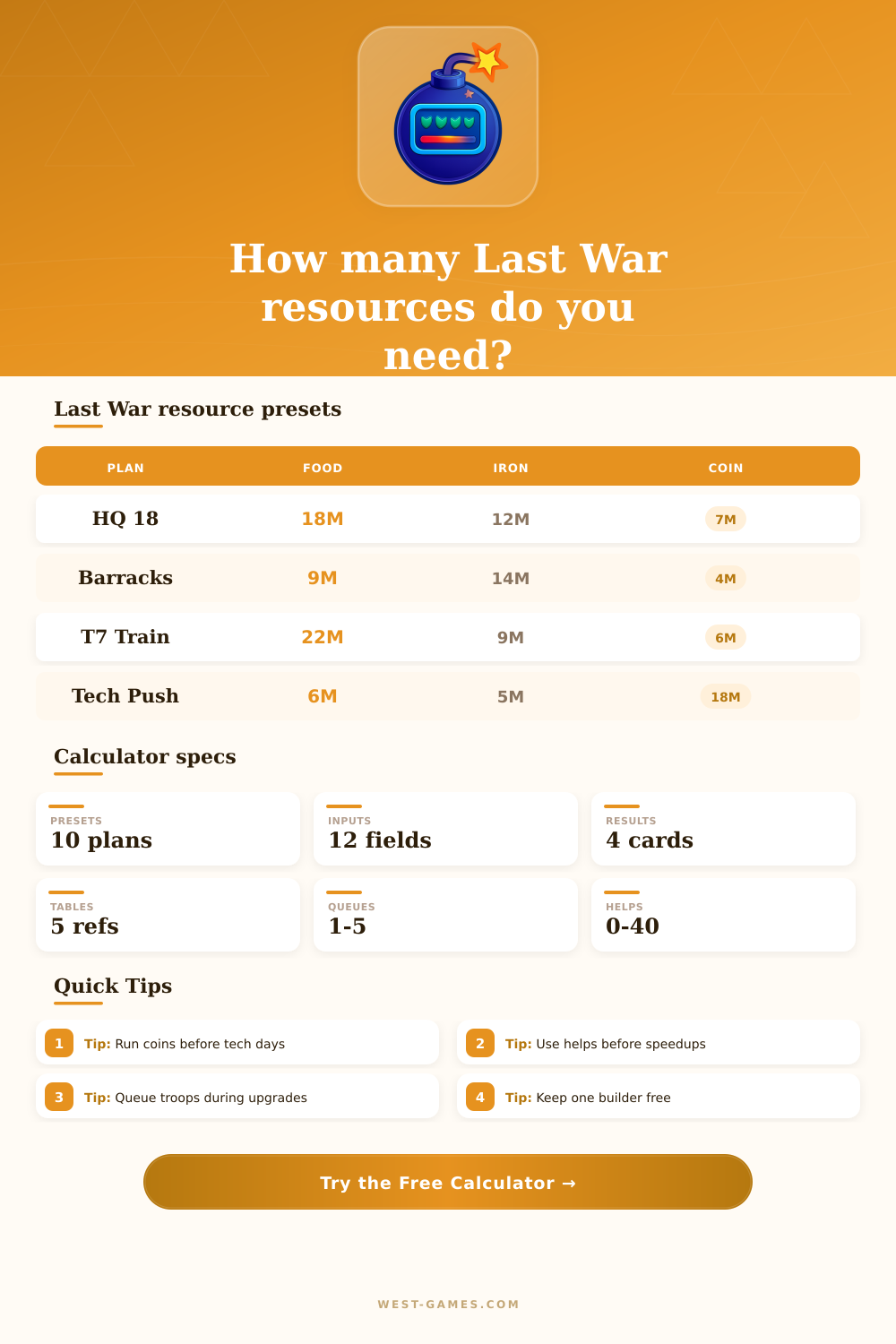
Estimate food, iron, and coin needs for Last War building upgrades, troop training, tech research, production recovery, alliance helps, speedups, queue count, and remaining shortfall time.
| Plan | Food pressure | Iron pressure | Coin pressure |
|---|---|---|---|
| HQ upgrade | High | High | Medium |
| Barracks upgrade | Medium | Very high | Low |
| Troop training | Very high | Medium | Medium |
| Tech research | Low | Low | Very high |
| Hospital recovery | High | Low | Low |
| Event stack | High | High | High |
| Wait time | Read | Best action | Risk |
|---|---|---|---|
| 0-3 hours | Ready | Start after helps | Low |
| 3-12 hours | Small gap | Gather or open boxes | Low |
| 12-24 hours | Daily gap | Time with reset rewards | Medium |
| 1-3 days | Large gap | Prioritize bottleneck | High |
| 3+ days | Delayed | Split the plan | Very high |
| Input | Default | Modeled effect | Planning note |
|---|---|---|---|
| Alliance helps | 25 | Timer reduction | Applied before speedups |
| Help percent | 1% | Per help cut | Editable by queue type |
| Speedups | Hours | Flat time removal | Cannot go below zero |
| Queues | 1-5 | Parallel pressure | Spreads repeat work |
| Base timer | Hours | Timer before cuts | Use displayed queue time |
| Preset | Target | Main gate | Timer style |
|---|---|---|---|
| HQ 18 Push | Level 18 | Food and iron | Builder |
| HQ 22 Push | Level 22 | Iron | Builder |
| Barracks Upgrade | Level 20 | Iron | Builder |
| T7 Training Day | Tier 7 | Food | Training queue |
| Core Tech Push | Level 22 | Coins | Research |
| Event Rush Stack | Level 24 | All resources | Mixed queues |
| Resource | Often used by | Shortfall fix | Do not forget | Calculator output |
|---|---|---|---|---|
| Food | Troops, HQ, recovery | Gathering and boxes | Training burns it fast | Food wait hours |
| Iron | Buildings, camps, vehicles | Mine routes and reserves | Late upgrades spike | Iron wait hours |
| Coins | Tech, heroes, research | Coin rallies and events | Research day needs coins | Coin wait hours |
| Alliance helps | Timers | Ask before speedups | Caps may apply | Help-adjusted queue |
| Speedups | Any matching queue | Spend after helps | Save type-specific ones | Remaining timer |
| Queues | Parallel work | Split repeat batches | Single upgrades still gate | Queue pressure score |
And nothing stinks worse than spending hours gazing at a forty-eight hour timer for a hospital upgrade. Your builders stare helplessly, idling while resources stays empty. Iron and food is needed.
But it’s not usually because you lack ambition. It’s usually because you don’t know what you should of be doing next. Until you separate the important parts from the unimportant ones, planning feel chaotic.
How to Plan Your Resources Better
Your resources aren’t just digits on a computer monitor. Your resources are time converted to money. For each million coins you use for tech research, that’s hours of waiting or gathering wasted. You might have used those millions of hour to train troops.
Enter your production rates and storage levels into the calculator above, and it’ll do calculations for you. It will save you the guesswork: Can you afford an aggressive push with your existing income? Does this game leave you feeling vaguely anxious? That’s a bottleneck you can fix.
Production pressure = Production Pressure
Most players focus on what they lack rather then what restricts them. I have a lot of iron. I need coin to research. The upgrade won’t begin until the slowest resource catch up. That’s why it doesn’t matter that much how rich or poor you are, it matters how fast you get money per hour.
If you’re running out of storage now… and the amount you need is huge… then it won’t help that you makes lots of money per hour. The tool takes all this into account, and shows you exact time you’ll be waiting.
The difference here is Alliance. Players think that speedups are quicker and ignore them as a result. A big no-no. Before you lay down any coin, these things shave time off in percentage points. The key is to use them first. Filling the gap with speedups is where they shine.
The page’s reference table clarifies all of this. It illustrates the outcome for every kind of input and just how much it affect the total result.
Then there’s queuing, which is something most people don’t think about intuitively. Five little upgrades don’t get them done one-fifth as fast. You’ve diluted your concentration and still spread out the risk. If you’re racing to a raid window or some other kind of event, parallel queues let you continue to move forward. Even if one queue slows down, they help.
On the flip side, if you’re racing to build something big, like the HQ, then you’re splitting up your focus fire and diluting your ability to concentrate on the clock.
The silent killer of progress is coin shortfalls. Base production and gathering routes bring food and iron right back in no time at all. Coins don’t. They need special events, rallies, or long term farming that doesn’t necessarily works around your schedule. If you go to make a tech push before double-checking your coin reserves you’re probably going to stall out.
This gap is highlighted on the calculator where it shows how long you’ll have to wait for each resource individualy.
Don’t let perfect planning become the enemy of good enough. Stuff happens. Events pop up. Buffs go live. Game balance will shift. What worked last week might be dead today. Use the tool to get a starting point, then change things based off what’s happening on your server. You aren’t trying to predict the future, just minimize surprises.
It is better to know that you are low on iron by twelve million before you start than after you do.
The bottom line is this: Last War is a game about managing expectations when it comes to resources. There’s not going to be all of it all the time. Some things you’ll need to upgrade will need to wait. Some troops won’t get their training until later.
A competitive player isn’t usually more lucky than a casual player. That player who keeps everybody second-guessing is the one who does the boring math. They are willing to plan for the wait, acknowledge the bottleneck, and move forward confidently rather then hopefully.