Lost Ark Loot Auction Calculator
Raid-end bid math for winning share, buyer net cost, break-even bid, seller payout, roster runs, and weekly auction return.
| Split policy | Share divisor | Buyer net cost | Best use case |
|---|---|---|---|
| Winner does not receive split | Party size minus 1 | Winning bid | Standard party auction calls |
| Winner shares with all members | Party size | Bid minus one share | Static group house rules |
| Seller keeps auction amount | No party split | Winning bid | Private sale comparison only |
| Weekly split return | Final bid divided by divisor | Not a buyer metric | Roster pass-and-share estimate |
| Lost Ark auction lot | Value treatment | Fee input | Break-even note |
|---|---|---|---|
| Legendary engraving book | Tradable market value | Usually include resale fee | Bid below usable value after fee |
| Class engraving book | High personal demand | Include fee if flipping | Raise use multiplier for own build |
| Ancient accessory chest | Expected roll value | Apply fee to resale plan | Use a conservative market number |
| Honing material chest | Roster material value | Often zero for bound use | Compare to immediate honing need |
| Elixir material box | Progression material value | Often zero for bound use | Lower value if already capped |
| Transcendence material chest | Character progression value | Often zero for bound use | Best for mains pushing raids |
| Legendary card pack | Roster collection value | Usually zero | Use personal missing-card value |
| Gem pouch auction | Expected gem fusion value | Include fee if selling | Account for fusion variance |
| Scenario | Party | Common lot assumption | Why it changes the bid |
|---|---|---|---|
| Thaemine legendary book | 8 | Tradable book at end auction | Market fee and competition shape break-even |
| Echidna advance honing | 8 | Progression materials | Bound value depends on active roster goals |
| Akkan material chest | 8 | Honing material auction | Good for weekly teammate share planning |
| Ivory Tower elixir box | 4 | Elixir material auction | Small party size increases each seller payout |
| Kayangel class book | 4 | Class engraving book | Fewer players means faster break-even pressure |
| Brel ancient accessory | 8 | Accessory value estimate | Roll uncertainty rewards lower safety margin |
| Behemoth raid chest | 16 | Large group auction chest | More members lowers per-player split share |
| Kakul card pack | 4 | Roster card progress | Personal collection value can beat market logic |
| Party size | 10,000 bid share | 30,000 bid share | Buyer-excluded divisor |
|---|---|---|---|
| 4-player group | 3,333 gold | 10,000 gold | 3 eligible teammates |
| 8-player group | 1,429 gold | 4,286 gold | 7 eligible teammates |
| 12-player group | 909 gold | 2,727 gold | 11 eligible teammates |
| 16-player group | 667 gold | 2,000 gold | 15 eligible teammates |
| Weekly roster model | Input to watch | Result affected | Practical reading |
|---|---|---|---|
| Single main clear | Roster clears equals 1 | Weekly return stays close to one share | Use for deciding whether to bid today |
| Six gold earners | Roster clears equals 6 | Pass-and-share return compounds | Useful for weekly gold planning |
| Mixed raid ladder | Auction appearance under 50 percent | Expected return becomes conservative | Good for book and card assumptions |
| Static funnel week | Use value over 100 percent | Break-even bid rises | Helpful when a main needs materials now |
In the Argos lobby, you see raid timer tick down. The last boss crumbles away into light. An engraving book appears. It is legendary. It is tradable. And eight folks sits there silently staring at it. Ultimately, Lost Ark progression are about social economy: Who will get this? Is it worth bidding on? Will I give up this chunk of my personal gold for a shot at better one if someone else passes?
Bidding has huge upside, but it requires having the liquidity to spare. Get it wrong and you’ll cost yourself thousands of gold each week for the duration of the season. The question isn’t if it’s worth something. The question isn’t if it’s worth something. The question is who gets most out of it in short term.”
How to Share Loot Fairly in Your Group
In-game auctions are meant to convert assets into cash, which means group must decide between distributing the asset or converting it into currency through an internal auction when a raid ends and loot appears. “Generally speaking, most groups will use some sort of internal auction system where you can put things up for bids. The winner doesn’t get it all; instead, money goes back to everybody else. It takes some nice accounting so that guy who won didn’t pay too much for something that might have cost less based off the market. But the advantage is that nobody goes home without anything.
Plug in your bid amount and number of players, and calculator does all the math for you. No more long division when you’re still pumped full of adrenaline. Now you want to know how much each losing player get back to determine whether or not this bid was competitive with market price. If it’s not enough per person relative to other opportunities, people will be resentful. And if the winner ends up paying significantly above-market for the item, that means he just gave his team some gold away and didn’t even know it. The key to bidding confidently is understanding how much of that stack will go towards each person.
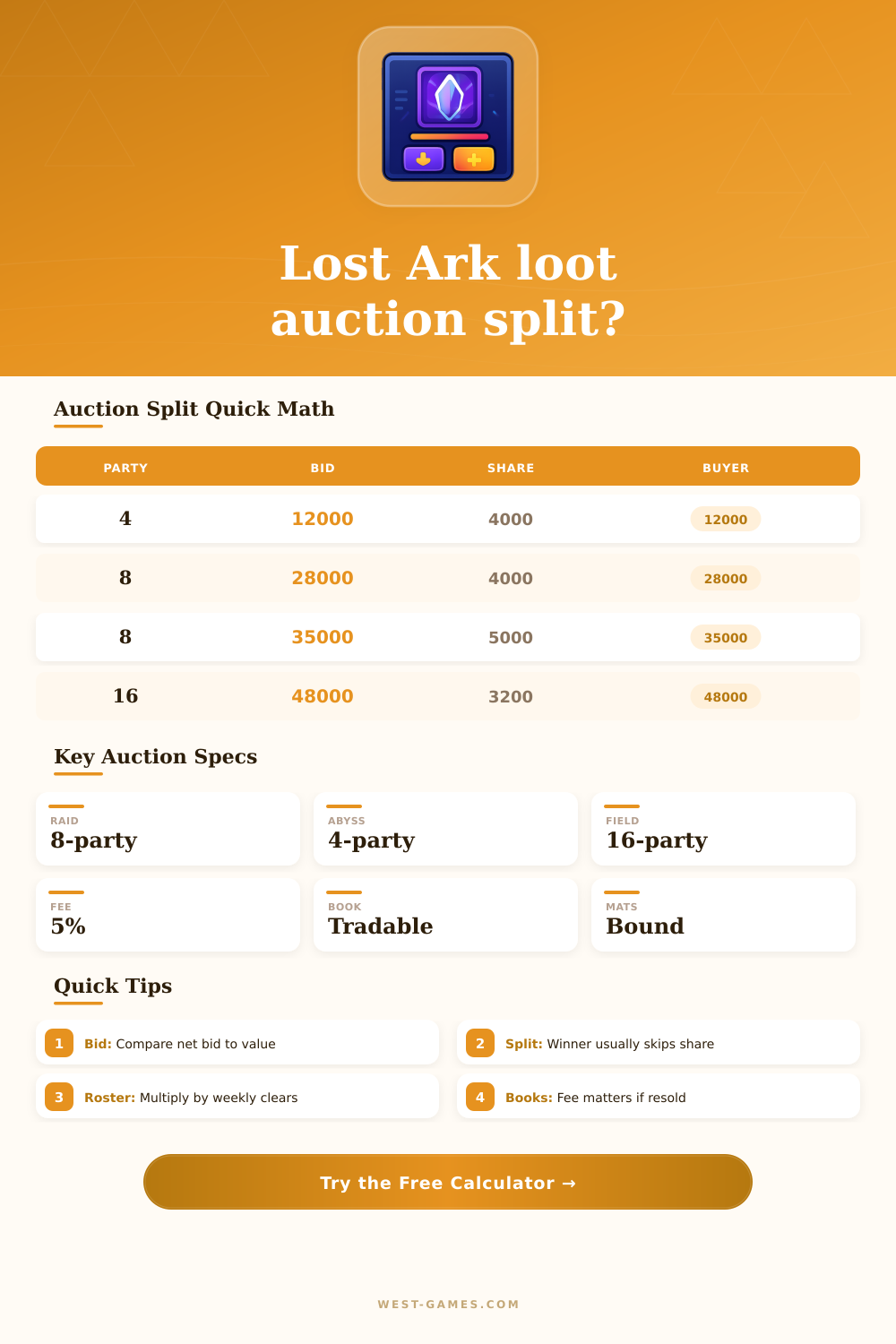
If you have 8 members in a standard 8 player legion raid and the winner receives nothing, then they split up that money among other seven people. That’s a solid baseline for what something “should of” be worth. When you’re running an abyssal dungeon with 4 members, loot is split among three person. That really concentrates things. When you have bigger open world events that may involve 16 different parties, that math changes again and individual amounts dont matter as much as before… They’re more like tips now than anything.
To put it another way, when you participate in any given event, you aren’t purchasing an item. You’re indirectly contributing part of the team’s weekly pay. Finally, there are factors of personal usage and resale fees. Let’s say you won a legendary book. You could sell it immediately for gold, or you might use it on your alt character next month instead. Perhaps you’ll want to use it on your alt next month instead. By adjusting the usable value multiplier, the tool will take that into account.
You can further deduct expected resale fees from break-even point. This becomes significant when considering the difference between an item with limited liquidity (like a bound material, which has no resale cost) vs. This refers to an item with transaction taxes that reduce profits, such as a tradable accessory. Failing to consider these implicit costs results in auction wins that look impressive on paper but end up making you poorer then before.
This logic extends to weekly planning. Do you have serious roster? Then do they know their raid clearing rate? Do they calculate their total income when passing on items consistently? For example, if your raid team clears 6 raids per week, their guaranteed gold shares will add up over time. This total can end up being more than the value of a single mediocre item gained from bidding aggressively. Use calculator to get an idea of what this weekly return will look like and help you see forest for the trees. It will force you to balance the instant satisfaction of acquiring a particular drop versus the consistent drip of guaranteed gold shares during the week.
People mistake their own wants with mathematical truth. Yes, you may desperately want that class book. But unless price is high and it won’t slow down the rest of your team’s long term growth (which means it’s worth more elsewhere), then throwing in a big bid will hurt both parties over time. This is laid out in reference table on the page. It compares split policies. And it explains exactly how they change payout to the seller, while changing net cost to the buyer.
There is no single right bid. It is just the one that matches your group’s particular economic plan. In the end, it’s all about balance: you don’t want to be too weak to run the content well, but you also don’t want to lack funds to continue upgrading. That’s where an internal auction comes in; providing the opportunity to convert some of those rare drops into collective spoils.
It’s not a lottery; it’s a matter of careful calculation. Know the numbers and honor the division. Follow the mathematics when making gold choices, and everyone will feel like they walked away with something valuabel today.