🎮 Steam Booster Pack Drop Rate Calculator
Estimate booster pack eligibility, account level multiplier, eligible game pool, weekly community badge crafting volume, expected weeks, and cumulative chance.
| Account level | Weight | Example effect | Planning note |
|---|---|---|---|
| 0-9 | 1.0x | Base odds | No level bonus yet |
| 10-19 | 1.2x | +20% | First visible jump |
| 30-39 | 1.6x | +60% | Common badge target |
| 50-59 | 2.0x | Double weight | Large library helps |
| 100-109 | 3.0x | Triple weight | Strong long-run boost |
The calculator uses 1 + 0.2 times each full 10 Steam levels for the level weight.
| Volume | Crafts / week | Pool example | Odds signal |
|---|---|---|---|
| Quiet | 8 | 20,000 | Low but steady |
| Steady | 35 | 45,000 | Typical estimate |
| Active | 110 | 120,000 | Popular title |
| Sale | 300 | 180,000 | Event spike |
| Custom | Your value | Your value | Manual model |
Craft volume matters because booster packs are tied to community badge crafting for each game.
| Condition | Counts? | Calculator input | Why it matters |
|---|---|---|---|
| All drops received | Yes | Eligible games | Unlocks booster pool |
| Drops remaining | No | Pending games | Still needs playtime |
| Weekly activity | Usually | Activity status | Keeps account current |
| Limited account | No | Badge status | Eligibility can fail |
| Game has cards | Yes | Eligible games | No cards means no pack |
If a game cannot award Steam trading cards, it should not be included in eligible games.
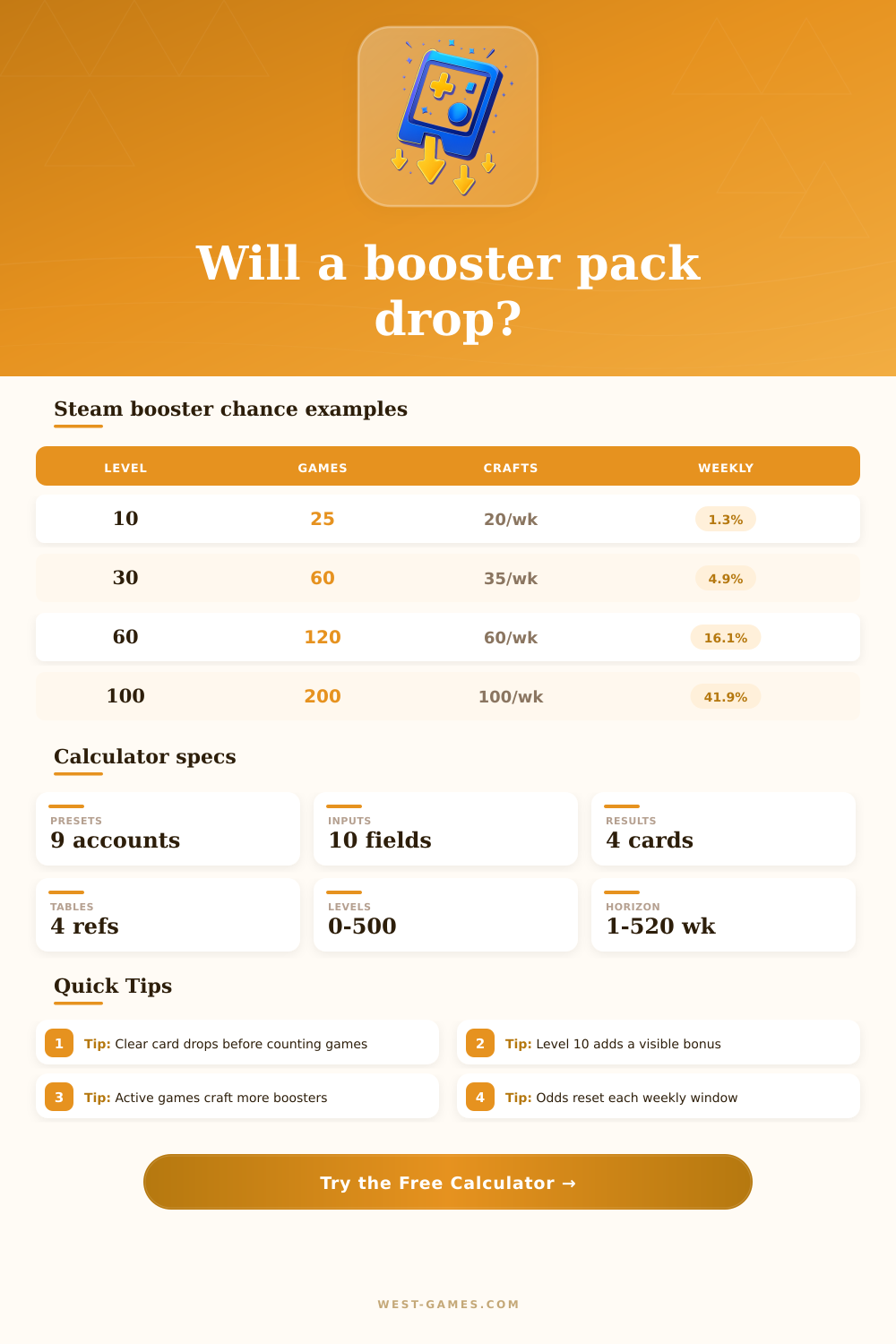
| Account model | Level | Eligible games | Weekly chance |
|---|---|---|---|
| Badge starter | 10 | 25 | About 1% |
| Mid library | 30 | 60 | About 5% |
| Collector | 60 | 120 | About 16% |
| Veteran | 100 | 200 | About 42% |
| Huge library | 150 | 400 | Often high |
Examples assume steady-to-active crafting volume and a broad mix of eligible trading card games.
If you’ve played a game long enough, you’re likely familiar with noticing a friend getting a booster pack of cards from a game you owned. They start clicking around and making badges, then suddeny leave with inventory you never laid eyes on. Steam booster drops are an obscure piece of math that, at first glance, appears to be completely random. However, once you look closer, there is more to it than it seems. While it isn’t simply a matter of waiting out the clock, it isn’t purely chance either.
After specifying how your library is set up, our calculator will do the legwork for you so you don’t have to guess if you’re truly in contention or merely watching from the sidelines. For most folks the biggest barrier to entry are figuring out what “eligible” realy means. A lot of people think if you own a game then it counts towards your booster pool, but nope, Steam says otherwise. According to its rules, you must have received all the normal trading card drops from each game before it becomes eligible for booster packs.
How to Get Steam Booster Packs
That gets lots of people. They’ll count games as eligible when they don’t have all the drops, which isn’t true until the last card arrives. And that keeps them locked out of the booster system with all those pending cards. It is the difference between having your name drawn and sitting in bleachers. And this is just a small thing. But it breaks most people’s intuition about how the odds are calculated.
So what happens after you clear all that crap from your library? After that, it’s just your account level and then some multipliers. Your account level are basically going to be your main multiplier for how much pull you have in the draw. As you level up your Steam account, the system reward you by giving you more of the pie. Going up a level gives you a pretty nice bump to your estimated chance weight. You don’t go up one level and have barely improved odds over someone who was level 10. Youve got far more power in every crafting event.
That’s why badge grinding sucks early on but begins paying dividends late. You’re buying influence within the drop system. The page lays this out well with its reference table which show the curve steepening as you get into high tiers. That said, how much do you weigh? That’s meaningless unless people is actually playing from your library. Your eligible count is determined based off what games you craft badges for.
Do you have a huge pile of indie game that everyone ignores? Sure, that makes for a lot of eligible counts, but little real exposure. Volume matters here. The calculator takes that into account, allowing you to include weekly crafting profiles per game. A game with hundreds of badge being crafted every day has far more opportunities to hit than a silent, niche game in your library, though both exist. This is why some weeks you feel lucky, other weeks dead.
It isn’t always about your own stat line. It can be as much about the activity elsewhere in the ecosystem. It is also about activity status. An account where someone plays everyday (or even weekly) is going to be newer to the Steam system than someone who hasn’t logged on for months at a time. There is not a strict cut-off point there, but it is something that keeps you fresh in their mind. Add in a mix of active titles and many completed games. Add a decent amount of crafts and a good level. Then the odds change from a long shot to probable.
Taken together over a year, it becomes more realistic. Everyone seems to overlook the fact that most players attempt to game the system by purchasing low-level badges and trying to buy their way through. Instead, the key is to use active, deep libraries. Patience and clearing out those last few card drops unlock the multiplier. Then you just have to sit back and wait on community crafting increases for when the right games are being played.
It is a slow burn strategy, not a quick fix. Can’t force a drop, only put yourself in position for where a drop will likely occur. It’s not about beating randomness, it’s about maximizing presence in the rooms where loot gets dropped. Keep playing, empty out your backlog, and let level weight work over time.