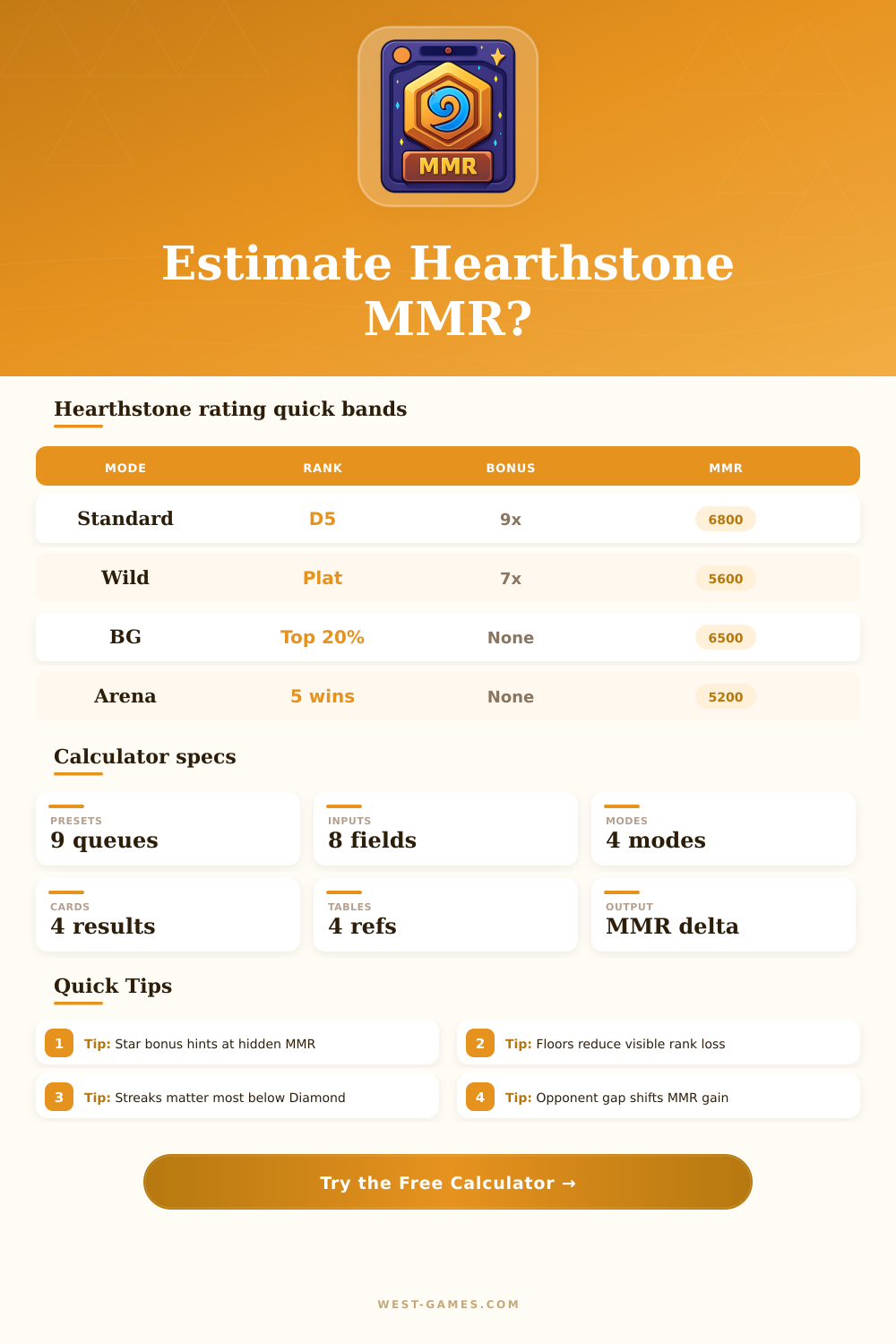
🃏 Hearthstone MMR Calculator
Estimate hidden rating movement from mode, visible rank, star bonus, opponent MMR, match result, streak pressure, floor protection, and expected gain.
| Band | Baseline | Stars | Use |
|---|---|---|---|
| Bronze-Silver | 2500-4200 | 2x-5x | Early climb |
| Gold-Platinum | 4300-5800 | 5x-8x | Mid ladder |
| Diamond | 6000-7200 | 8x-10x | Final push |
| Legend | 7300+ | None | Rank order |
| Top Legend | 9000+ | None | Elite queue |
These are practical modeling bands, not official Blizzard-published hidden MMR values.
| Bonus | Signal | MMR bump | Meaning |
|---|---|---|---|
| None | Mode-based | 0 | Use rank only |
| 5x-6x | Solid | 250-450 | Mid climb |
| 7x-8x | Strong | 600-850 | Above rank |
| 9x-10x | Very strong | 1050-1350 | Fast reset |
| 11x | Elite | 1650 | High legend |
A high star bonus can mean your hidden MMR is well above the visible rank you currently see.
| Opponent gap | Win gain | Loss drop | Reading |
|---|---|---|---|
| -600 | Small | Large | Favored |
| -200 | Normal | Normal | Slight edge |
| Even | Base | Base | Fair match |
| +200 | Better | Smaller | Underdog |
| +600 | Large | Small | Upset value |
Expected score uses Elo-style probability, then mode volatility and streak pressure adjust the delta.
| Protection | MMR | Stars | Note |
|---|---|---|---|
| None | Full move | Normal | Rank can fall |
| Rank floor | Full move | Protected | Floor holds rank |
| Fresh rank | Full move | Buffer | Short grace |
| Legend | Full move | No stars | Rank shifts |
| BG floor | Full move | No stars | Rating floor |
Visible protection is a rank-display rule; hidden rating still reacts to the match result.
Climb Diamond five once more. Pile up your stars. Feel unstoppable. Queue for just another match. Lose the game you should of won. Rank icon flickers but doesn’t move. Tell yourself the floor’s holding; you’re safe.
Each loss get harder to bear. Players still see you at the same level, even as your real-life rank slowly drop. That disconnect between where you think you are in player pool compared with what you can see on screen. That becomes frustration. It becomes a fake safety net that causes you to slide further then you thought before it catches up to you and the math.
Understanding Your Hidden Rank
To estimate this, we used the calculator here. As you can see, it take all of those inputs into account, including the fact that your actual rank is only one variable. Your true MM ranking (which is your matchmaker score) are another variable entirely. This number is also kept secret. Blizzard updates this number in silence.
This is what decides your opponents. And this is what influence your overall rating gains/losses after each match. If you’re beating opponents handily, then your hidden score increases at a faster rate compared to your visible star count. This mean that the system think you’re more powerful than your ranked rating implies. Those star bonuses show your hidden score are higher than your public rank.
But knowing those inputs shifts everything into perspective. For example, if you have a star bonus of nine times, and you’re sitting at Diamond five, the tool knows that’s a sign of high confidence. Your hidden rating is probably well above average for your bracket. That means when you queue up against an opponent, they’ll be statistically better than their rank would indicate on paper. Beat ‘em? Not a big deal. Lose to ‘em? Not as much of a big deal either.
This is where the calculator kicks in: it accounts for your level of relative strength versus your opponent’s estimated strength. In doing so, it applies what’s known as expected score logic, like most traditional Elo systems do, but with more Blizzard twists. For casual players, I think they overrate impact of streaks, but streaks do matter.
If you’re on a three game winning streak, the system puts more pressure on you to see if you’re lucky or skilled. It will reward a bigger ratings bump when you win (because it wants to see if you really are good). On the flip side, if you break your own losing streak and get protected by rank floors, it won’t hurt as much. Hearthstone’s protection mechanisms aren’t about rewarding consistency, they’re about decreasing tilt. Your actual rating can still fall behind while you’re getting shielded from dropping below your current tier to fast.
This is precisely why you follow it yourself. The reference tables included in the tool help put this change into context. For example, if you’re a Gold ten player, you’re roughly at four thousand five hundred points on average. It’s an arbitrary-sounding number until you consider it’s a benchmark at which the game begins to matchmake you against more reliable competition. While you’re still popping up in matches and remain visible at Gold but have a hidden rating above that mark, you’re facing uphill battles pretending to be fair matches.
The calculator converts these unseen numbers into real world changes that enable planning out your gaming session. Maybe you’ll choose to take a breather following a substantial victory instead of pushing it and getting less for your effort. Since there are multiple cards and many more possible combinations than in 1v1 queues (the depth of the queue matters), wild mode follow a slightly different set of rules for the volatility model.
That means that the range of volatility factors takes into account greater variation, and one swing of a bad random number generator sequence or one upset carry goes farther. Because both arena and battlegrounds don’t follow traditional star progression, their estimates work differently yet again, relying on placement data and run length instead. In essence, the tool turns all these different systems into something comparable, where you can get an idea of how risky each mode is compared to the others.
Not to say it predicts anything exactly, but it lets you know whether you’re climbing steeply uphill or sliding downhill. Hidden rating is your momentum indicator, not absolute truth. It changes every day depending on who you’re playing and how consistently you perform. When climbing, you want to be ahead of it. When sliding, you want to be behind it so you can minimize the losses people will actualy see.
To do this, use the calculator to get a snapshot of where things stand. Is it time to log off for the night, or grind out another hour? Once you look at the expected score against your pool, you’ll know. The rank icon on your profile page is nothing more than a label, the true terrain over which you climb is the number below the surface. Watch out for what’s beneath the surface until the stars stop moving all together.