🔮 StarCraft 2 MMR Calculator
Estimate ladder MMR movement from race, league tier, current MMR, opponent MMR, match result, matchup pressure, uncertainty, bonus pool, streak, and expected league movement.
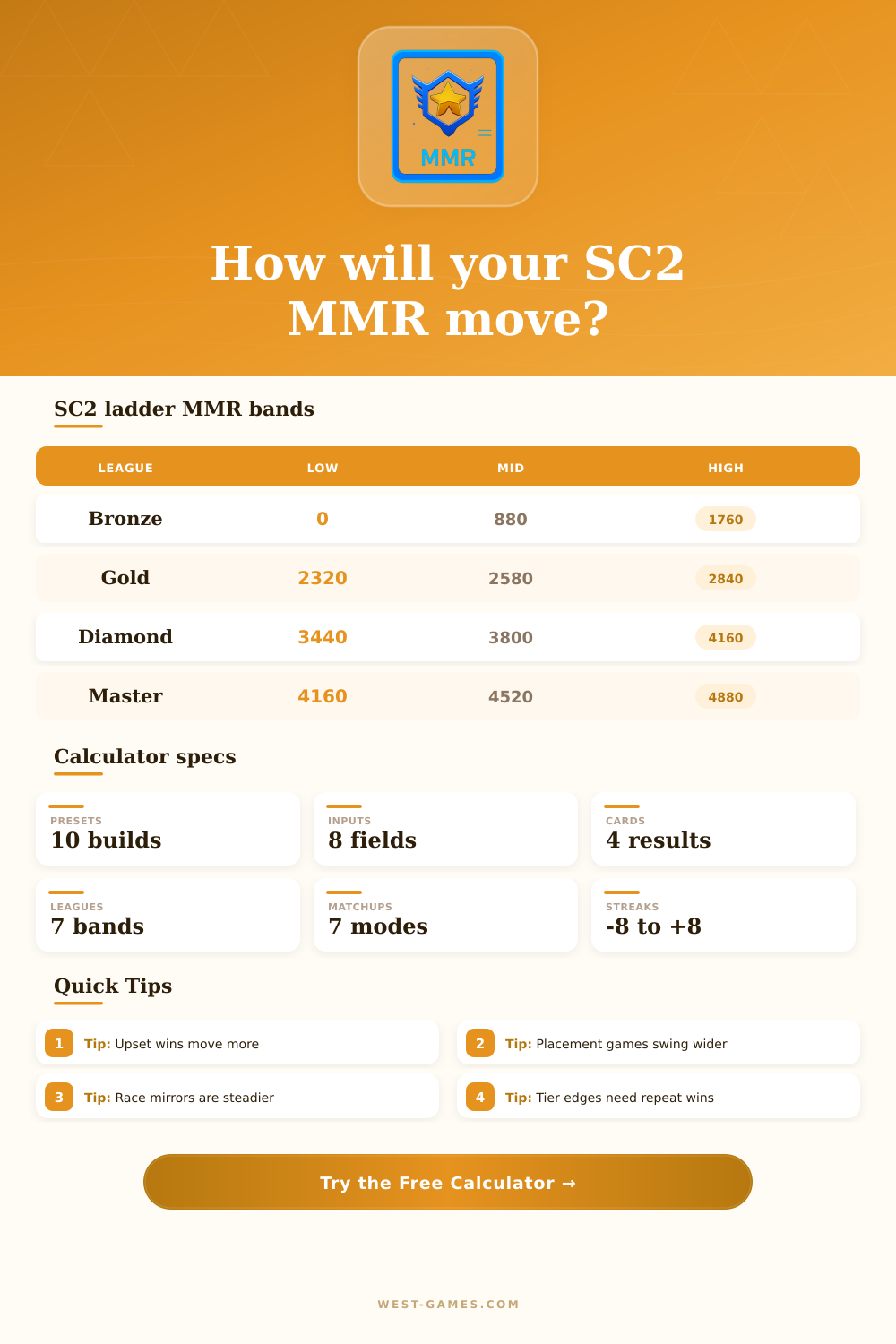
| League | Model range | Tier 3 | Tier 1 edge |
|---|---|---|---|
| Bronze | 0 to 1760 | 0 to 586 | 1173+ |
| Silver | 1760 to 2320 | 1760 to 1946 | 2133+ |
| Gold | 2320 to 2840 | 2320 to 2493 | 2667+ |
| Platinum | 2840 to 3440 | 2840 to 3040 | 3240+ |
| Diamond | 3440 to 4160 | 3440 to 3680 | 3920+ |
| Master | 4160 to 4880 | 4160 to 4400 | 4640+ |
| Grandmaster | 4880+ | 4880 to 5250 | 5600+ |
Boundaries vary by region and season, so treat these as planning bands rather than official live cutoffs.
| MMR gap | Favored player | Expected score | Typical swing |
|---|---|---|---|
| -400 | Opponent | 9% | Upset win large |
| -200 | Opponent | 24% | Win gains more |
| 0 | Even | 50% | Normal swing |
| +200 | You | 76% | Loss hurts more |
| +400 | You | 91% | Favorite risk |
Gap means your MMR minus opponent MMR. Positive gaps make wins smaller and losses larger.
| Setting | Multiplier | Use when | Effect |
|---|---|---|---|
| Settled | 0.90x | Many recent games | Tighter change |
| Normal | 1.00x | Active laddering | Standard change |
| Bonus | 1.12x | Return session | Slightly wider |
| Placement | 1.35x | Provisionals | Wide swing |
| Inactive | 1.20x | Long break | Recalibration |
The setting combines visible bonus pool pressure with hidden confidence in your current rating.
| Modifier | Delta bias | Confidence | Best use |
|---|---|---|---|
| Mirror | 0 | High | Same race skill check |
| Favored | -2 | Medium | Build order edge |
| Unfavored | +2 | Medium | Map or style issue |
| Volatile | +1 | Low | Cheese or all-in |
| Macro | 0 | High | Long standard game |
| Off-race | +2 | Low | Random or practice race |
Modifier bias is intentionally small because result and opponent MMR should remain the main drivers.
StarCraft two ladder is special. When you queue, there’s a certain brand of depression that sets in. You play a tough game against someone who’s ranked higher then you. Then you look down at your MMR and see it’s gone down by eight points. It feel as if the entire universe has taken personal offense at how well you just played.
So you go back into your match history and start scrolling. Maybe you made a mistake? Are you broken? Is this all rigged somehow? The answer is almost always simpler (but hardly more reassuring). Your rating isn’t randomly changing: it’s a measured reaction to a spider-web of factor that most players don’t even care to monitor. Understanding these variables are the difference between a steady climb and a raging tilt-fest.
How StarCraft 2 MMR Works
Really, what this means is your ladder climb has a secret mathematical formula: It’s an Elo system masquerading as real-time strategy game. The game has a rating for you and one for your opponent, and at a glance it figures out roughly how likely you are to win prior to the map loading. Win when expected? Gain fewer points. Lose a match you should of won? Gain far more. That’s all very simple competitive theory.
Where StarCraft two complicates things is in adjusting that baseline for context. Are you the steady-as-you-go Platinum player or someone who hasn’t logged into the game in a month? Was it a regular old macro game or a wild cheese gambit gone awry after five minutes? The calculator does the math for you so long as you input your race, current tier, opponent strength and outcome. No more guessing about hidden multipliers and coefficients, just plug in some numbers and go.
The uncertainty factor is something most player completely neglect. That’s a bad idea. If you’ve played a lot of recent games, then the system has some confidence in your skill level estimate. Your MMR settles down, gains aren’t huge, losses are manageable, everything is stable. That’s great for consistency purposes, but very bad for fast climbing.
If you want it to be faster, set the system to treat it as if you’re playing placement games or getting a bonus pool back. Then the multiplier it applies will be broader. Each result will swing harder; the game just doesn’t has enough data yet to know exactly where you belong. It will work as expected, but that also means things is going to get nuts during early season sessions. You don’t control when the season starts, but you’ll know what to expect from variance.
The other thing that casual players don’t see much is matchup modifiers, which add yet another layer of detail. Generally speaking, a mirror match is a pure skill check and there’s high confidence in who will win. A volatile matchup, like an all-in that got scrambled up late game, lowers that confidence. The system acknowledges that all wins aren’t created equal.
Maybe you won a messy, disorganized game where neither player played their best. That may blunt the rating change compared to clean outplay. You didn’t lose progress just because you are bad.