PoE Cooldown Recovery Calculator
Model cooldown recovery breakpoints, server tick rounding, trigger rate caps, APS matching, CoC timing, and CwC channel timing in one planner.
⚙Trigger preset
🎯Cooldown and trigger inputs
🔁Comparison grid
⏱Calculated breakpoint table
| Tick target | Required CDR | Rounded cooldown | Rate cap | Planning note |
|---|---|---|---|---|
| Breakpoint rows load after calculation. | ||||
📋Trigger defaults and assumptions
| Trigger family | Typical base | Matching input | Chance inputs | Use in calculator |
|---|---|---|---|---|
| Cast on Critical Strike | 150 ms | Final attacks/sec | Crit x hit | Classic APS breakpoint planning |
| Bow CoC | 150 ms | Projectile attack rate | Crit x hit | Ranged trigger matching |
| Cast while Channelling | 350 ms | Channel pulse rate | Uptime x stability | Channel trigger cadence |
| Mjolner style trigger | 150 ms | Hit rate | Condition x uptime | Fixed cooldown hit trigger |
| Brand or repeating trigger | 250 ms | Activation rate | Uptime x target | Repeating source comparison |
| Custom trigger | User input | User input | Chance x uptime | Patch, item, or lab testing |
📊Preset comparison table
| Preset | Base cooldown | CDR | Action rate | Expected result |
|---|---|---|---|---|
| Preset rows load with the calculator. | ||||
🖥Server tick reference
| Tick model | Tick length | Ticks per second | Effect on breakpoints | Best use |
|---|---|---|---|---|
| Common 30 Hz | 33.33 ms | 30.00 | Standard CoC 14/52/128 style | Most build planners |
| Rounded 33 ms | 33.00 ms | 30.30 | Slightly more generous caps | Community shorthand |
| High tick test | 16.67 ms | 60.00 | More breakpoints, higher caps | Sandbox comparison |
| Latency buffer | 50.00 ms | 20.00 | Lower cap, wider safety margin | Conservative planning |
Cooldown recovery in Path of Exile dont always work in a linear manner, and it is possible for cooldown recovery to fail to enhance a setup that is supposed to trigger based on certain criteria. The game server measure time in fixed interval known as server ticks. Cooldown recovery shortens the internal timer for a skill, but the game server measures it in server ticks.
If the cooldown recovery isnt sufficient to make the internal timer of the skill move to a new server tick, then the cooldown recovery will not provide any benefit to the build that rely on the skill to trigger. By adding more cooldown recovery to a character build, a player will not necessarily experience an increase in how often that trigger fires for that skill if the timer always round up to the same number of server ticks. Using the calculator available on the website, players can input there specific values for cooldown recovery to see how it will interact with the server ticks.
How Server Ticks Change Cooldown Recovery
The player will have to input their cooldown, cooldown recovery percentage, action rate, and chance values. From these values, the site will be able to calculate the rounded tick count and the real trigger cap. The real trigger cap is the number of times the trigger will fire within a specific timeframe.
This value will allow the player to understand whether their attack or cast speed are wasted. For instance, if they have an attack speed that exceeds the real trigger cap, then their extra attack speed is wasted. Cooldown recovery does not work in a linear fashion; thus, players sometimes make the mistake of thinking that any amount of cooldown recovery is beneficial to a character build.
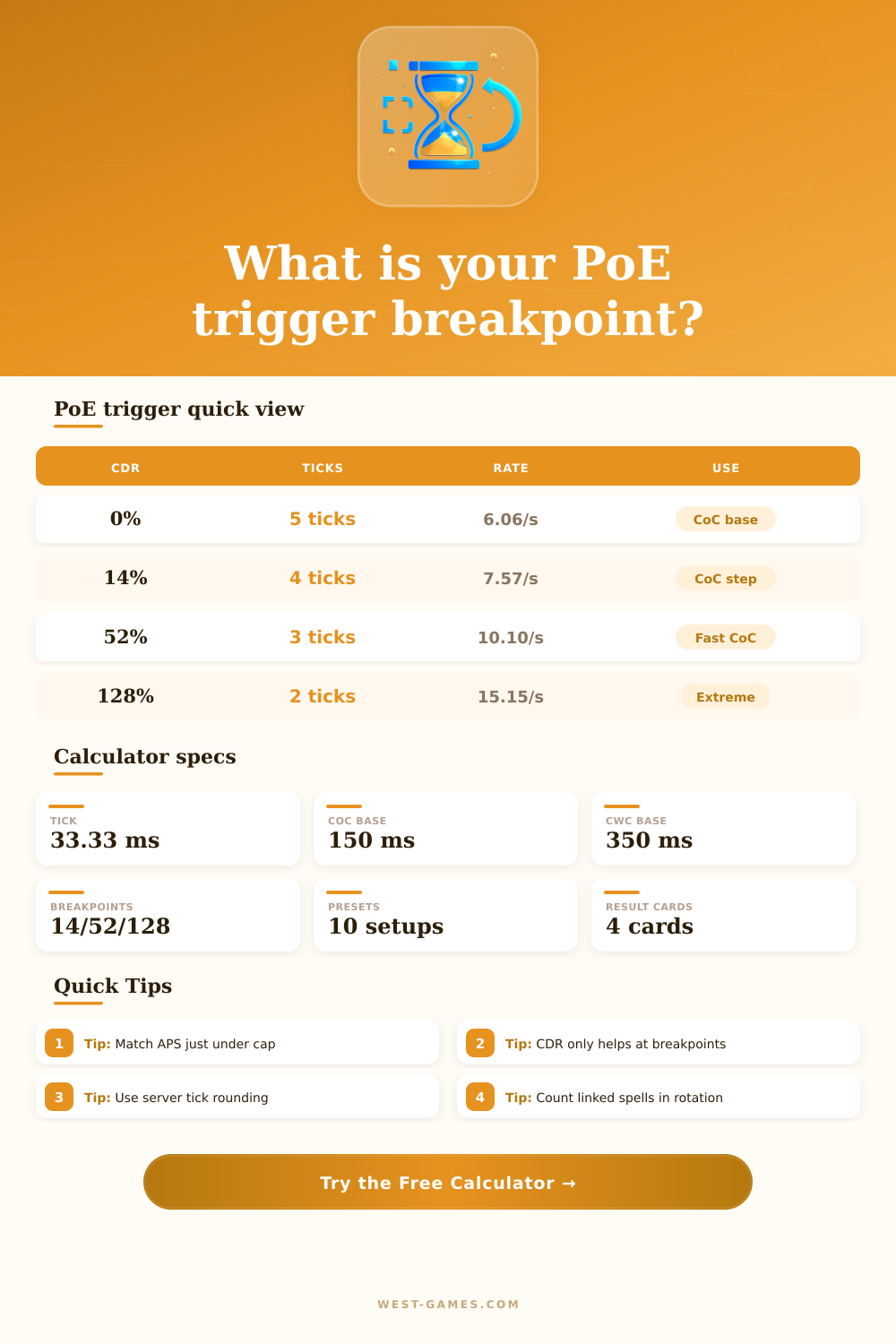
For instance, for setups that require casting a skill on critical strike, the first important mark of cooldown recovery is at 14%, which takes the cooldown from five server ticks to four. The next important mark of cooldown recovery is at 52%. Between 14% and 52% of cooldown recovery, the player will waste any additional cooldown recovery.
By using the calculator to determine these values, players can decide whether a piece of gear or a cluster jewel is worth purchasing to improve their characters cooldowns. Action rate can create problems for cooldown recovery setups. If the action rate is set too highly for a character that does not have enough cooldown recovery, the high action rate will often push the number of attempts for a character to go past the real trigger cap.
As a result, the extra action rate will be wasted. However, if the critical strike or hit chance is too low for a character, then the character will never reach the real trigger cap. In both instance, the player will feel as if their character has a sluggish trigger.
However, the solution for a sluggish trigger will differ depending on if the problem is caused by action rate or critical strike chance. For builds that use shared skill, the trigger rate for that skill will be split between the different spells. Each spell that shares the same trigger source will have a reduced rate of utilize that trigger.
For instance, if a player builds a character to encourage one spell, that same build will create sluggishness for that character when the second spell starts to use the same trigger. The calculator accounts for this split trigger rate so that players can determine the actual rate at which each individual spell will fire. The way that the game calculates server ticks will change depending on the model that is used.
Most planners use the 30 hertz model, which calculates server ticks at 33 millisecond. Other models will produce other lengths for each server tick. These different lengths can be compared using the reference table that is available on this website to determine the length of each server tick for each model.
Cooldown recovery should only be purchased and add to gear that will allow a player to reach the next tick. Using the calculator to determine how many server ticks a character has and how much cooldown recovery is required to reach the next server tick will allow a player to stop adding cooldown recovery to their character that does not change the number of server ticks the characters skill use. Instead of adding cooldown recovery that will not benefit the players character, the player can invest that effort into increasing attack speed, critical strike chance, or uptime for the skills that use the trigger.