WoT Armor Calculator
Estimate World of Tanks effective armor from nominal plate thickness, impact angle, shell normalization, 3x overmatch, shell caliber, spaced armor, range loss, and the +/-25% penetration roll.
| Impact Angle | Adjusted Angle | Main Effective | Total Required | Pen Chance | Shot Read |
|---|---|---|---|---|---|
| 0 deg | 0 deg | 0 mm | 0 mm | 0% | Calculate to compare. |
| Shell Type | Normalization Used | Ricochet Check | Range Loss Model | Spaced Armor Behavior |
|---|---|---|---|---|
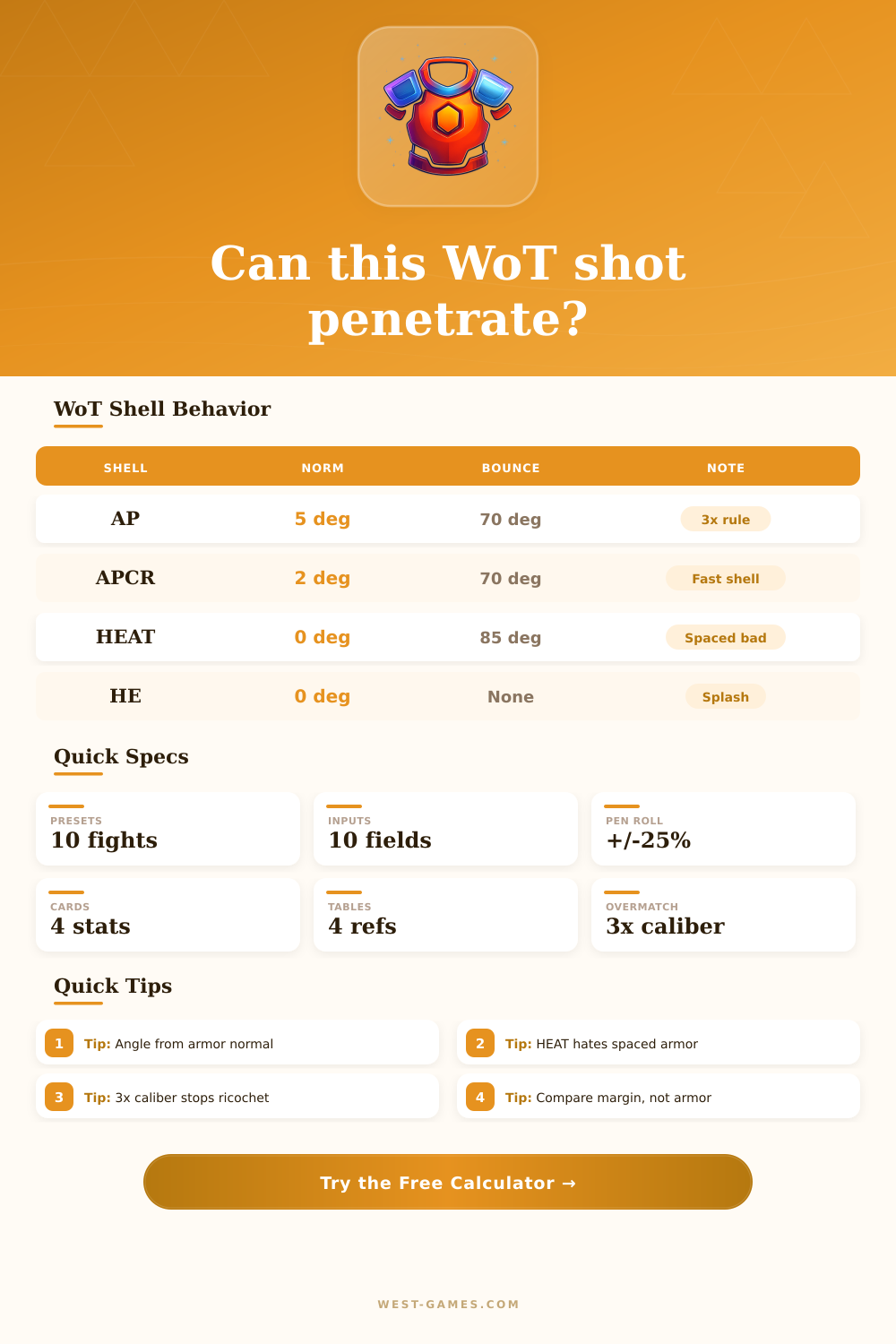
| AP | 5 deg | 70 deg unless 3x overmatch applies. | Up to about 12% in this planner. | Counts spaced armor with moderate penalty. |
| APCR | 2 deg | 70 deg unless 3x overmatch applies. | Up to about 18% in this planner. | Counts spaced armor with light-normalized pathing. |
| HEAT | 0 deg | 85 deg check in this simplified model. | No range loss in this planner. | Strongly penalized by tracks, skirts, and outer plates. |
| HE | 0 deg | No classic AP-style ricochet check here. | Small direct-pen loss estimate. | Direct penetration is difficult through spaced armor. |
| Caliber Ratio | Calculator Treatment | Practical Meaning | Example Read |
|---|---|---|---|
| Below 2x | Normal shell normalization only. | The plate angle remains very important. | 90 mm gun into 60 mm side armor. |
| 2x to 2.99x | Small extra angle help for AP/APCR planning. | The plate is thin enough that angle is less punishing. | 122 mm gun into 50 mm side armor. |
| 3x or more | AP/APCR ricochet warning is removed. | Sharp angles can still require penetration, but do not auto-bounce in this model. | 152 mm gun into 50 mm plate. |
| HEAT | No overmatch credit applied. | HEAT relies on raw penetration and dislikes spaced armor. | Premium HEAT into tracks or side skirts. |
| Armor Zone | Typical Input Range | Angle Sensitivity | Spaced Armor Risk | Calculator Setup |
|---|---|---|---|---|
| Lower plate | 120 to 240 mm nominal | Medium; often angled back. | Usually low unless tracks overlap. | Use 40 to 55 deg impact angle. |
| Turret cheek | 220 to 360 mm nominal | Medium to high with round casts. | Medium when mantlet overlaps. | Use quality factor above 1.04x. |
| Cupola | 120 to 230 mm nominal | Low to medium but small target. | Usually low. | Use 0.95x weak spot factor. |
| Pike nose | 140 to 260 mm nominal | Very high; wrong side can bounce. | Low unless spaced details overlap. | Use pike factor and high angle. |
| Side with tracks | 40 to 120 mm main armor | High when side-scraped. | High due to tracks and skirts. | Add 20 to 80 mm spaced armor. |
| TD casemate | 230 to 330 mm nominal | High when wedge-shaped. | Low to medium. | Use 55 to 70 deg impact angle. |
| Average Margin | Roll Needed | Estimated Chance | Decision Read |
|---|---|---|---|
| +50 mm or more | Usually below 85% | High to guaranteed. | Strong shot unless ricochet or spaced armor interferes. |
| +1 to +49 mm | About 85% to 100% | Favorable but not certain. | Good when you can afford a low-roll miss. |
| 0 mm | 100% roll required | About 50% in a uniform roll estimate. | Coin-flip penetration planning. |
| -1 to -49 mm | Above 100% | Unfavorable but possible. | Needs a high roll or a better impact point. |
| -50 mm or worse | Often above 115% | Very low to impossible. | Relocate, load a better shell, or aim elsewhere. |
| Scenario | What Usually Matters | Best Calculator Inputs | Common Failure Point | Shot Planning Read |
|---|---|---|---|---|
| Hull-down heavy vs medium | Turret cheek shape and cupola thickness. | High nominal armor, low weak spot factor for cupola. | Aiming at the mantlet instead of the weak spot. | Compare cupola and cheek as separate plates. |
| Side-scrape corner trade | Impact angle and track armor. | High angle, 30 to 80 mm spaced armor. | HEAT getting caught by tracks or side skirts. | AP/APCR may be safer than HEAT despite lower pen. |
| Pike nose face-hug | Which pike side the shell hits. | Pike factor, 50 to 70 deg angle. | Shooting the better angled half of the pike. | Small aim shifts can flip the chance sharply. |
| TD ridge fight | Wedge slope and high base armor. | Casemate preset, high angle, strong shell pen. | Underestimating the final adjusted angle. | Check if low roll still beats the plate. |
| Light tank side shot | Overmatch on thin side plates. | Low nominal armor, high caliber ratio. | Counting on HEAT overmatch that does not apply. | Large-caliber AP can remove ricochet risk. |
| Long-range sniper shot | Penetration drop and precise impact point. | Range above 300 m, AP/APCR selected. | Average pen looked enough at garage values. | Use adjusted pen and chance, not listed pen. |
Effectively armor is the distance that a shell must travels through a metal plate when a shell hits an armor plate at an angle. When a shell hits a tank at an angle, the shell must travel through more metal than if the shell hits the plate at a straight angle. A tank may have thick armor plate, but if those armor plates are angled, the effective armor value of the tank increase.
Effective armor take into account the angle of the armor plates, while the nominal thickness of the armor plates dont. The type of shell that is fired from the tank can also impact how the shell interact with the armor plate of the opposing tank. Standard AP rounds will benefit from normalization, which reduce the effective angle at which the shell hit the armor plate.
How Armor Angle and Shell Type Change Penetration
APCR rounds will experience less normalization than standard AP rounds, but they will have more better velocity traveling a distance. HEAT rounds does not use normalization. Additionally, spaced armor will negatively impact HEAT rounds if they encounter it.
Finally, HE rounds will not follow the same rule as AP, APCR or HEAT rounds. The calculator can be used to compare the different shell type. The three times caliber rule allow AP and APCR rounds to ignore the effect of armor plate angle when the diameter of the shell is three times the thickness of the armor plate.
If the armor plate angle’s effect is to cause the shell to ricochet off an armor plate, this rule will make that effect impossible for AP and APCR rounds. Additionally, the calculator will alert the user if the three times caliber rule are met. Spaced armor is armor that is placed in front of the main armor plates on a tank.
It help to absorb the energy of the tanks shells and change the path of those shells before they can hit the main armor plates. Additionally, HEAT rounds are very sensitive to spaced armor. The thickness and angle of the spaced armor must be entered into an armor penetration calculator.
Range can have an effect upon penetration of armor. AP rounds will lose their penetration power over distance. APCR rounds will also lose their penetration power over distance.
However, HEAT rounds will maintain their penetration power over distance. Additionally, the loss of penetration power will be more noticeable at ranges over 300 meter. The armor penetration calculator will use a simplified model for the loss of penetration power over distance.
The calculator will give the user a probability that the shell will penetrate the armor. It will calculate the average penetration needed to defeat the armor and the chance that a random roll will achieve that penetration. However, a high margin for penetration does not ensure that the shell will penetrate the armor; there is a risk of a low roll of the dice.
Additionally, if the penetration roll is below the listed armor penetration value, there is still a chance that the shell will penetrate the armor if the roll is high. However, there is a risk of a low penetration roll. The armor value that is listed for each tank should not be regarded as the final armor value that must be penetrated by the shell.
The armor thickness value listed for each tank in it’s garage is the nominal armor thickness. However, you must take into account the angle of the armor, the normalization of the shell, the shape factor of the tanks armor, and the effect of spaced armor to determine the armor penetration effectiveness of each tank. If the angle and spaced armor is ignored, the armor that must be penetrated by the shell will be much higher than the nominal armor thickness value listed for that tank in it’s garage.
Additionally, the roll window should of not be ignored. The reference tables will allow users to understand how the different types of shell interact with armor angles and spaced armor. Additionally, the tables will allow users to understand how overmatch affect ricochets and the typical input values for each armor zone.
Each armor zone has a different armor value. For example, armor zones include lower plates, turret cheeks, and pike nose. Additionally, the armor penetration calculator can be used to calculate the penetration power of two different shell.
For example, a round of AP ammunition with a higher penetration power may not be the best round if another round of AP ammunition with a lower penetration power will have a better chance of penetrating the armor that must be defeated by the tank. The final result of the armor penetration calculator will only be accurate if the user provides accurate input. Additionally, the user must accurately enter the inputs for thickness of armor plates, impact angle of armor, and type of shell into the armor penetration calculator to recieve an accurate result from that calculator.