DAoC Character Planner
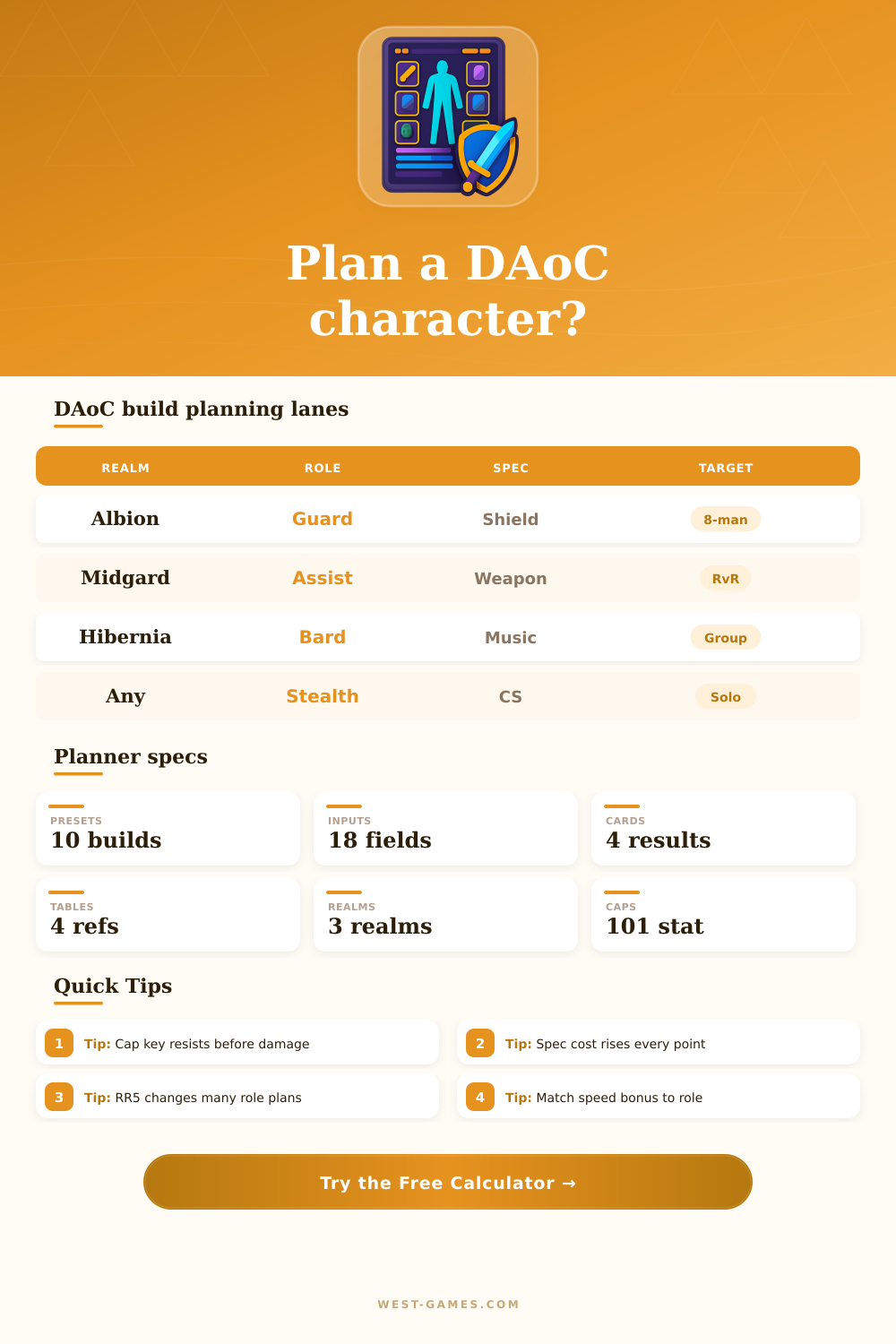
Plan a Dark Age of Camelot build across realm, race, class, specialization points, realm abilities, template caps, resists, speed bonuses, and RvR or PvE readiness.
| Preset | Realm | Class | Role | Typical Planning Target |
|---|---|---|---|---|
| Armsman Guard | Albion | Armsman | Guard / peel tank | Shield 42+, weapon 39+, strong bodyguard uptime |
| Sorcerer CC | Albion | Sorcerer | Mez and interrupt control | High mind spec, capped casting speed, Purge/MoC lane |
| Cleric Healer | Albion | Cleric | Heal and cure support | Rejuvenation and enhancement split with DI/MCL tools |
| Berserker Assist | Midgard | Berserker | Melee assist pressure | Weapon and left axe pressure with capped melee speed |
| Pac Healer | Midgard | Healer | Primary CC and heals | Pacification lead with enough mend and high RA priority |
| Runemaster Nuker | Midgard | Runemaster | Ranged caster damage | Runecarving or darkness pressure with casting caps |
| Bard Driver | Hibernia | Bard | Speed, mez, endurance | Music and nurture split with SoS and survivability |
| Hero Bodyguard | Hibernia | Hero | Defensive tank | Shield 42+, weapon pressure, protect and peel role |
| Eldritch Debuff | Hibernia | Eldritch | Debuff caster | Void/light/mana lane matched to group damage plan |
| Nightshade Solo | Hibernia | Nightshade | Stealth pressure | Critical strike, weapon, stealth, and envenom balance |
| Planner Formula Area | What It Measures | Strong Range | Warning Sign |
|---|---|---|---|
| Spec budget | Estimated points from level and multiplier compared with spec cost | 95%-100% used | Overspend means the plan cannot train cleanly |
| Realm abilities | Spent RA points compared with rank-derived available points and role package | 90%-100% used | Too few points leaves missing Purge, Det, SoS, DI, or MoC lanes |
| Template caps | Main stat, constitution, hits, power, skill, and ToA cap completion | 90%-100% | Damage builds with low speed or supports with low duration feel weak |
| Resist targets | Average resists and pressure resists against the 26% style target | 25%-26%+ | One hole can decide a fight before RAs matter |
| Speed bonus | Weapon speed for melee, casting speed for casters, and support tempo | 9%-10% | Low speed loses interrupts, swings, heals, and nukes |
| Utility score | Template density across stats, skills, hits, power, resists, and bonuses | 780+ | High caps with low utility may hide missing survival stats |
| Realm Ability Package | Best Fit | Planner Weight | Common Priority |
|---|---|---|---|
| Det/Purge/IP tank core | Guard tanks, defensive tanks, melee trains | Control recovery and survival | Purge, Determination, IP, Aug stats, damage passives |
| Purge/MoC/WP caster core | Sorcerer, Runemaster, Eldritch, other casters | Cast uptime and burst reliability | Purge, MoC, Wild Power, acuity, Mastery of Focus |
| Purge/DI/MCL healer core | Cleric, Healer, Druid, and healing support | Recovery, power, emergency healing | Purge, DI, MCL, Serenity, healing passives |
| Purge/SoS utility core | Bard, Minstrel, Skald, utility drivers | Tempo, disengage, and group mobility | Purge, SoS, speed tools, survivability passives |
| Vanish/Purge stealth core | Nightshade, Infiltrator, Shadowblade | Reset power and kill window | Purge, Vanish, Viper or weapon passives |
| PvE utility and sustain | Encounter tanks, farm casters, support bots | Consistency over peak RvR burst | Power, healing, defensive, and damage passives |
| Template Target | Melee Role | Caster Role | Support Role | Stealth Role |
|---|---|---|---|---|
| Core resists | Body, heat, cold, energy near cap | Body, heat, cold, spirit near cap | All pressure resists near cap | Slash, thrust, body, heat near cap |
| Speed bonus | 10% melee speed or style speed | 10% casting speed | 10% casting speed and duration where possible | 10% melee speed and quickness support |
| Primary caps | Strength, constitution, hits, weapon skill | Acuity, dexterity, hits, power pool | Dexterity, piety/empathy, hits, power pool | Strength/dexterity, constitution, hits, stealth skills |
| ToA pressure | Style damage, melee damage, melee speed | Spell damage, spell range, casting speed | Healing, duration, range, casting speed | Melee damage, style damage, speed, utility |
| Readiness tell | Can peel while staying alive under assist | Can cast after interrupts and survive swaps | Can recover group tempo after CC or damage spike | Can open, survive purge, and reset safely |
| Realm | Common Build Identity | Group Planner Pressure | Solo Planner Pressure |
|---|---|---|---|
| Albion | Specialized classes with strong CC, plate tanks, and classic caster lines | Role precision, caster support, guard discipline, and recovery RAs | Stealth tools, shield pressure, and template coverage |
| Midgard | Direct melee pressure, strong support tempo, and durable frontline setups | Assist timing, healer survivability, interrupts, and melee speed | Burst windows, toughness, and escape planning |
| Hibernia | Mobile utility, hybrid pressure, and flexible caster or tank groups | Bard tempo, peel control, debuff alignment, and resist coverage | Kiting tools, stealth balance, and role flexibility |
| Any Realm | Ruleset and patch differences can change exact caps, class access, and RA value | Use the planner as a build audit before checking current server details | Test openers, purge timing, and template holes in real fights |
Creating a Dark Age of Camelot character for play in Realm versus Realm requires the player to consider several different components of the game at the same time. Each player must choose a realm, a race and a class for their character. Furthermore, players must also decide how to distribute their specialization points and which realm abilities is required for the type of combat that they will participate in while playing.
Each of these components has an impact upon the survivability of the character template. A character that appears to be well-constructed on the character creation screen may fail during a keep fight if the template is missing any essential component for survival. The calculator can mathematically calculate the values for each of the components that a player must consider for creation of a viable character.
How to Make a Strong Realm versus Realm Character
The calculation considers each of the four specializations for the character and compares the value of the points that are spent in those specializations to the total number of specialization points that are available to the character at its level and multiplier. If a player spends too many points in one specialization, the calculations will reveal that the player is going to be unable to adequately provide points to other specializations, such as shield or critical strikes. By providing an indication of the errors in specialization point allocation, the tool enables a player to correct those error prior to spending points in a respec.
In addition to calculating the values of the specializations for the character, the tool can also calculate the points that are spent in realm abilities. The tool calculates the realm abilities in the same way as the specializations are calculated. The points that the character has spent in each of those abilities is compared to the points that are available with each rank of the realm.
Furthermore, the points that the player spends can also be compared to the specific abilities that the player has selected for the character’s role. For example, if the character that is selected is a tank but it does not purchase the Determination specialization, or if it is a caster but does not purchase Mastery of Concentration, the calculator will recognize that the character is underprepared for its role. While the tool will not indicate the specific ability that should be purchased, it will make visible the gap in the characters abilities such that the player can make a decision regarding whether to reshuffle their specialization points or to accept any weakness in those abilities.
The role for which the player intends to use the character will impact the definition of a good result from the realm point calculator. Guard roles require different attribute from those that are required of bards drivers or nightshades that are to run solo. The attribute calculations that are performed for the character are weighted according to the role that the player intends to use for the character to reveal any potential issue between the role and the class profile for the character.
For instance, if the character is to be played as a hero but is to be used as a damage dealer, the readiness score will reflect the difference between those two role. Beyond the calculations that are made for the character, there is also a factor in the tool that considers the quality of the character template. Factors like capped critical resist will protect the character from incoming bursts of damage, as will bonuses to the characters speed.
These factors are incorporated into a template score that allows players to recognize if the template for the character has a weakness, such as low speed. Many Dark Age of Camelot players make mistakes when creating there character. For instance, many players will allocate all of their specialization points to their primary specialization but then find themselves without any remaining points to allocate to utility skills.
In another instance, many players will attempt to purchase every realm ability but end up with a thin template that does not survive the first few minutes of combat with enemies prior to being able to use those realm abilities. While the realm point calculator will not prevent players from making these mistakes, it will allow players to recognize them prior to spending points on a respec to correct the issues. In addition to the factors that relate to the character itself, there are also difference between the various game realms.
For instance, players who play in Albion tend to focus on the timing of crowd control spells. Players that play in Midgard focus on melee abilities. Hibernia players focus on mobile abilities.
The realm in which the player is located and the patch that the server is currently using also impact the outcome of a character. Reference tables are provided alongside the realm point calculator that allow players to see the point allocations of other players in their realm who have purchased the same roles. Beyond the role-specific calculations, the level of mastery that the player has attained in the game and the ruleset with which the game is played are also impacting factors.
As players progress in their mastery levels, their scores in both Realm versus Realm and PvE increases. However, the improvement in scores for mastery levels is smaller if the players dont make use of the abilities that are purchased with those mastery levels. Furthermore, players who use classic rulesets or freeshard rulesets will have different available abilities to those who use other rulesets.
As such, the calculations provided with the calculator are only approximate score that should of been audited for the specific values that the players have on their servers. While the realm point calculator is a helpful tool that will calculate a player’s potential results in the game, the goal isnt to achieve perfect scores in each of the categories. Instead, the goal is to create a template for the players character that is appropriate for the types of fight that they intend to participate in.
Furthermore, it leaves room for the player to make adjustments according to any shifts in the games meta. After recognizing the gaps in the players character template, the player must make a decision as to which gap are to be accepted versus fixed before the next campaign in the game begins.