Diablo 4 Character Planner Calculator
Plan class identity, active skill package, key passive, specialization, paragon depth, glyph levels, armor and resistance caps, aspects, uniques, sustain, and endgame target readiness.
⚡ Descriptive build presets
🔧 Character inputs
Formula breakdown
📊 Current build snapshot
🗂 Reference tables
| Class package | Active skill role | Key passive fit | Specialization check |
|---|---|---|---|
| Barbarian Upheaval | Core burst, shouts, stun window | Unconstrained or Walking Arsenal | Technique should support weapon or berserk scaling |
| Sorcerer Frozen Orb | Projectile control with barrier uptime | Avalanche, Enlightenment, or Shatter by variant | Enchantments should feed cooldown, vulnerable, or orb casts |
| Rogue Barrage | Close cone marksman damage | Precision for crit windows | Combo Points or Inner Sight depending target |
| Necromancer Shadow | Blight zones, corpses, minion pressure | Shadowblight or Kalan's Edict | Book choices must match sacrifice or minion count |
| Druid Pulverize | Fortified overpower and large area hit | Ursine Strength | Boons should reinforce spirit, fortify, and crit |
| Spiritborn Quill Volley | Fast spender loop with mobility | Vital Strikes or Prodigy's Tempo | Spirit Hall pairing should support resource and vulnerable |
| Defense item | Planner input | Formula use | Practical reading |
|---|---|---|---|
| Armor rating | Current armor value | Armor coverage = armor / armor target | Below target means the defense card loses score |
| Armor target | Cap or recommended rating | Target is clamped above zero | Adjust this when a patch changes the model |
| Average resistance | Average of five elemental resists | Resistance coverage = resist / resist cap | Use the weak element if one resist is far behind |
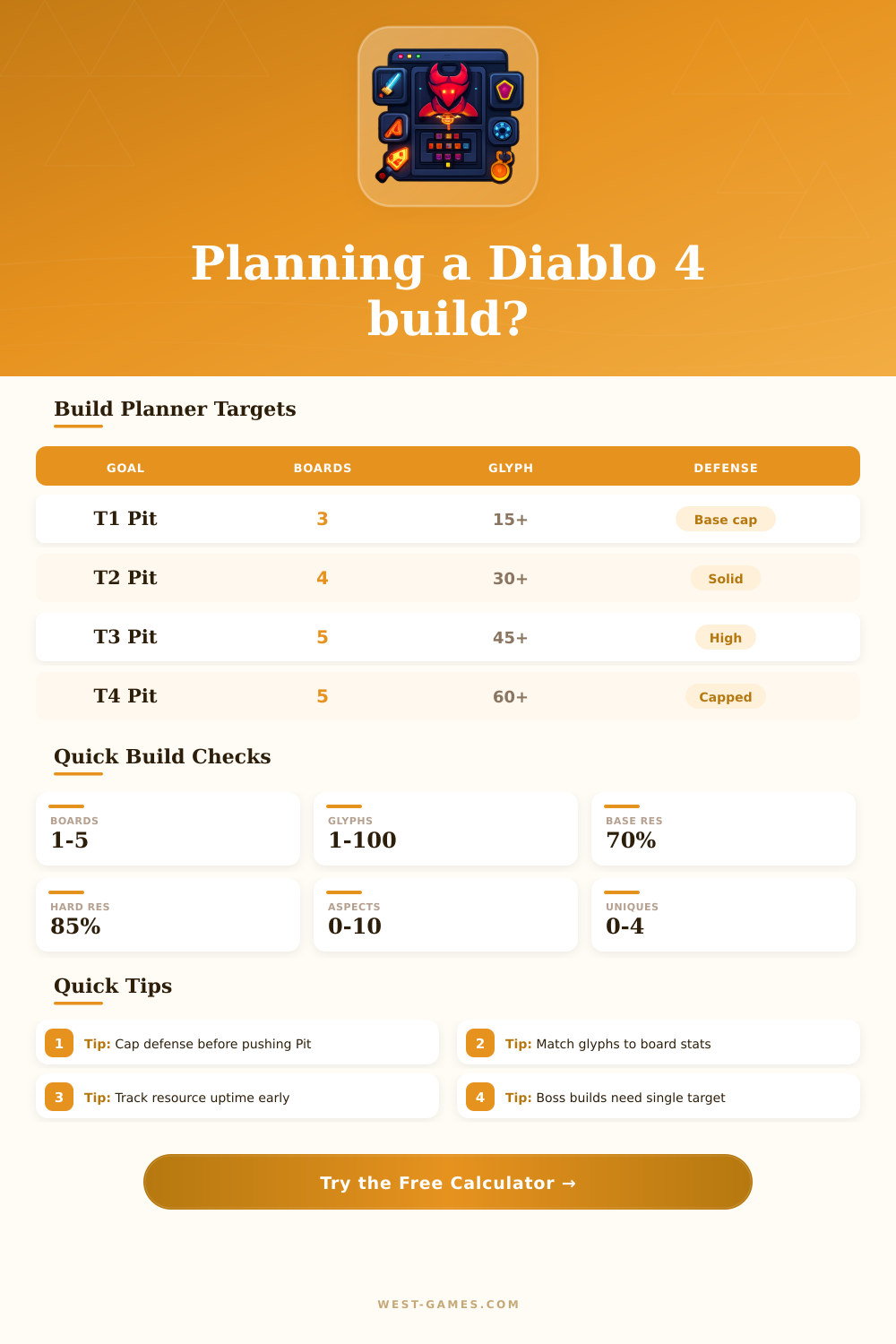
| Resistance cap | 70% base, up to 85% with max-res effects | Cap coverage is limited to 100% | Raising max res requires more actual resistance |
| Endgame target | Planner need | Common weak point | Adjustment priority |
|---|---|---|---|
| Penitent and early endgame | 40 readiness | Incomplete skill package | Finish aspects and core resource loop |
| Pit 20 to Pit 35 | 50 to 60 readiness | Unleveled glyphs | Complete first four useful boards |
| Pit 50 to Pit 65 | 70 to 78 readiness | Defense cap gaps | Cap armor and all elemental resists |
| Pit 80 to Pit 100+ | 86 to 94 readiness | Single-target damage | Optimize key passive, uniques, and glyph sockets |
| Nightmare 100 | 75 readiness | Affix pressure and crowd control | Balance clear speed with unstoppable access |
| Boss rotations | 74 to 88 readiness | Resource gaps during immune phases | Favor boss damage, sustain, and defensive cooldowns |
| Paragon marker | Board count | Glyph level | Planner meaning |
|---|---|---|---|
| Starter route | 1 to 2 | 1 to 15 | Core rare nodes and first glyph are active |
| Functional build | 3 | 15 to 30 | Main multiplier boards are online |
| Endgame shell | 4 | 30 to 46 | Glyph bonuses and legendary nodes are coordinated |
| Push setup | 5 | 46 to 100 | Every board must justify pathing and stat thresholds |
⚔ Preset comparison grid
Upheaval
Best when shout uptime, berserk scaling, and stun windows are high.
Frozen Orb
Control-focused planner path with strong clear and barrier dependency.
Barrage
Balanced Rogue path that rewards positioning and critical windows.
Shadow Minions
Safer mapping setup if minion scaling and corpse uptime are solved.
Pulverize
Fortify-heavy Druid route with high defense and slower boss pacing.
Quill Volley
High-tempo spender loop that needs resource and vulnerability support.
Dust Devil
Fast farming package that needs enough single-target help for bosses.
Chain Lightning
Excellent speed-clear path with sustain and cooldown breakpoints.
Twisting Blades
Push-oriented Rogue route with mobility, setup, and boss execution.
Blood Surge
Overpower boss plan that wants health, fortify, and Rathma timing.
💡 Planner tips
When planning a Diablo 4 build, there are many different variable to consider to ensure that the character is able to survive the dificult content within the game. While a player may choose a class and a skill for a variety of reasons, the class and skill will have an impact upon the defensive needs of the character. Characters that rely upon barriers will require different statistic from those that rely upon fortify or armor for their defense.
Each statistic provide a different type of protection for the character. The choice between the different passive skill and specialization skills for the character can also have an impact upon the character; each of these choices will impact how the character scale as they reach higher level within the game. Beyond these beginning choices for the character, there are still other aspect of the build that require consideration.
Diablo 4 Build Planner: Check Your Build and Defense
For instance, the player will make the choice of Paragon boards and glyph level over time for the character, and these choices are separate from the characters immediate power. However, each new Paragon board will provide access to new legendary node and glyphs, but the glyphs will not be effective until they are of a certain level. An average level for the glyphs is used rather than focusing upon the level of only a few glyph, as those that are evenly developed will be more effective than only a few high-rank glyphs.
Armor and resistance can be measured for the character, but the planner does not provide recommendation for the level of armor that a character should have. However, the player can measure the armor of the player in relation to the target armor level that the player intend to use for the character of varying difficulty. The armor that is considered to be strong for one target level may be weak for another target level.
Aspects and unique item for a character also have separate field for each within the Diablo 4 build planner. Not all aspects and unique items are equally valuable for a character, so each field within the planner will ask the player for how many aspect will support the characters spender, resource loop, and defensive layer. Similarly, a single unique item that define a character’s build can be more important than four unique item that are weaker for the character.
The Diablo 4 build planner recognizes the importance of these item. Resource sustain for a character is another important factor to consider for the build, but is often overlooked until the character’s failure. Such a field within the planner will ask for the number of times that the character is able to use its main skill in relation to the cooldown of that skill.
Without resource sustain for the character, the character will not be able to succeed within the game. The Diablo 4 build planner will provide a readiness score for the character, as well as several other measurement of the characters build. The readiness score for the character will compare the current state of the character with the demands of the endgame target that the player has chosen for the character.
A high readiness score does not ensure that the character will be successful, but if the readiness score is low, the character will have issue scaling to the endgame target. Other measurement of the character include defense coverage, Paragon score, and a verdict as to whether the character is ready, close to being ready, or needs to put more work into the build to reach its specific goal. These score can be used to determine issues with the build.
For instance, if the defense coverage score is the lowest score of all of the measurement, the player should focus upon improving the characters armor and resistance stats. Similarly, if the Paragon score is the lowest score, the player will need to invest more time into leveling the Paragon boards and glyphs. Many people tend to make mistake when they attempt to create a build for Diablo 4.
For instance, one of the most common mistake is to count every aspect that the character has, rather than only those aspect that increase the characters number. Another common mistake is to target too high a level of difficulty with the character prior to equipping glyphs that provide the character with the required power to reach those difficulty. Finally, many people will measure the resistance stat of the character as a single average, but they should measure if one element of the characters resistance is lower than the others.
However, the Diablo 4 build planner will catch these mistake, so that the player is aware of these issue. The player can adjust these suggested readiness score. For instance, the player might determine that increasing the resource uptime of the character is more important than increasing the number of Paragon board that the character purchase.
Similarly, adding a unique item may be less important than increasing one of the characters resistance. These different trade-off can be made easier for the player when the planner handles the calculation for the character. However, the planner will not replace play in game content, but it will limit the number of time that the player decides that the build requires adjustment after having invested the necessary material for the items.
Thus, using such a Diablo 4 build planner will help the player to successfully finish there build so that it doesnt require constant adjustment.