D3 Character Planner
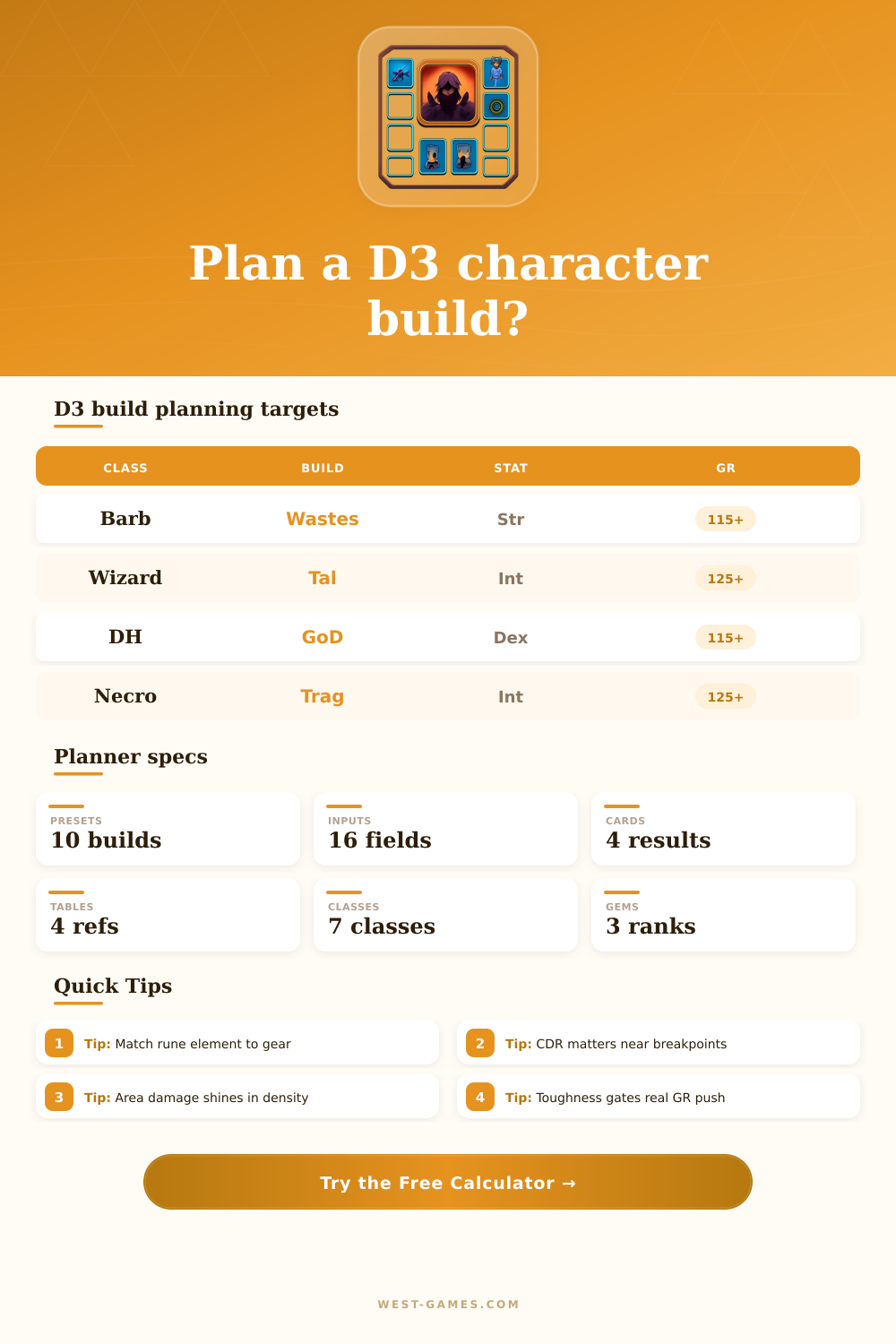
Compare real Diablo 3 build presets, active skill packages, passives, stats, paragon, toughness, legendary gems, and Greater Rift readiness.
| Preset Build | Class | Core Skill Package | Key Stat Pressure | Typical Target |
|---|---|---|---|---|
| Wrath of the Wastes Rend | Barbarian | Rend plus Whirlwind movement | CDR, CHC, CHD, area damage | GR 110-125 |
| Gears of Dreadlands Hungering Arrow | Demon Hunter | Hungering Arrow while Strafing | CHC, CHD, CDR, primary skill bonus | GR 110-125 |
| Tal Rasha Meteor | Wizard | Meteor burst with elemental cycling | CHC, CHD, area damage, elemental uptime | GR 120-140 |
| Trag'Oul Death Nova | Necromancer | Blood Nova with Simulacrum | CHC, CHD, area damage, life scaling | GR 120-140 |
| Armor of Akkhan Condemn | Crusader | Condemn Vacuum with Akarat uptime | CDR, CHC, CHD, area damage | GR 105-120 |
| Inna Mystic Ally | Monk | Mystic Ally waves and Cyclone Strike | CDR, CHD, elemental cycle, toughness | GR 105-120 |
| Mundunugu Spirit Barrage | Witch Doctor | Phantasm stacks and soul harvest | CHC, CHD, area damage, positioning | GR 110-130 |
| Legacy of Dreams Wave of Light | Monk | Wave of Light bells with LoD scaling | LoD rank, ancient count, CDR, CHD | GR 105-125 |
| Stat | Planner Formula Role | Strong Range | Watchout |
|---|---|---|---|
| Main Stat | Base offense and armor/resistance by class | 14,000-28,000 | Large paragon gaps can hide weak rolls |
| Cooldown Reduction | Uptime multiplier weighted by build profile | 35%-65% | Extra CDR has less value past uptime needs |
| Critical Hit Chance | Part of crit multiplier: 1 + CHC x CHD | 45%-65% | Low CHD makes high CHC less valuable |
| Critical Hit Damage | Part of crit multiplier: 1 + CHC x CHD | 400%-650% | Needs CHC to convert into real damage |
| Area Damage | Density multiplier for packed monster pulls | 80%-160% | Weak on sparse maps or pure single target |
| Toughness | Survival check against target GR floor | 500M-1800M | Sheet value misses some mitigation uptime |
| Legendary Gem | Best Planner Use | Rank Signal | Build Fit |
|---|---|---|---|
| Bane of the Trapped | Reliable damage multiplier | 100+ push, 125+ high push | Most damage builds |
| Bane of the Stricken | Rift Guardian and elite scaling | 100+ when boss time is high | Push builds and single target |
| Taeguk | Channeling damage and armor stack | 100+ for Whirlwind or Strafe | Wastes, GoD, channel builds |
| Legacy of Dreams | No-set legendary item multiplier | 99+ baseline, 125+ strong | LoD Wave of Light and custom LoD |
| Enforcer | Pet damage and pet survival | 100+ for pet setups | Inna allies and pet variants |
| Zei's Stone of Vengeance | Range-based damage multiplier | 100+ when distance is stable | Meteor, Impale, ranged casters |
| GR Band | Offense Need | Toughness Floor | Planning Note |
|---|---|---|---|
| GR 90-105 | Starter ancients and rank 75-100 gems | 250M-600M | Good speed and augment farming range |
| GR 106-120 | Strong rolls, rank 100-125 gems, good crit | 600M-1000M | Most builds need cleaner cooldown uptime |
| GR 121-135 | Optimized stats, augments, density control | 1000M-1700M | Area damage and fishing begin to matter |
| GR 136-150 | High paragon, high gems, excellent maps | 1700M+ | Planner score assumes strong execution |
Planning a Diablo 3 character for an Greater Rifts will require an understanding of the interactions between the different choices for your character. Your character build, your choice of gem, and your paragon points will all have an impact upon how high a ceiling you can reach before damage or toughness kills your character. A character planner will help you to understand how these various aspect of your character will interact with each other to impact your ability to reach that ceiling.
While the toughness number for your character is important, it doesnt provide the whole story for your character. A high number of toughness will protect you from some of the enemies in the Rifts, but that toughness may not be enough when facing some of the other enemies or the Rift Guardian. The character planner will allow you to compare your toughness to the toughness that your character build will provide at a specific level of Greater Rift, helping you to determine if you need more vitality or better mitigation skill to succeed.
How to Use a Character Planner for Greater Rifts
Offense for your character also have specific interactions that must be considered. Main stat, critical hit chance, and critical hit damage are all elements that will impact your characters performance in the Rifts. Your character build will change the value of each of these stats.
For example, a Tal Rasha Meteor build values area damage and elemental uptime while a Shadow Impale Demon Hunter values single-target skill and damage output. Each of these different builds will have different weight given to each of these offensive statistics, which the planner software will automaticly calculate. Cooldown reduction is another statistic for your character that has a specific meaning and value.
Cooldown reduction is different for each of the character builds due to the diminishing returns for some builds compared to others. For instance, a Crusader may require more cooldown reduction than a Barbarian to reach the same cooldown breakpoint. The planner will compare your cooldown reduction to the cooldown reduction of your character build, and your readiness for the Rifts will be lowered if your cooldown reduction is less than expect from your target level.
Another factor to consider for your character are legendary gem. The rank of each legendary gem and the legendary gem itself will provide benefits for your character. For instance, the Bane of the Trapped legendary gem can provide multiplier for many different character builds, while the Bane of the Stricken may be more useful for Rift Guardian battle.
Additionally, builds based off the Legacy of Dreams legendary gem are dependent upon the rank of the legendary gems, as they provide a multiplier based upon the number of ancient item that the character possesses. These legendary gems will be combined into a single factor that is represent in the planner. One of the variables for your character is the allocation of paragon points.
Your paragon points will allow you to increase your main stat, your vitality, and your speed. Most builds will use the balanced allocation of paragon points, although builds that focus upon offense may use more main stat than the balanced allocation. The character planner will allow you to select the allocation style that you would like to use, which will impact the power index of your character.
The impact upon the power index is one of the factors that will impact your estimated ceiling for the Rifts. The reference tables located on the planner will provide more information about your character and what it is capable of within the Rifts. These tables will show different band for the Rifts, the toughness floor for those Rifts, and the rank of legendary gems that work best in those Rifts.
Additionally, the table can show the types of character builds that perform best within certain Rift range. These tables can be used to help you determine your goal for your character prior to attempting to clear any Rifts. Overall, using a character planner will allow you to see the tradeoffs of your character build.
By entering each of your characters stats into the planner, by selecting the build that you intend to utilize, and by selecting your target for the Rifts, the planner will show you which aspect of your character are weak. For instance, your toughness may be sufficient for the Rift that you are attempting to clear, but your cooldown reduction may be too low. Additionally, your legendary gems may be strong, but your area damage may be too low for the number of enemies that are in the Rift.
By recognizing these weakness in your stats, you can decide which stats will require upgrading for your character to improve. Using a character planner will provide you with clarity regarding your character and how it can be best progress within the Rifts. The planner will not replace playing the game, but it will explain to you why one character build may succeed at higher rate than another build.
Additionally, if the planner matches your in-game experience, your characters stats are accurate; however, if they dont match your in-game experience, you will know that you need to change your character stats prior to attempting to clear the next Rift.