Pathfinder 2e Experience Calculator
Build PF2e encounters with creature XP, simple and complex hazards, accomplishment awards, party-size budget adjustment, and 1,000 XP level progress.
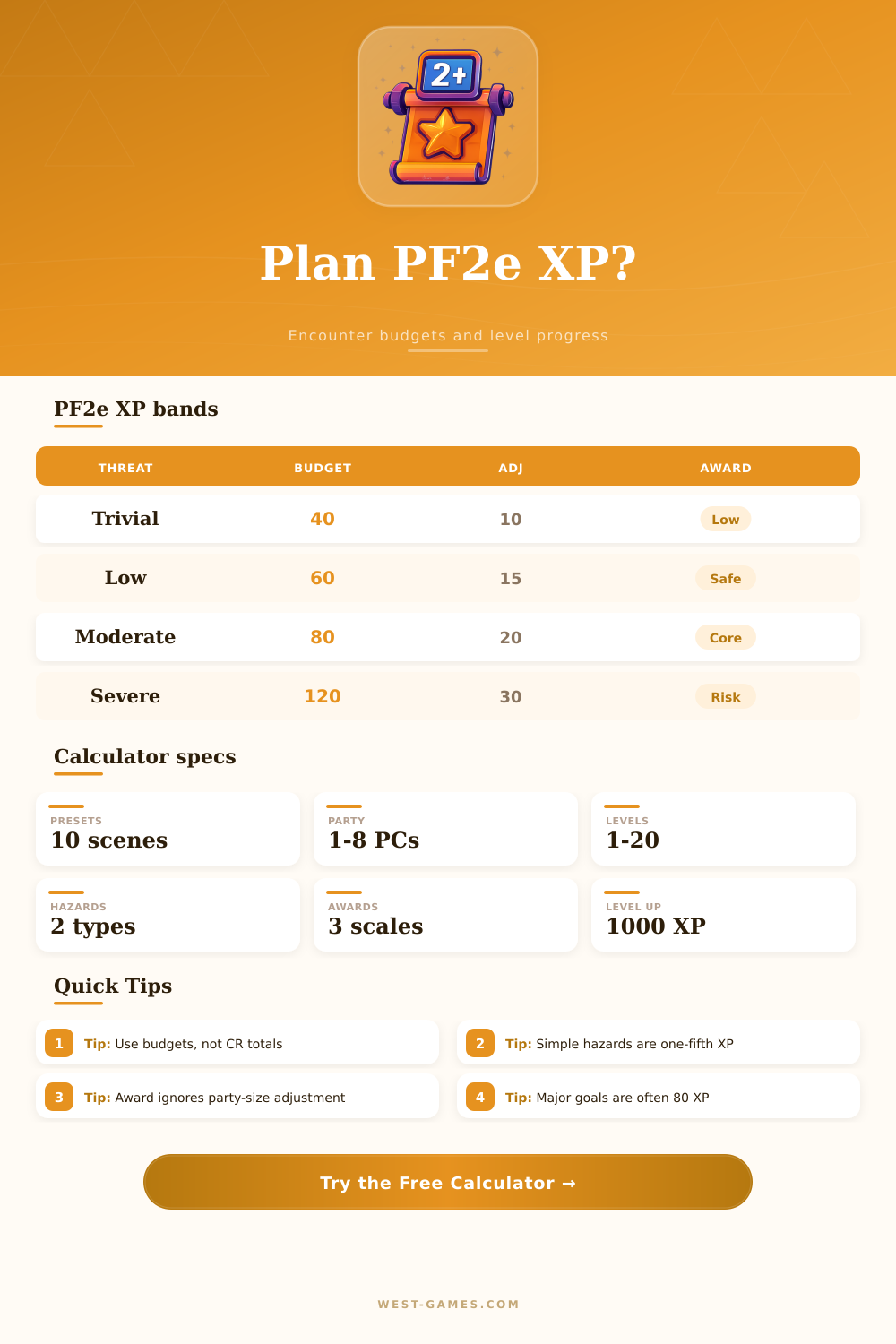
| Threat | Base budget for 4 PCs | Adjustment per PC | Typical use |
|---|---|---|---|
| Trivial | 40 XP or less | 10 XP | Low pressure scene, speed bump, favorable setup |
| Low | 60 XP | 15 XP | Light fight, scouting clash, resource tap |
| Moderate | 80 XP | 20 XP | Standard encounter with real tactics |
| Severe | 120 XP | 30 XP | Major boss, dangerous terrain, hard stakes |
| Extreme | 160 XP | 40 XP | Possible defeat if the party misplays |
| Relative level | Creature XP | Complex hazard XP | Simple hazard XP |
|---|---|---|---|
| Party level -4 | 10 | 10 | 2 |
| Party level -3 | 15 | 15 | 3 |
| Party level -2 | 20 | 20 | 4 |
| Party level -1 | 30 | 30 | 6 |
| Party level | 40 | 40 | 8 |
| Party level +1 | 60 | 60 | 12 |
| Party level +2 | 80 | 80 | 16 |
| Party level +3 | 120 | 120 | 24 |
| Party level +4 | 160 | 160 | 32 |
| Award type | XP each | When it fits | Calculator field |
|---|---|---|---|
| Minor accomplishment | 10 XP | Small clue, single room goal, bypassed nuisance | Minor accomplishments |
| Moderate accomplishment | 30 XP | Meaningful social win, solved hazard chain, scene objective | Moderate accomplishments |
| Major accomplishment | 80 XP | Adventure chapter, rescued objective, campaign-turning success | Major accomplishments |
| Custom milestone | Any XP | Use when your table blends XP and milestone pacing | Custom milestone XP |
| Shape | Math example | Budget | Play feel |
|---|---|---|---|
| Solo brute | One party level +2 foe | 80 XP | Swingy moderate fight with strong numbers |
| Elite captain with guards | PL+1 plus two PL-2 | 100 XP | Between moderate and severe for 4 PCs |
| Many weak foes | Eight PL-4 creatures | 80 XP | Moderate on paper, area attacks matter |
| Trap room | Two PL simple hazards plus PL foe | 56 XP | Low unless terrain compounds danger |
| Set-piece hazard | PL complex hazard plus two PL-1 foes | 100 XP | Demanding action economy puzzle |
Pathfinder 2e reward you for thinking about the encounters that you are about to create before you begin to play. The experience system for Pathfinder 2e is based upon budgets rather than the number of creatures that are to be encountered. The math problem that you have to solve for a party of four players of level five will be differ than the math problem that you must solve for a party of six players of level five.
Once you understand the concept of the experience budget, you will find that planning for the encounter becomes easy for you. This tool will run the numbers for you once you have entered the level of the party, the size of the party, and the creatures and hazards that you would like to include in the encounter. Additionally, there is accomplishment awards included in the tool that will allow you to see the total experience that the characters will earn from the encounter.
Plan Pathfinder 2e Encounters and XP
The experience system for Pathfinder 2e is simple in that every monster and hazard have an experience value. The experience value for a creature or hazard is based upon the level of that creature or hazard as compare to the characters in the party. For instance, a creature that is four levels beneath the characters is worth ten experience points, but a creature that is one level above the characters is worth sixty experience points.
The encounter calculator will automatically calculate the experience values for the creatures and hazards that you select for your encounter. Additionally, the encounter calculator will separate hazards from complex hazard so that you can more easly determine the experience value of each. This division is made since traps that fire only once are worth less experience than hazards that require actions from the players over several rounds of the game.
The size of the party will impact the experience budget that is allotted to the characters during the game, but it dont impact the amount of experience that is awarded to the players. The experience budget for the game is based upon four characters. If there are more players than four, then the experience budget will be increased.
If there are fewer player than four, then the experience budget will be decreased. However, the size of the party does not affect the experience that the players earn. The experience is earned from the creatures and the hazards of the encounters and not from the experience budget that is established for the players.
The accomplishment awards sits on top of the experience value that is earned from combat. The accomplishment awards allow you to provide experience for players for activities other than combat. For instance, if the players complete a minor task, they earn ten experience points.
If they complete a more demanding (moderate) goal, they earn thirty experience points. If they complete a major goal, they earn eighty experience points. These accomplishment awards are provided so that you have a way of rewarding your players even if the encounter was not combat.
This accomplishment award calculator can be performed after you have established the experience value of the creatures and hazards in the encounter. Additionally, if your campaign use story-based experience advancement, you can enter a custom milestone for your players. Most players likes to have encounters of a moderate level of challenge.
Moderate challenges for the players ensure that they are not killed in the encounter. Severe challenges are used in encounters that require it for the story, but trivial and low challenges are often used for encounters that require the players to gain information only. Encounters can be of any challenge level, but the encounter calculator will allow you to set up the encounter and select the challenge level for the encounter prior to beginning to play.
It is tempting to consider each encounter as separate from the others in the campaign. However, the challenges of the early encounters can have an impact upon the challenges in the later encounters. For instance, if the players faced a severe challenge in one encounter, it is likely that the next encounter should be of a low or moderate challenge to allow the players to survive the campaign.
The experience budget does not track the hit points or spell slots of the players. However, you can use the experience budget to ensure that the challenges of the encounters remain within a manageable range throughout the day of adventuring. The experience budget also includes experience values for hazards in the adventure.
Complex hazards are treated differently from simple hazards in the game in that complex hazards require more experience points to overcome than simple hazards. For instance, a simple hazard may be a trap that triggers once, but complex hazards may require players to take actions over several rounds. The experience value for each type of hazard is accounted for in the encounter calculator so that you dont unknowingly set up a complex hazard that requires more experience to overcome than an encounter with a boss monster.
One benefit of using the encounter calculator is that you can use this tool to focus upon the encounter and the location within the game that is to be explored. The calculator allows you to determine the experience values of the creatures, the hazards, and other aspects of the encounter. Additionally, the encounter calculator will remain consistent with other encounter calculators in the game.
This consistency in calculations will allow for the players to move between different campaigns for the game. Over time, you will become more familiar with the experience calculations in the game. For instance, you will learn that an encounter with a single creature that is two levels above the players will be considered a severe challenge.
However, an encounter with eight creatures that are four levels below the players may be considered to be of a moderate level of challenge. Additionally, adding a complex hazard to the encounter will increase the experience value of the encounter without increasing the number of creature in the encounter. These experience calculations can be made visible to you in the game prior to the players begin to explore the encounter.
The experience system for Pathfinder 2e allows you and your players to have a shared language for the encounters that you plan to design. For instance, you may use the language of experience value to explain to your players the type of challenge that is to face them in the next encounter. Additionally, the language of the experience budget can help you to focus upon your players and the adventure that you are to craft for them.