🎮 Gotham Knights Skill Tree Calculator
Plan hero AP spending, Knighthood unlock value, momentum uptime, damage focus, and patrol survivability before committing a build.
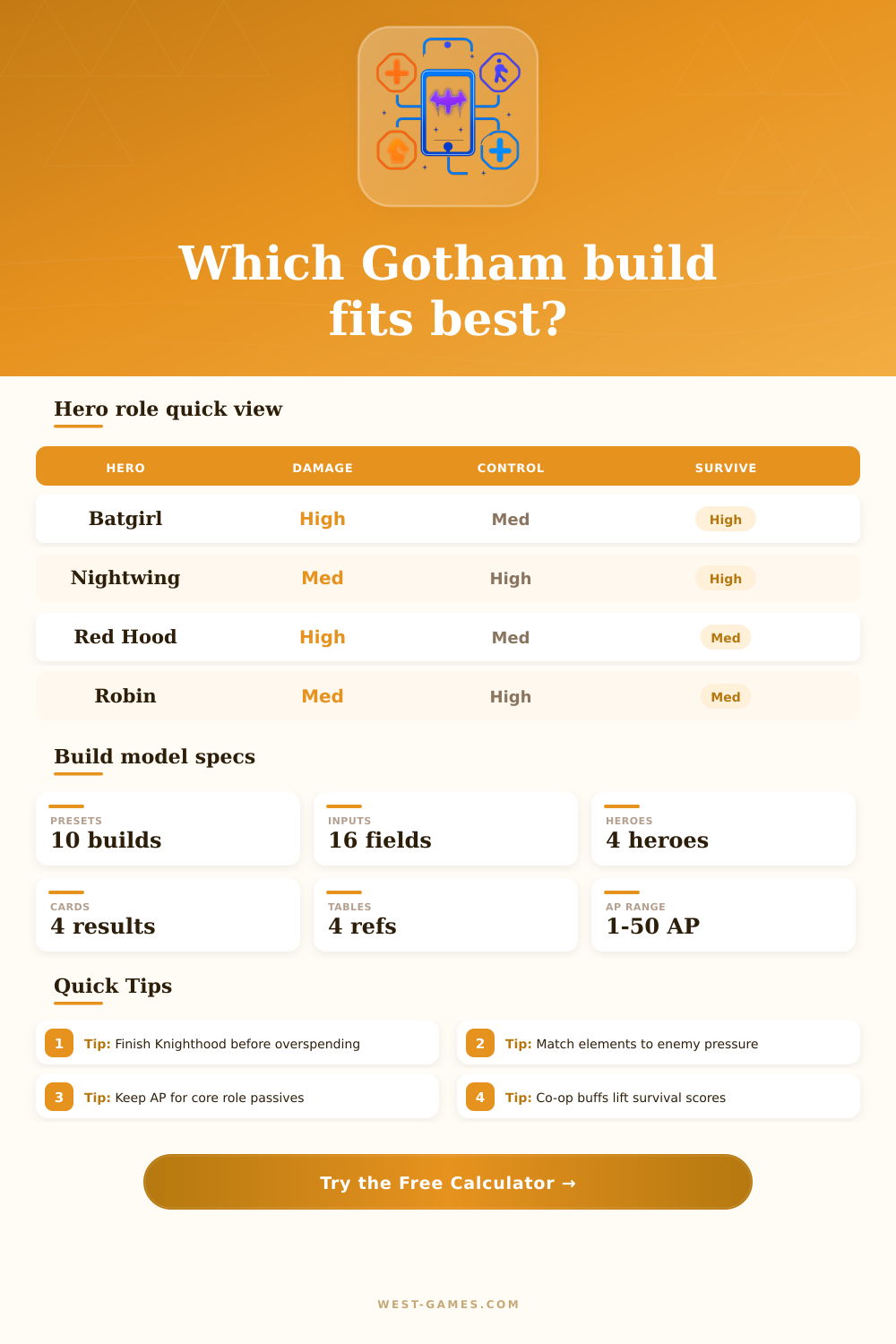
| Hero | Best score lanes | Skill identity | Watch item |
|---|---|---|---|
| Batgirl | Melee, survival, hacking control | Reliable solo brawler with strong durability | Do not ignore momentum generation |
| Nightwing | Support, mobility, team sustain | Fast acrobat with co-op and evasion value | Needs focused damage investment |
| Red Hood | Ranged damage, grabs, brute pressure | High burst marksman with strong single-target play | Defense can lag on high pressure |
| Robin | Stealth, control, elemental pressure | Technical setup hero with strong crowd control | Boss damage needs gear support |
The calculator treats each hero as a planning profile. Adjust AP numbers to match your actual unlocked nodes.
| AP lane | Starter | Focused | Effect |
|---|---|---|---|
| Justice / damage | 4 AP | 10+ AP | Raises direct damage and crit value |
| Grit / survival | 3 AP | 8+ AP | Improves uptime under pressure |
| Momentum | 4 AP | 9+ AP | Speeds ability cycles and finishers |
| Knighthood | 3 AP | 7+ AP | Unlocks hero identity and traversal payoff |
| Hybrid spread | 12 AP | 28+ AP | Works best after core passives are covered |
| Focus | Best use | Score bonus | Limit |
|---|---|---|---|
| Concussive | Mob packs | Control | Lower boss value |
| Cryogenic | Brutes | Safety | Needs buildup |
| Incendiary | Bosses | Damage | Less control |
| Toxic | Long fights | Sustain DPS | Weak on fast clears |
| Shock | Ranged squads | Chain clear | Gear dependent |
| Pressure | Synergy | Survival | Read |
|---|---|---|---|
| Story | 45+ | 40+ | Flexible AP spread works |
| Normal | 55+ | 50+ | Balanced patrol ready |
| Hard | 65+ | 60+ | Focus role passives |
| Very hard | 74+ | 70+ | Use defense or control |
| Heroic | 82+ | 78+ | Needs refined AP and gear |
The skill tree for Gotham Knights determines the abilities of the player-controlled hero during gameplay. The skill tree directly impact the movement of the hero, the heros ability to gain health, and how long the player can remain in the fight with the enemy. Because these skills impact the heros performance, players must plan how they allocate there skill points.
Allocating skill points with a plan is more effective than simply assigning skill points to the most attractive skill upgrades. The calculator determine the best allocation of skill points for the players hero. The player must enter their chosen hero, role preference, action point budget, and activity pressure.
How to Use the Gotham Knights Skill Tree Calculator
The calculator determines a score based on the heros emphasis on dealing damage, having control skill, or surviving enemy attacks. This score determines the best allocation of skill points for the player. Different heroes have different starting ability.
Batgirl has many abilities that enhance survival. Therefore, players should not allocate too many skill points to damage for Batgirl. Nightwing has many abilities that enhance mobility between battles.
Therefore, players should ensure that their allocation of skill points ensures that they have a balance between momentum and grit attributes. If players want to use the power of Nightwing abilities to revive team members and enhance enemy control during long battles, then they must ensure that they balance their skill points. While Red Hood players may choose the early game skills that enhance ranged damage, this could be ineffective against many enemy types.
Robin players must invest their skill points in skills that enhance the setup tools and the stealth skills that Robin use. The payoff for investing in these skills comes later in the battle when the enemy encounter these stealth opportunities. The calculator allows players to adjust the relative weights for damage, control, and survival skills depending on the enemy types they will encounter.
Therefore, the calculator recognizes that the different heroes has different game strategies against the enemies. Other decisions players must make include the elemental attacks the characters use. For example, the cryo element allow breathing room for the heroes to deal with brutes while the incendiary elements places too much pressure on the heroes to focus on a single target but prevents them from using many control skills.
Players must decide which elemental attacks to choose based off the enemy types they will face. The difficulty of the enemies players face will also determine how players allocate their skill points. The higher the difficulty level, the higher the enemy health and the enemy aggression.
This means that players will need better survival skills at higher difficulties. The Knighthood skill tree is a part of the game that many players tend to overlook. However, it contains valuable skills that enhance traversal and the players identity passive.
Players should unlock this game tree early in the game to gain the benefit of the early skill upgrades. Rather than investing skill points equally into all four trees, players can create a more effective build by investing points in hybrid builds. However, the hybrid build game tree will only be effective if players have invested in the abilities that improve the heros role skills first.
If they dont, then the player will have a hero that is competent in many area but is not strong in any particular area. An additional game variable is the need for co-op play. When playing co-op, players will need to use many support game skills that enhance their co-op playmates abilities.
The solo focused builds that may work for a single player will waste players skill points when playing co-op games. The opposite is true for when players are playing alone. In this situation, players will not want to invest too much into support skills for their teammates as they will be the only character in the game.
The calculator will save players a great deal of time. By using the calculator, players can simulate different skill point allocations and see how it affect specific metrics. For example, they can use it to see whether moving some skill points from momentum to grit will improve their readiness score.
They can also use the calculator to see how their build will differ different than their enemy matchups. Using these simulations, players can see whether their current game build will match their content preference before they begin to encounter these game enemies in their patrols. While the game skill calculator is not the replacement for experimentation, it will eliminate the guesswork for players when they approach the skill point allocation process.
Knowing what the calculator measures and what the scores mean for the game will allow players to make more informed and decisive game build decisions. Using this information, players can create an intentional game build for their preferred hero rather than an improvised game build.