🎮 Diablo 3 Skill Tree Calculator
Compare class skills, rune elements, cooldown uptime, resource pressure, and Greater Rift readiness from one build planner.
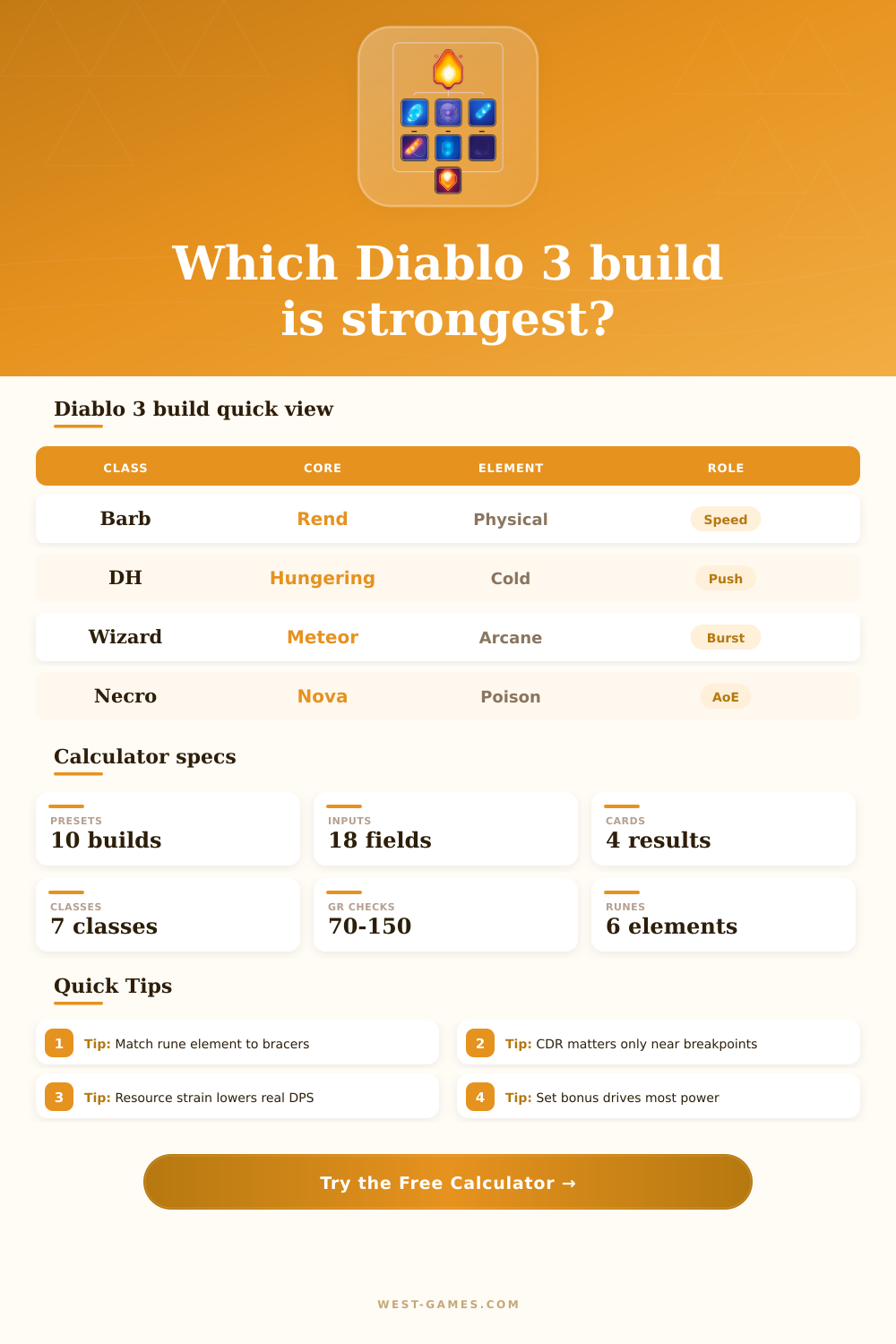
| Class | Build package | Core skill | Typical role |
|---|---|---|---|
| Barbarian | Wrath of the Wastes | Rend with Whirlwind | Speed farming and solo push |
| Demon Hunter | Gears of Dreadlands | Hungering Arrow | Strafe-based clear speed |
| Wizard | Tal Rasha | Meteor | Element cycle burst damage |
| Necromancer | Trag'Oul | Death Nova | Area burst with life scaling |
| Monk | Inna | Mystic Ally | Pet burst and support uptime |
| Crusader | Aegis of Valor | Fist of the Heavens | Holy spender pressure |
Presets are modeling profiles, not item recommendations. Adjust your actual skill bonus, cooldown, and legendary values after loading one.
| Source | Low | Strong | Impact |
|---|---|---|---|
| Element bonus | 20% | 80%+ | Multiplies rune damage |
| Skill bonus | 15% | 60%+ | Targets one spender |
| Legendary | 400% | 8000%+ | Build-defining power |
| Crit package | 2.6x | 4.4x+ | CHC and CHD pair |
| Gem ranks | 50 | 120+ | Push scaling |
| Skill | Base CD | Duration | Watch |
|---|---|---|---|
| Mystic Ally | 30 sec | 10 sec | Needs burst timing |
| Bombardment | 60 sec | 8 sec | Heavy CDR demand |
| Meteor | 8 sec | 3 sec | Element cycle sync |
| Death Nova | 0 sec | Always | Resource sustain |
| Rend | 0 sec | 15 sec | Refresh frequency |
| Target | Power index | Toughness | Read |
|---|---|---|---|
| GR 70 | 1M+ | 80M+ | Starter ancient farm |
| GR 90 | 8M+ | 180M+ | Efficient gem leveling |
| GR 110 | 45M+ | 500M+ | Strong seasonal build |
| GR 125 | 160M+ | 1100M+ | Augment territory |
| GR 140 | 550M+ | 3000M+ | Optimized push |
| GR 150 | 1200M+ | 6000M+ | Top-end clear plan |
| Tier | Model | Multiplier | Best use |
|---|---|---|---|
| Starter | 2-piece | 2.5x | Fresh level 70 |
| Partial | 4-piece | 8x | Early season |
| Full set | 6-piece | 101x | Core build play |
| LoD | Ancients | 76x | No-set builds |
| Push | Optimized | 151x | High GR pushing |
Creating an strong Diablo 3 character involve finding the proper interaction between various game skills. For many player, it is difficult to find ways to improve their character because they are unaware of how power and skill interaction work together. The calculator that the game provide to players will assist in mastering the math of their Diablo 3 character build.
The calculator will use the gear and skill rolls that the player choose in order to make their game build and remove guesswork for the players. Damage and attack speed is essential for defining the damage that the player’s main skill will do. Main stat, critical chance, and critical damage define the potential of the players character to do damage with their attacks.
Use the Diablo 3 Calculator to Improve Your Character
Additionally, elemental and skill bonuses are apply when the rune element of the player’s character matches the element of their gear. Cooldown and resource reduction are important for rotations in the game. The player will fail to use their skill if they do not have the cooldown for each skill.
Additionally, the resource pressure that a character have will determine whether or not their resources will be able to keep up with the demands of their skills. Set bonus tier are important because it will provide the most power to the character when increased. Lastly, legendary gem rank and toughness will determine the strength of the player’s defensive system and supports.
There are four differently output cards that provide the player with feedback on their character build. The skill power index will calculate the player’s damage with all multipliers apply to the damage of the player’s main skill. Cooldown uptime will allow the player to see how often they can use their main skill.
Resource pressure will warn the player if they are spending their game resources more faster than they are receiving them back, which is essential for ensuring that their character does not fail in the game. Lastly, the GR readiness bar will allow to player to compare their damage and toughness to the difficulty settings for the game, providing them with a status label that indicates whether or not their character build is ready for play or if it requires further work. One of the most common mistake is focusing on raw damage output while ignoring sustain.
It is true that increasing the legendary multipliers will lead to an increase in the player’s damage index. However, if the player does not have enough resource to use each of their skills, their character will stall. Another of the most common mistake is investing too much into cooldown reduction because at some point, there will be a plateau in damage increases with further cooldown reductions.
The calculator will identify these mistake in order to provide players with information that indicates to them to stop adjusting these statistic. The seasonal meta will change how the player’s build work. For example, set bonuses and legendary gem will have more or less importance during certain seasons in relation to others.
While the tables provided for the players show the general importance of each game statistic, players must adjust these statistics for their gear piece. For the most part, players will want to focus on the importance of resource pressure and cooldown uptime in addition to the damage that their skills can deal with the enemies in the game. The player can use these feedback systems to make better decisions regarding their gear.
For example, they can test the difference in applying one jewelry piece instead of another, or they can use the information provided to determine whether they should work on their resource loop before focusing on another aspect of their game build. Overall, the Diablo 3 character build calculator will allow the player to make adjustments to their build more faster than they could without the calculator.