🚀 Starfield Skill Tree Calculator
Route points across Combat, Science, Tech, Social, and Physical trees with level, NG+, challenge depth, and crew synergy weighting.
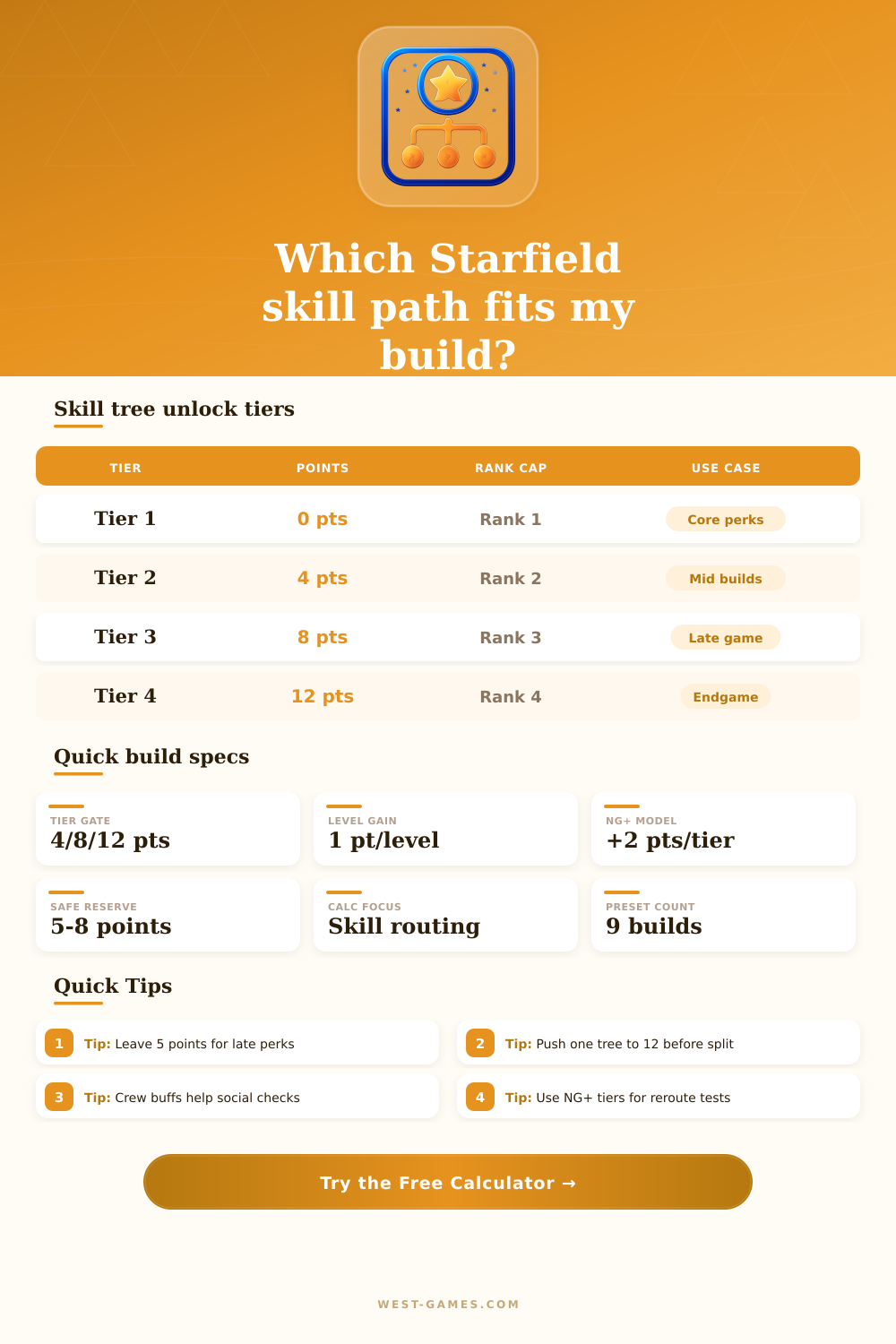
| Branch Points | Unlocked Tier | Rank Ceiling | Practical Effect |
|---|---|---|---|
| 0 to 3 | Tier 1 | Rank 1 | Core starter perks only |
| 4 to 7 | Tier 2 | Rank 2 | Mid-branch utility and sustain |
| 8 to 11 | Tier 3 | Rank 3 | Late mission specialization |
| 12+ | Tier 4 | Rank 4 | Endgame synergy and capstone perks |
| Archetype | Combat / Science | Tech / Social | Physical Total |
|---|---|---|---|
| Ballistic Vanguard | 18 / 6 | 10 / 4 | 10 |
| Stealth Sniper | 15 / 10 | 8 / 6 | 12 |
| Outpost Engineer | 8 / 16 | 20 / 4 | 10 |
| Persuasion Diplomat | 6 / 10 | 8 / 18 | 8 |
| Particle Hunter | 16 / 14 | 14 / 6 | 10 |
| Challenge Completion | Rank Depth Factor | Recommended Timing | Expected Build Impact |
|---|---|---|---|
| 0 to 29% | 1.00x to 1.09x | Early quest chain | Shallow rank progression |
| 30 to 59% | 1.10x to 1.16x | Faction mid-game | Reliable tier climbing |
| 60 to 84% | 1.17x to 1.23x | Late campaign | Strong rank momentum |
| 85 to 100% | 1.24x to 1.32x | NG+ optimization | Fastest rank conversion |
| Difficulty | Efficiency Multiplier | Crew Value Weight | Use This For |
|---|---|---|---|
| Very Easy / Easy | 0.92x | Low | Casual route checks |
| Normal | 1.00x | Medium | Baseline planning |
| Hard | 1.08x | Medium | Mission pressure builds |
| Very Hard | 1.16x | High | Survival-heavy setups |
| Extreme | 1.24x | Very High | Min-max endgame runs |
All table values are planning references to compare routes quickly; adjust branch points for your exact perk unlock order.
A skill tree calculator are a tool that you can use to plan your skill allocations within the game Starfield. You can use a skill tree calculator for the game because it will take the guess that you might make as to which skills you should level and turn that into a plan for your skill points. Using a skill tree calculator will help you to decide which skills to allocate your skill points to within the game.
There is five skill trees within the game, and they are for the skills of Combat, Science, Tech, Social, and Physical. The Combat skill tree will allow you to level your guns and targeting suite, which will be important for the zero-gravity fights that you will face. The Science skill tree will allow you to use your research and exotic module, which will allow you to create grav drive from the part that you find in the game.
Plan Your Skill Points in Starfield
The Tech skill tree will allow you to maintain your ships. The Social skill tree will allow you to interact with other groups in the game and skip certain quest. The Physical skill tree will allow you to sneak and move more easy while you are in the game.
Each skill tree has different tier that you can level in your game. You will recieve zero point in each of your skills at the start of the game, and you will have access to rank 1 skill. If you spend four point into a skill tree, you will be able to access the tier two skills.
At eight skill points, you will be able to access the tier three skills for the later part of the game. Finally, at twelve skill points in a skill tree, you will be able to access the capstone skill. You should not spread your skill points to too many of the skill trees, as you will end up with mediocre skills across the board.
You should instead focus on one skill tree before you move into the other. In the New Game Plus mode, you will receive more planning point. You will receive roughly two additional planning point for each cycle of the game.
You should save five to eight skill point for later in the game for specific quest. Additionally, you can use the background bonus from your previous run of the game to help increase your total skill points. For New Game Plus, you can take a more aggressive approach to your skill.
For example, you can focus on your Tech skill to learn boarding tool for your ships and focus on your Social skill to better command your crew. Depending on the type of player that you are in the game, your skill allocation will change. For instance, to play the UC Vanguard archetype in the game, you will require eighteen point in your Combat skill and the remainder of your skill tree can be at a minimum.
This is so that you can focus on other aspect of the game like the Tech skill tree. Similarly, stealth sniper will require twelve points in the Physical skill tree to allow for silent take downs and science modification to your rifle. Outpost engineer will require twenty point in the Tech skill tree and sixteen in the Science tree so that they can move and scan the area for resource for their outposts.
Your skill point allocation should match the archetype that you play into the game so that your readiness score remain high. Your companion for the game will provide some synergy for your character. With your companions, you can boost your Social skill by as much as eighteen percent within normal difficulty.
However, on extreme difficulty with the game, the value of your companions increase because every game element is important at this difficulty. You should avoid the mistake of ignoring the depth of the skill within the game. Additionally, challenge will allow you to progress through the game much faster as your kill and scan will translate into progression within the game.
By playing aggressive on New Game Plus, you can increase your challenge from one to one-point-three-two. Many player often ignore the Physical skill tree. However, the Physical skill that you gain will be important for your survival in the game.
You should always push one of your skill tree to twelve point before you allocate your point to any other tree. You want to ensure that one tree will allow you to survive the games raid or heist while your other tree develop. Additionally, the skill point preset will allow you to see how much each of the archetype require in specific skill.
For instance, the Freestar sniper will require thirteen point in the Physical skill and fifteen in the Combat skill. For the Crimson Raider, you will have sixteen point in the Combat skill and fifteen in the Tech skill but eight in the Social skill so that your crew does not mutiny on you. The difficulty level for the game will change the efficiency of your skill.
At normal difficulty, each skill will have a baseline efficiency of one times. However, on extreme difficulty, each skill will have a one-point-two-four efficiency. On the very hard difficulty, your crew weight will increase.
Thus, having companion will be necessary for your ship index to remain efficient. You should always have some skill point in reserve. When your skill point dip into a negative value, you will suffer five percent reduction in your readiness for every point of shortfall.
Thus, hoard your skill point for your capstone skill as those skill at rank four will allow you to change the way that you play the game. A skill tree calculator will distill your skill point into the index for your game. These index will show you how effective that your character is for each skill.
If you recieve a high score in one of these index, you are clear in your allocation of skill. If you receive a low score, you will want to move your point to another area. These number will help you determine your skill, but you must also test your build in the Settled Systems for the game to ensure that the build is appropriate for you.