💡 Ring Light Lifespan Calculator
Calculate exactly how long your ring light LED will last based on your usage habits
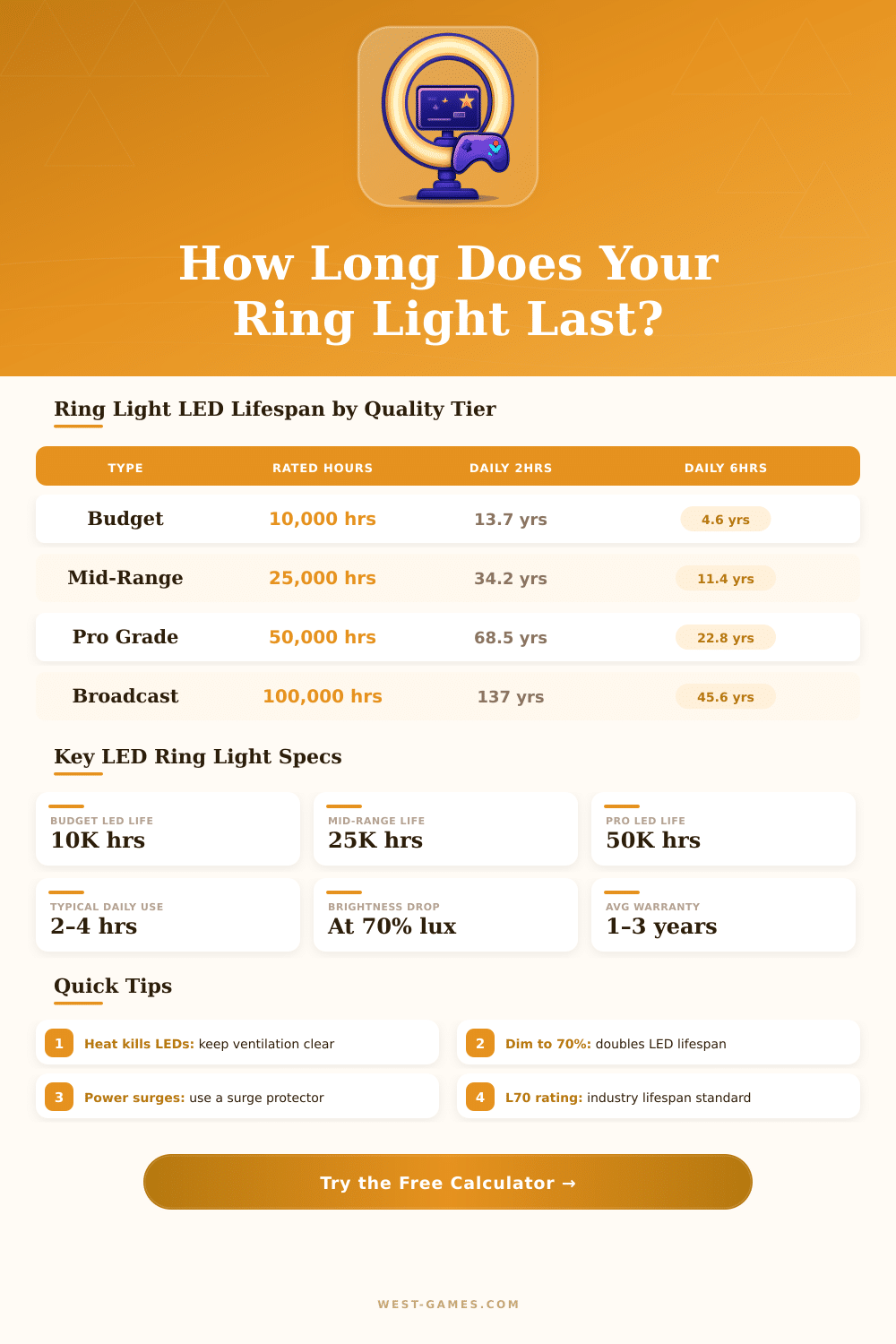
| Ring Light Type | Rated LED Life | @ 2 hrs/day, 5 days/wk | @ 4 hrs/day, 7 days/wk | @ 8 hrs/day, 7 days/wk |
|---|---|---|---|---|
| Budget / Unbranded | 10,000 hrs | ~19.2 years | ~6.8 years | ~3.4 years |
| Mid-Range Brand | 25,000 hrs | ~48.1 years | ~17.1 years | ~8.6 years |
| Pro / Premium | 50,000 hrs | ~96.2 years | ~34.2 years | ~17.1 years |
| Broadcast Grade | 100,000 hrs | ~192 years | ~68.5 years | ~34.2 years |
| Environment | Approx. Temp | Life Reduction | Effective Multiplier |
|---|---|---|---|
| Cool, well-ventilated | Below 25°C / 77°F | None (optimal) | 1.00x |
| Normal room | 25–30°C / 77–86°F | ~8% reduction | 0.92x |
| Warm / poor airflow | 30–40°C / 86–104°F | ~20% reduction | 0.80x |
| Hot / enclosed | Above 40°C / 104°F | ~35% reduction | 0.65x |
| Brightness Level | Relative Heat Output | Lifespan Effect | Recommendation |
|---|---|---|---|
| 50% or below | Low | Extends life up to 2x | Best for longevity |
| 60–70% | Moderate | Near rated lifespan | Ideal balance |
| 80–90% | High | ~10–15% reduction | Acceptable for shoots |
| 100% (max) | Very High | Up to 25% reduction | Avoid continuous use |
• Dim to 70%: Running at 70% brightness instead of 100% can nearly double LED lifespan.
• Surge protector: Power spikes are a leading cause of premature LED failure.
• Cool-down time: Allow 10–15 minutes between extended sessions to prevent heat buildup.
• Dust regularly: Dust blocks ventilation and raises operating temperature significantly.
A ring light is made up of those round lights that you likely saw in studios or during live shows. They stand out because of their empty center, so surrounding light forms a ring. This setup uses even lighting, that spreads the reflections equally around the object and strongly reduces shades.
Because of that they enjoy big use in close-up shots: they form that classic light ring that reflects in the eyes and give to photographs and videos a polished, professional atmosphere.
What Is a Ring Light and How to Use It
In photography the lighting decides everything (it makes or destroys the result). Whether streaming, vlogging or jumping into a video call, it matters little. Even the best camera will make you look tired and grainy if it lacks good light on your face.
A good ring light settles that by means of soft, even lighting above the main part. It changes genuinely how you appear on the screen.
A ring light is commonly found in beauty work, portraits and close-up photography. The build stores one or several little tubes in a circle or a single tube that bends into a ring. The goal is simple: cast equal light on the object, so that shades go off the face and marks in the background disappear.
The eyes receive gloss and force. Photographs escape those unwanted warm spots, a big advantage for jewelry photography. On the otehr hand, that circular reflection can seem a bit strange or fake, if one does not care about the positioning.
It depends on your taste.
Most ring light models come with extras that ease the use in practice. Adjustable stands, dimming controls and options for phones, cameras and computers are already usual. Some models connect directly to a computer and receive energy through USB.
The ability to darken is more important than one thinks. Being able to move between warm and cold tones helps a lot. Moving the light a bit away from the face reduces the intensity and cuts gloss on glasses.
Do not forget about the room lighting, a dark space with too strong lights on the face makes everything nasty quickly.
One good model has 176 white LEDs together with 176 yellow, what gives a 20-inch ring, that ranges from warm tones at 3200K until cold at 5600K. Another set includes an 18-inch ring light with a 61-inch aluminum stand, phone handle for most devices and even Bluetooth control. Also color accuracy matters. CRI above 95 ensures that skin and other objects seem natural on camera, not weird or fake.
Place your ring light directly before the object, that stands before the camera, for the most even spread. You can tilt it sideways four experiments. On the other hand, LED panel lights give more freedom, if you need to direct light from various corners and create more moody setups.
Lowering the brightness of the ring light and adding gentle fill light from other sources helps. Using a rectangular softbox blocks those round reflections in glasses. For a base in live shows a good ring light…
One with controls for heat and gloss, coversalmost everything that you need.